Judging a Legal-Size Florida Alligator
There are few experiences in Florida hunting quite as thrilling as a nighttime alligator hunt, but it also comes with its unique set of challenges. One of the biggest head-scratchers for new and even seasoned hunters is accurately figuring out how big that gator really is before you commit to a harvest. It's not just about bragging rights; misjudging size can lead to wasted tags, unsafe situations, or even failing to meet permit requirements if you’re aiming for a specific class of animal. This guide is here to walk you through the practical, real-world tactics for accurately judging a legal-size Florida alligator in the wild.
Why Accurate Alligator Sizing is Crucial
You might think that if you have a permit, any gator is fair game. And while the statewide alligator harvest program doesn't actually impose a minimum length restriction, accurately estimating an alligator's size before you attempt to capture it is absolutely critical. It’s not just about avoiding legal trouble; it’s about safety, managing your limited tags wisely, and making ethical decisions in the field.
Legal and Ethical Considerations
While Florida’s statewide alligator permits allow you to harvest alligators of any size within your quota, accurate sizing still plays a huge role. Imagine you've drawn a coveted permit through the Florida's Statewide Alligator Permit Lottery. You're allowed to harvest two alligators. If you're hoping for a true trophy — say, a gator over ten feet — and you mistakenly take a seven-footer because you misjudged it in the dark, you've just used up a valuable tag on an animal that wasn't what you were after. This isn't breaking a rule, but it certainly can be a missed opportunity and a source of deep frustration.
Ethically, knowing your target's size helps you prepare. A small gator might be manageable for one person in a small boat, but a twelve-foot behemoth is a completely different ballgame, requiring more robust equipment and potentially more hands on deck. Going into a situation under-prepared because of a poor size estimate can lead to a dangerous wrestling match, unnecessary stress on the animal, or even a lost gator, which is never the goal for a responsible hunter. It’s also important to remember that during the process of tagging an alligator with a CITES Tag, you'll record its length, so accuracy matters from start to finish.
Managing Your Limited Alligator Tags
Most statewide permits come with two alligator tags. That's it. Two opportunities to fill your freezer, or hang a trophy on the wall, or both. If you're like many hunters, you're not just looking for any gator; you're looking for one that makes the effort and cost of the hunt worthwhile. This might mean you're specifically targeting a larger animal for its hide or for the sheer challenge.
Think about it: you’ve invested time, money, and effort to get your permit, maybe booked a guide, and now you’re out on the water. Every gator you see looks big in the dark or across a wide expanse of water. If you don't have reliable methods for estimating size, you're essentially taking a shot in the dark, risking one of your precious tags on an animal that might be far smaller than you intended. This is where a little upfront knowledge and discipline pay huge dividends, helping you conserve your tags for the gators that truly meet your expectations.
Understanding Florida's Statewide Alligator Harvest Rules
The Florida Fish and Wildlife Conservation Commission (FWC) manages the alligator harvest program with a focus on conservation and opportunity. Unlike deer hunting, where antler point restrictions or antlerless tags are common, alligator hunting has a different set of primary rules to navigate.
The Absence of a Minimum Length Requirement
This is often the most surprising detail for new alligator hunters: for the statewide harvest program, there is no minimum length requirement for alligators. If you have a valid permit and are Hunting Alligators at Night Legally during the designated season, you can legally harvest an alligator of any size, from a small five-footer to a giant fourteen-footer, as long as you adhere to all other regulations. This flexibility is a testament to the healthy Florida Alligator Population Estimate and effective management practices.
However, just because there's no minimum doesn't mean size doesn't matter. Hunters usually want a larger alligator, and knowing how to discern a decent-sized gator from a smaller one is key to a successful hunt. This is where the art of field judging really comes into play, even if it's not strictly a legal mandate for the statewide program. Be aware that specific Wildlife Management Areas (WMAs) or private land hunts might have their own specific rules, so always double-check the area-specific regulations if you're not on the statewide permit.
Permit Specifics and CITES Tags
When you successfully apply for a Statewide Alligator Permit, you'll be allocated tags specific to a harvest unit and period. Each permit typically comes with two CITES tags, which are federal tags required for the legal harvest, possession, and transport of alligators. Once you've harvested an alligator, you must immediately validate and attach one of these CITES tags to the carcass. This is a non-negotiable step and a crucial part of the legal harvest process.
The CITES tag system ensures that every legally harvested alligator is accounted for, helping FWC monitor harvest levels and maintain healthy populations. While applying for a Statewide Alligator Permit, you'll learn all about these requirements. Understanding the permit details, including the season dates (like the Florida Alligator Season Opening Date), and how to properly use your CITES tags is just as vital as knowing how to find and size a gator. It's all part of being a responsible and successful Florida alligator hunter.
Field Techniques for Estimating Alligator Length
Out on the water, especially in low light or at night, estimating an alligator's true length can feel like a guessing game. But there are proven methods and tricks that veteran hunters use to get a surprisingly accurate read on a gator's size. It takes practice, patience, and often a little bit of geometry.
The Snout-to-Eye Measurement Method
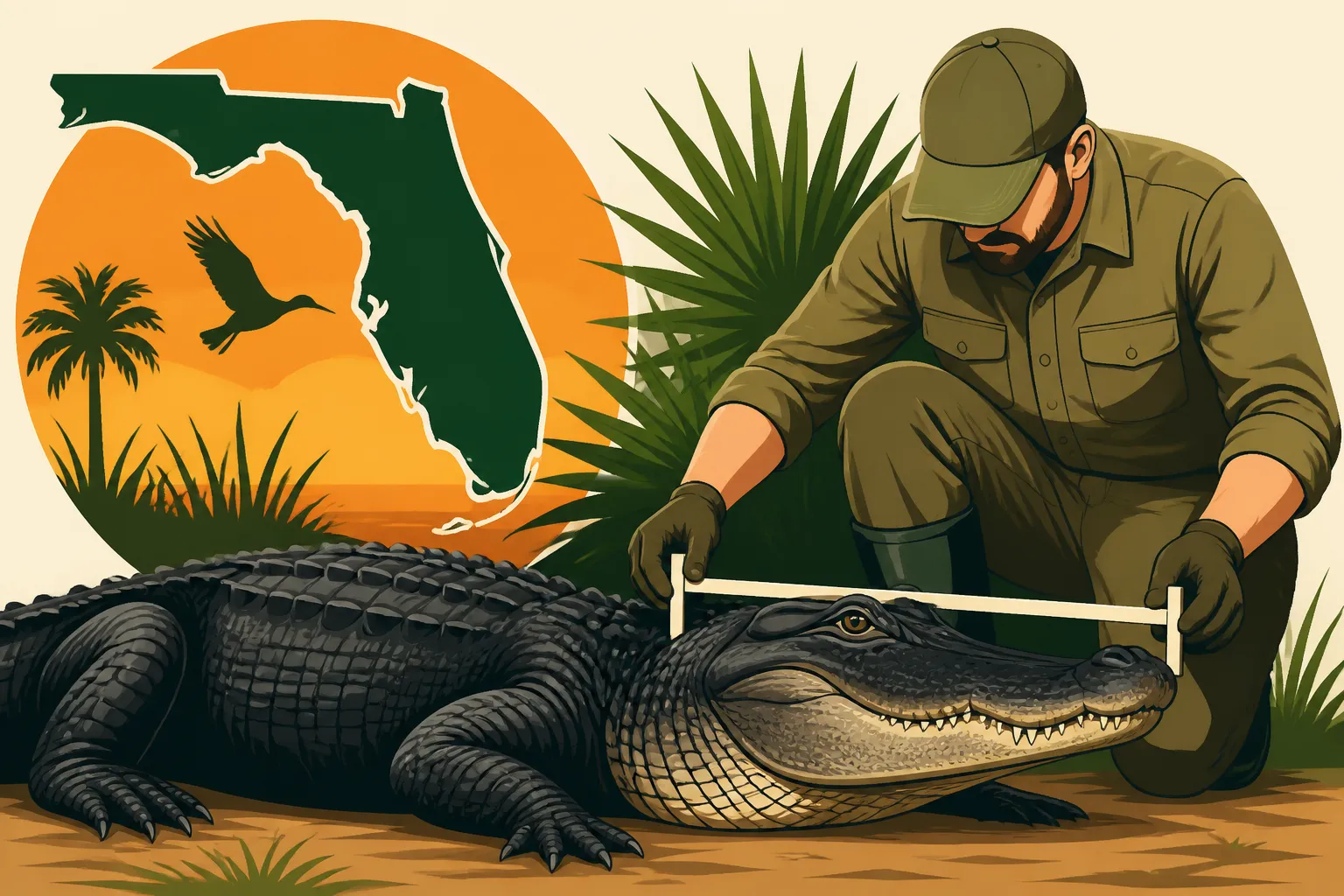
This is by far the most widely accepted and surprisingly accurate method for estimating an alligator's length while it's still in the water, only showing its eyes and snout. The rule of thumb, based on scientific studies, is that an alligator's total length in feet is roughly equal to the measurement in inches from the tip of its snout to the front edge of its eyes.
Let's break it down:
- The Observation: You spot an alligator, and all you can see is its head breaking the surface – the snout, the eye-bumps, maybe a bit of its back.
- The Estimate: Mentally or actually (if you're close enough and brave enough to use a ruler on your boat) estimate the distance from the tip of its nose to the front of its eyes.
- The Conversion: If that distance is, say, 8 inches, you're likely looking at an 8-foot alligator. If it's 10 inches, you're probably seeing a 10-footer.
This method works because alligator head proportions are remarkably consistent across different sizes and ages. It's not 100% foolproof, but it's a solid starting point that gives you a much better estimate than just "that looks big!" You can refine this by getting a bit closer, safely, to confirm your initial assessment. This is especially useful when Stalking an Alligator on a Freshwater Lake.
Using Landmarks and Known Distances
Sometimes you can't get close enough for a clear snout-to-eye measurement, or the gator is partially out of the water. In these situations, using known landmarks and distances can be incredibly helpful.
- Your Boat or Equipment: If you know the length of your boat (say, 16 feet) or the length of a paddle (5 feet), you can use these as mental rulers. If a gator is lying alongside your boat, you can visually compare its length to your boat's length. Or if a gator is swimming parallel to a known object, use that.
- Shoreline Features: On a riverbank or lake edge, look for identifiable features like a downed log, a specific clump of grass, or a dock post. If you know the distance between two posts on a dock, for example, and a gator is swimming between them, you can approximate its length.
- Casting Range: For those using cast-and-retrieve methods or Bowfishing for Florida Alligators, knowing your effective casting range (e.g., you can accurately cast 20 yards) gives you another reference point. If a gator is "two casts away," you know roughly how far out it is, which can help put its apparent size into perspective.
The trick here is to establish a reliable mental scale. Before you even head out, spend some time visualizing these known lengths against common hunting scenarios. It seems simple, but it can drastically improve your judgment when the adrenaline kicks in.
The Importance of Patience and Multiple Observations
This is probably the most understated, yet critical, piece of advice for judging alligator size. Hunters, especially new ones, often get tunnel vision and rush to judgment or action. Alligators are masters of stealth, and they often give you only fleeting glimpses.
- Wait and Watch: Don't commit to a gator based on the first impression. Alligators will often submerge and resurface, or slowly cruise the area. Try to observe the animal for an extended period. Watch how its body moves through the water, how much of its back you can see, and how wide its tail appears when it propels itself. A truly large gator will displace a significant amount of water and have a broad, powerful tail.
- Vary Your Angle: If possible, try to view the gator from different angles. What looks like a monster from straight on might appear much smaller from the side, or vice-versa due to water refraction. Circle around carefully, staying downwind and out of sight.
- Confirmation: If you're hunting with a partner, compare your estimates. "I think that's a 9-footer." "Nah, his head looks more like 7 inches, so I'd say 7 feet." Debating it out with a trusted hunting buddy can help iron out individual biases and lead to a more accurate consensus. Always use good binoculars or a spotting scope for a closer look, especially if you’re trying to make a judgment from a distance. Tools like the GoHunt app can also help you mark locations and revisit spots where you’ve previously seen large gators, aiding in long-term observation.
Avoiding Common Sizing Misjudgments
Even with the best techniques, alligator hunting presents challenges that can easily trick your eyes. Water, low light, and sheer excitement are all factors that can lead to misjudgments. Knowing these common pitfalls can help you consciously counteract them.
Water Distortion and Refraction
This is a classic problem when hunting any aquatic animal. Water can play serious tricks on your vision, making things appear larger, smaller, closer, or further away than they actually are.
- Refraction: When light passes through water, it bends. This can make a gator just below the surface appear distorted or slightly displaced. A gator's body might seem thicker or longer due to the water's magnifying effect, especially in clear, shallow water.
- Surface Ripples: Ripples or chop on the water's surface can break up the image of the gator, making it hard to get a clear outline. A gator's back might look incredibly broad, but it could just be the play of light on the water around a much smaller animal.
- Murky Water: In tannic or murky waters common in many Florida lakes and rivers, you often only see the very top of the gator. This makes the snout-to-eye method even more critical, as you can't rely on seeing the full body.
The best defense against water distortion is patience and getting as clear a view as possible. Try to wait for the water to calm, or for the gator to surface more completely, before making your final judgment.
The "Big Head" Illusion
A common mistake, particularly with alligators, is to overestimate the size of the animal based solely on the size of its head. Some alligators, especially older males, can have surprisingly massive, broad heads that look absolutely enormous above the waterline.
However, a huge head doesn't always equate to a proportionally huge body. You might see a gator with a thick, gnarly head that makes you think "12-footer," but when it finally surfaces more, you realize the body behind it is only eight or nine feet long. Its large head might just be an indication of age or genetics, not overall length. Conversely, a gator with a sleeker head might have a very long, slender body.
This is why the snout-to-eye method is so valuable. It gives you a more reliable proportion-based estimate than just reacting to the perceived "mass" of the head. Train your eye to focus on that specific measurement, rather than being swayed by the overall impression of a large head.
Rushing the Shot
Adrenaline is a powerful thing, and when you finally get a gator in your sights, it's easy to get excited and rush the decision. This is where most sizing mistakes happen. The pressure of the moment, the fear that the gator might disappear, and the sheer thrill of the hunt can override careful judgment.
Take a deep breath. Slow down. Before you even think about deploying a harpoon or making a cast when you're Bowfishing for Florida Alligators, go through your mental checklist:
- Snout-to-eye measurement: What's your best estimate?
- Known landmarks: Can you compare its length to anything else nearby?
- Multiple observations: Have you watched it long enough to get a consistent read?
- Buddy check: If you're with a partner, what do they think?
It’s always better to let a gator go if you're unsure about its size than to harvest an animal you'll regret or that doesn't meet your goals. There will always be another gator, especially in Florida. Remember, the challenge and reward are in the hunt, and making a responsible, informed decision about your target is a huge part of that. Using resources like GoHunt to scout areas beforehand can give you an edge, letting you analyze terrain and potential gator hangouts with a clearer head before the hunt begins.
Comparing Alligator Sizing Methods
| Method | Description | Pros | Cons | Best Use Case |
|---|---|---|---|---|
| Snout-to-Eye Measurement | Measures inches from snout tip to eye front; converts directly to feet of length. | Highly accurate; works well in low light when only head is visible. | Requires a clear, stable view of the head. | When gator is partially submerged, showing only its head. |
| Known Landmarks | Compares gator length to objects of known size (boat, paddle, shoreline). | Useful for larger gators; works at a distance. | Requires nearby reference objects; visual distortion can be a factor. | When gator is fully or partially exposed near known objects. |
| Patience/Observation | Waiting to observe gator's full body, movement, and displacement. | Provides most comprehensive picture of true size. | Requires time; gator may submerge or move away. | For confirming initial estimates or when in doubt. |
Conclusion and Final Thoughts
Hunting Florida alligators is an incredible experience, blending the thrill of the chase with a deep connection to the state's wild heart. While the FWC's statewide permit program is generous in not imposing a minimum length, the responsible and successful hunter understands that accurately judging an alligator's size is paramount. It’s about more than just legal compliance; it’s about safety, ethical harvest, and making the most of your valuable tags.
By mastering techniques like the snout-to-eye measurement, using known landmarks, and exercising patience in observation, you'll dramatically improve your chances of targeting the alligator you truly desire. Avoid the common pitfalls of water distortion, the big head illusion, and the rush of adrenaline. Go into your hunt prepared, informed, and with a clear strategy for sizing up your quarry, and you'll come away with not just a successful harvest, but a deeply satisfying hunting memory.
Disclaimer
This guide is intended for informational purposes only and does not constitute legal advice. Always refer to the most current Florida Fish and Wildlife Conservation Commission (FWC) regulations and federal guidelines before participating in any hunting activities. Hunting regulations can change, and it is the hunter's responsibility to stay informed and compliant.