Vehicle Rules on Florida Public Land
It’s a common scenario: you’ve meticulously scouted a promising hunting spot deep in a Florida Wildlife Management Area or National Forest, only to arrive and find a small, faded sign declaring "Foot Traffic Only" or "Motorized Vehicles Prohibited Beyond This Point." The heart sinks, doesn’t it? All that planning, all that driving, potentially for naught, or worse, for a costly citation. Navigating the myriad of vehicle rules on Florida's public hunting lands can feel like a maze, but this comprehensive guide is here to shed some light, helping you understand the regulations, avoid common pitfalls, and ensure your next public land adventure is both successful and legal.
Understanding the "Why" Behind Public Land Vehicle Rules
Before we dive into the specifics, it's helpful to understand why these rules exist in the first place. It’s not just to make our lives difficult, I promise! Florida's public lands are incredibly diverse and fragile, home to sensitive ecosystems and abundant wildlife. The regulations around vehicle use are put in place for a combination of ecological protection, safety, and to maintain the quality of the hunting experience for everyone.
Protecting Fragile Ecosystems and Wildlife
Florida's landscape is unique, from the ancient sandhills of the central ridge to the sprawling cypress swamps and pine flatwoods. Many of these habitats, especially those prone to flooding or erosion, simply cannot withstand unregulated vehicle traffic. Imagine an ATV churning up a wet firebreak after a heavy rain, creating ruts that last for months or even years, disrupting drainage patterns, and damaging sensitive plant life. This kind of damage doesn't just look bad; it can destroy critical habitats for ground-nesting birds, small mammals, and native plants.
Furthermore, vehicle noise and disturbance can displace wildlife, pushing deer, turkeys, and other game further into secluded areas, making them harder to find and impacting their natural behaviors. These rules are a big part of what keeps our public lands healthy and productive for future generations of hunters and wildlife alike. It's about preserving the wild character of these places so that you, and your kids, can continue to experience genuine wild Florida.
Ensuring Safety and Preserving the Hunting Experience
Think about it: if every hunter could drive their truck or ATV wherever they pleased, the woods would quickly become a chaotic mess of roaring engines and exhaust fumes. Not only would this be incredibly noisy and disruptive to game, but it would also create significant safety hazards. Imagine trying to still-hunt quietly when vehicles are constantly rumbling past, or having your shot opportunity ruined by a truck barreling down a trail.
These regulations create designated quiet zones, foot-traffic-only areas, and specific routes for motorized vehicles, allowing different types of hunting experiences to coexist. They help prevent collisions, reduce the chances of accidental trespass onto private property, and ensure that those who seek solitude and a traditional hunting experience can still find it. It's about managing human impact to keep the hunting spirit alive and well in the Sunshine State. For a deeper dive into finding hunting opportunities, check out Public Hunting Land in Florida.
Navigating Different Vehicle Types on Florida Public Land
The type of vehicle you drive plays a huge role in where you can and cannot go on public lands. What's perfectly fine on one main access road might be strictly forbidden on a smaller trail, and this often comes down to the classification of your ride.
Full-Size Trucks and SUVs
For most paved or well-maintained graded dirt roads on public land, your standard truck or SUV is generally welcome. These are your primary means of accessing many WMAs, National Forests, and State Forests. However, don't assume just because a road looks passable that it is. Many designated public land roads, especially those not maintained by county or state highway departments, can deteriorate rapidly, especially after heavy rains.
You'll often find signage indicating "authorized vehicles only" or "no vehicles beyond this point" at various junctions. These signs are there for a reason and must be heeded. Driving a full-size vehicle off a designated road or trail, even for a short distance to retrieve game, is almost always prohibited and can result in significant fines and environmental damage. Always stay on clearly marked and permitted roads. If in doubt, park it and walk. Many WMAs, for instance, have extensive road systems, but only certain ones are open to public vehicle traffic, and these can change with management cycles or weather conditions.
ATVs and UTVs: The Workhorses of the Woods
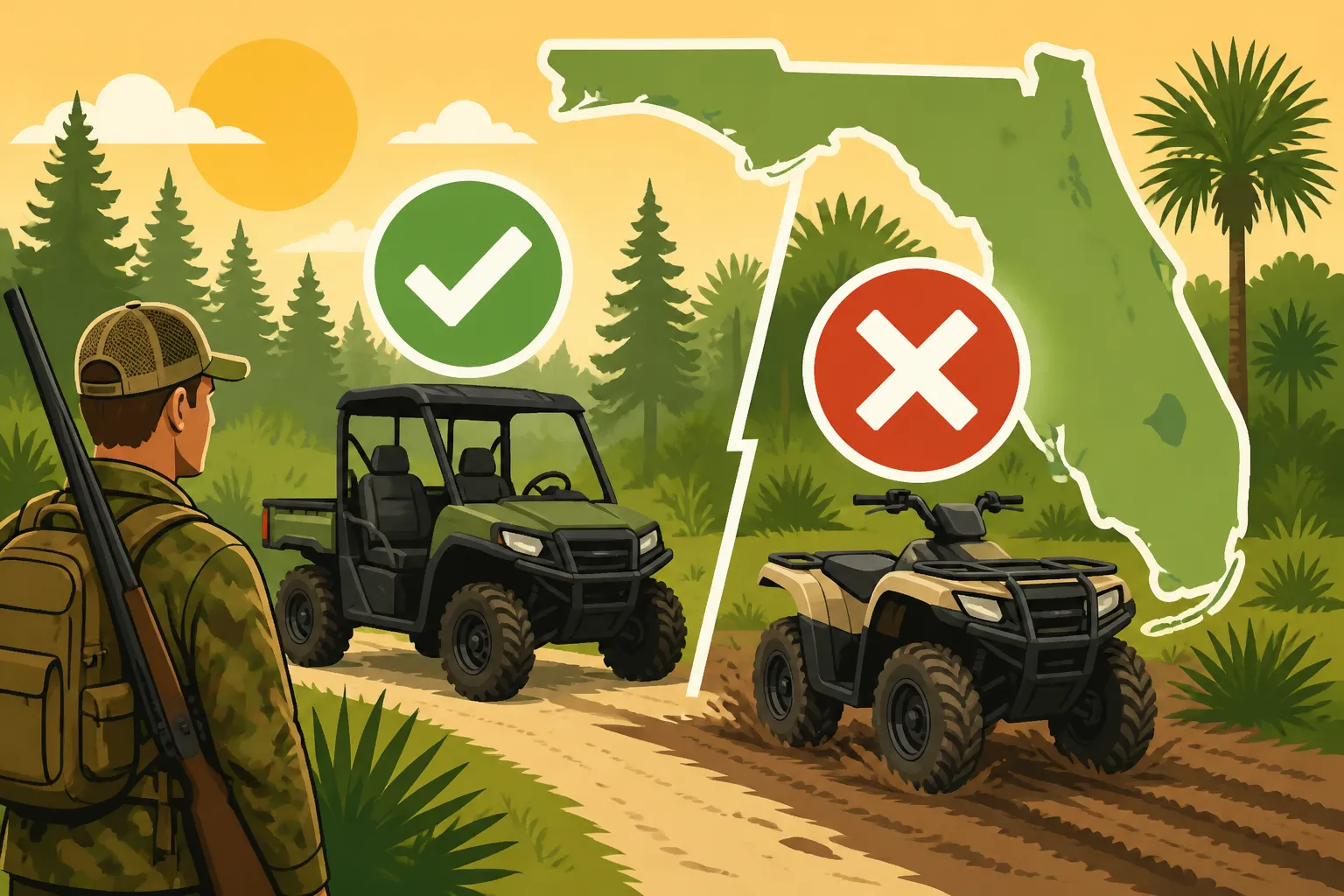
All-terrain vehicles (ATVs) and utility task vehicles (UTVs) are incredibly popular with Florida hunters for their ability to navigate rough terrain and haul gear. However, their use is heavily regulated on public lands. On most Florida WMAs, ATVs and UTVs are restricted to designated ATV trails or roads only. You cannot simply ride them wherever you please. These designated trails are usually clearly marked on FWC maps and with signage on the ground.
The rules for ATVs and UTVs can vary significantly between different WMAs. Some WMAs might allow them on any non-gated dirt roads that aren't specifically marked "foot traffic only," while others have very specific, limited ATV trails. Speed limits are also common on these trails, and riding off-trail is a surefire way to get a ticket and potentially lose your hunting privileges. Always check the specific WMA regulations before you head out. These details are usually available on the FWC website for each individual WMA. For more detailed information, you can also consult articles like ATV Rules on Florida Forest Roads.
| Vehicle Type | Typical Use on Public Land | Common Restrictions |
|---|---|---|
| Trucks/SUVs | Main paved or well-maintained dirt access roads | Must stay on designated, open roads; no off-road travel |
| ATVs/UTVs | Designated ATV trails or specified access roads within WMAs/Forests | Restricted to marked trails/roads; off-trail use prohibited; speed limits |
| Electric Bikes | Generally treated as bicycles, allowed where bicycles are | Check specific WMA/Forest rules; some may treat as motorized |
| Golf Carts | Limited to specific campgrounds or paved areas within parks | Very restricted on hunting lands; generally not permitted on trails |
| Bicycles (non-electric) | Allowed on most non-motorized trails and roads | Must yield to pedestrians; typically no off-trail use |
Electric Bikes and Golf Carts
This is a newer, and sometimes greyer, area. Electric bikes are growing in popularity, and many hunters see them as a way to cover ground silently without the physical exertion of a traditional bike. The key question is: are they considered motorized vehicles? Generally, in Florida, electric bikes that require pedaling and offer assistance (Class 1 or 2) are often treated like bicycles and are allowed anywhere traditional bicycles are permitted. This means they are usually allowed on designated bicycle trails, shared-use paths, and often on forest roads or trails open to non-motorized travel.
However, some WMAs or land management agencies might have specific regulations that classify any electric motor as a motorized vehicle, regardless of whether it also has pedals. This means they might be restricted to areas where ATVs are allowed, or even prohibited entirely. Always, always check the specific rules for the area you plan to hunt. Don't assume.
Golf carts are typically far more restricted. On hunting lands, they are almost never allowed on trails or access roads. You might see them used in specific campground areas or within very limited, designated paved areas, but not for general hunting access. If you're considering using one, assume it's prohibited unless you find explicit permission in the regulations for your specific hunting area.
Specific Rules for Florida Wildlife Management Areas and National Forests
Florida's public lands are managed by different agencies, and each has its own set of rules, often layered on top of state-wide regulations. This is where most of the confusion arises, but with a little research, you can avoid a lot of grief.
Wildlife Management Area (WMA) Specific Regulations
Florida's Wildlife Management Areas (WMAs) are managed by the Florida Fish and Wildlife Conservation Commission (FWC), and they have the most granular and often diverse rules regarding vehicle use. Every single WMA has its own set of regulations, and these are typically compiled into an annual brochure (available digitally on the FWC website). You must read the brochure for the specific WMA you intend to hunt. This isn't optional; it's absolutely essential.
These brochures will detail:
- Open vs. Closed Roads: Which roads are open to public vehicles, which are administrative use only, and which are foot traffic only.
- ATV/UTV Zones: Specific trails or areas where ATVs/UTVs are permitted, if at all.
- Seasonal Restrictions: Some roads may be open during specific hunting seasons but closed at other times of the year, or during wet periods.
- Parking Areas: Designated parking areas where you must leave your vehicle. You cannot just pull off to the side of the road anywhere.
- Vehicle Speed Limits: These are often lower than typical road limits to protect wildlife and reduce dust.
I've had countless times where I've spent an evening poring over a WMA brochure, cross-referencing it with my mapping app like onX Hunt, to ensure I understand exactly where I can drive and where I'll need to go by foot. This tool is invaluable for seeing boundaries, roads, and even some FWC-posted restrictions directly on your map, which can save a lot of guesswork and prevent accidental violations. Neglecting this step is one of the most common mistakes new public land hunters make. Always check the current year's regulations, as they can change annually. You can find more general information about these areas in Florida Wildlife Management Areas.
National Forest Regulations: Ocala, Apalachicola, and Osceola
Florida is home to three National Forests: Ocala, Apalachicola, and Osceola. These are managed by the U.S. Forest Service, often in cooperation with FWC for hunting seasons. While there are overarching Forest Service regulations, each forest, and sometimes specific districts within them, will have localized rules.
Generally, National Forests have extensive networks of Forest Service Roads (FSRs). Many of these are open to public vehicles, but again, look for signs. "Motor Vehicle Use Maps" (MVUMs) are the official documents dictating where motorized vehicles are allowed on National Forests. These maps show which roads and trails are open to which types of vehicles (highway legal, ATV, etc.) and during what seasons. It's crucial to obtain and understand the MVUM for the specific National Forest and district you plan to hunt.
Just like WMAs, driving off designated roads is strictly prohibited in National Forests. This includes cutting across open fields or driving down unmaintained logging trails not marked on the MVUM. For areas like Ocala National Forest Hunting or Apalachicola National Forest Hunting, the sheer size means there are many miles of roads, but it's important to differentiate between those open to all and those that are not.
State Forests and Environmental Areas
Florida's State Forests, managed by the Florida Forest Service, and other state-managed environmental areas, also have their own vehicle rules. These often mirror WMA regulations, with designated open roads and restricted areas. Access permits might be required for some State Forests, and these permits will outline vehicle usage. Always consult the specific management plan or hunting regulations for the particular State Forest or environmental area you intend to visit. The general rule of thumb is: if it's not explicitly marked as open for your vehicle type, assume it's closed.
Planning Your Access and Avoiding Common Pitfalls
The key to a successful and stress-free public land hunt in Florida, especially regarding vehicle access, lies in thorough preparation. Don't leave it to chance or assume you'll figure it out when you get there.
Pre-Trip Scouting and Mapping Tools
Before your boots even hit the ground, or your tires touch dirt, you should be doing your homework. Digital mapping tools are game-changers here. I personally rely heavily on apps like onX Hunt because they overlay public land boundaries, parcel ownership, and often, color-coded designations for different types of access roads or trails. You can mark potential parking spots, track foot-traffic-only areas, and plan your route in advance, both for driving and walking. This kind of visual information, combined with the official WMA brochures or Forest Service MVUMs, is your best defense against inadvertently breaking a rule. Many hunters use services like GoHunt for similar detailed mapping and land ownership data, which can be indispensable for complex public land systems.
Beyond the digital tools, don't underestimate the value of scouting drives. Sometimes, actually driving the roads a few weeks before the season opens (if permitted) can reveal gates, signs, or road conditions that weren't obvious on a map. Always cross-reference what you see on the ground with your digital maps and printed regulations. For a full breakdown on preparation, check out Scouting Florida Public Land Before Season.
Avoiding Fines and Trespass Issues
Ignorance of the law is never an excuse, and public land vehicle rules are no exception. Fines for vehicle violations on public lands can range from a couple hundred dollars to much more, depending on the severity and type of damage caused. Beyond the financial hit, you could also face a loss of hunting privileges or even have your vehicle impounded.
Here are some critical points to remember:
- Always read the specific regulations: This is the golden rule. Every WMA, National Forest, or State Forest has unique rules.
- Look for signs: Gates, chains, "no motorized vehicles" signs, or "foot traffic only" placards are there for a reason. If a road isn't explicitly marked as open to your vehicle type, don't go down it.
- Stay on designated roads/trails: This cannot be emphasized enough. Driving off-road is almost universally prohibited and incredibly damaging.
- Park legally: Don't block gates, fire lanes, or access points. Only park in designated parking areas or well off the shoulder where it's explicitly allowed and doesn't impede traffic or access.
- Respect private land boundaries: Public lands often border private parcels. Digital maps like those from onX Hunt are crucial for Finding Florida Property Lines and ensuring you don't accidentally drive or park on someone else's property. Even a slight miscalculation can lead to trespass.
By taking the time to understand and adhere to Florida's public land vehicle rules, you're not just avoiding penalties; you're also being a responsible conservationist and ensuring these incredible wild places remain viable and enjoyable for everyone who seeks to experience them. It all boils down to a commitment to doing your homework and respecting the land.
Disclaimer
This article is for general informational purposes only and does not constitute professional advice. Laws, prices and regulations vary by location and change over time. Consult a qualified professional for guidance on your specific situation.