Hunting Florida’s Fall Turkey Season Up North
The crisp air of a North Florida fall brings a different kind of challenge for turkey hunters. Gone are the booming gobblers of spring, replaced by often-silent, tightly knit flocks that demand a complete shift in strategy. If you've found yourself frustrated trying to locate and entice these wary birds after the leaves start to turn, you're not alone. This guide will walk you through the nuances of hunting Florida's Eastern turkeys in the fall, particularly in the Panhandle region, offering practical advice and proven methods to increase your chances of success.
Understanding the Fall Turkey Landscape in North Florida
Fall turkey hunting in Florida's Panhandle is a distinctly different endeavor than the adrenaline-fueled calling duels of spring. The birds' behavior, habitat use, and responsiveness to calls shift dramatically, requiring hunters to adapt their approach entirely.
Eastern Turkey Zone Boundaries
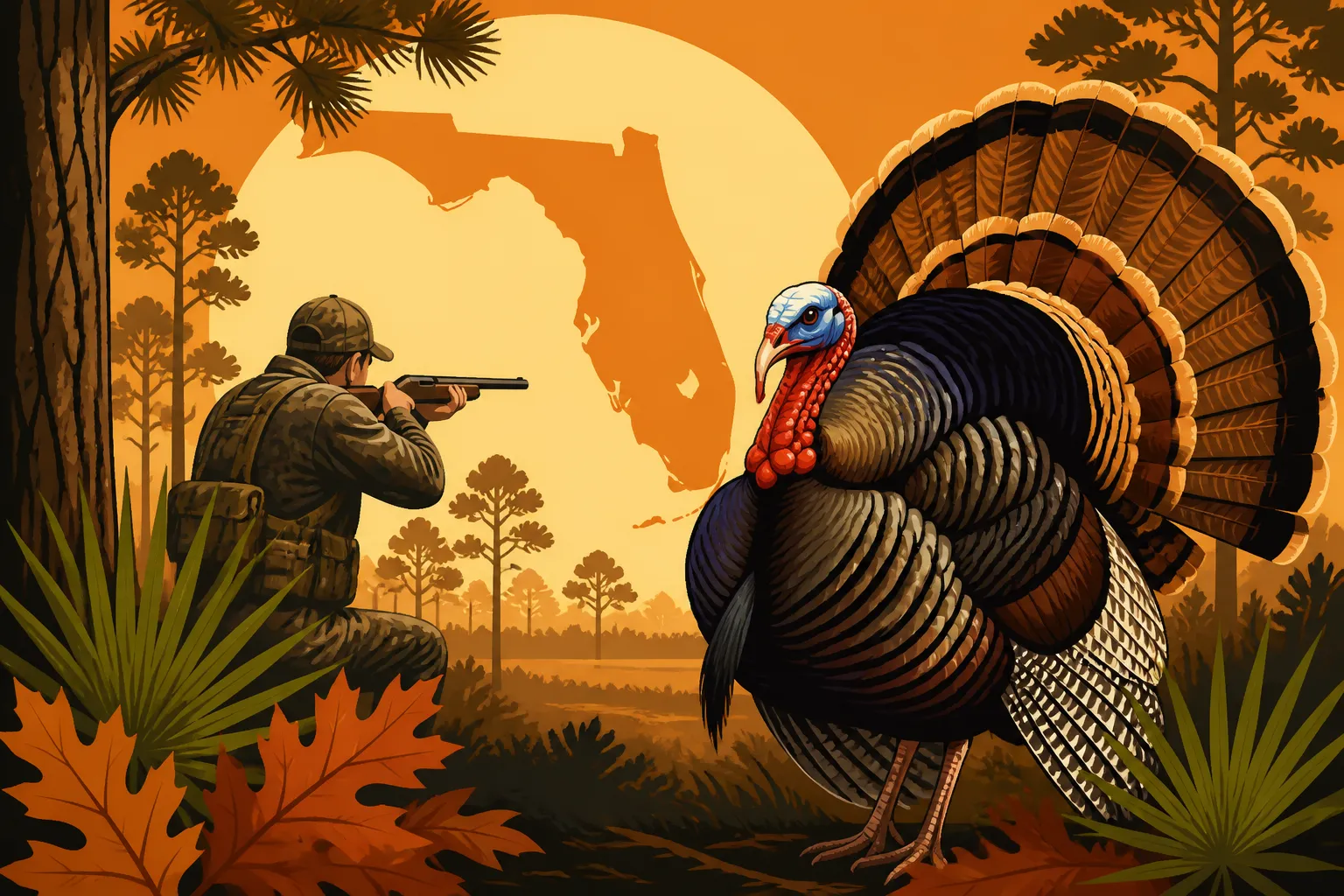
When we talk about "up North" in Florida for turkeys, we're specifically referring to the range of the Eastern wild turkey. Unlike the elusive Osceolas found south of State Road 70, the Panhandle and North Florida region is home to the Eastern subspecies. This area includes counties like Escambia, Santa Rosa, Okaloosa, Walton, Holmes, Washington, Bay, Jackson, Calhoun, Gulf, Liberty, Franklin, Gadsden, Leon, Wakulla, Jefferson, Madison, Taylor, Lafayette, Dixie, Suwannee, Columbia, Baker, Nassau, Duval, Clay, Union, Bradford, Alachua, Putnam, Flagler, and St. Johns. Understanding that you're pursuing Easterns is crucial, as their general habits, even within Florida, can differ from their more southern cousins. For more detailed information on regulations, you can check out the specific rules for "Florida Eastern Zone Turkey Permit Rules".
The Panhandle itself, with its vast pine plantations, hardwood bottoms, and agricultural fields, provides prime habitat for these birds. While you might associate fall turkey hunting with snow-dusted woods further north in the country, here in Florida, it's more about cooler temperatures, falling acorns, and drying swamp edges. The land often transitions from vast timber company holdings to smaller private parcels, all influencing turkey movement and hunting access.
Key Differences from Spring Hunting
Forget everything you know about finding that hot gobbler on the roost and trying to get him to commit to your calls. Fall turkeys, especially the Easterns in the Panhandle, are typically more concerned with flock dynamics, feeding, and security than breeding.
Firstly, fall turkeys are almost always found in family groups or bachelor flocks. These can be hens with their poults, or groups of adult gobblers. Their entire daily routine revolves around these flocks: feeding, dusting, preening, and roosting together. Breaking up these social units becomes a primary strategy, as a lone bird is far more likely to respond to a call to regroup. Secondly, vocalizations are drastically different. The thunderous gobble is largely absent, replaced by more subtle clucks, purrs, yelps, and kee-kees. These calls are used for communication within the flock, not to attract mates. Thirdly, their focus shifts heavily to food sources. As summer gives way to fall, acorns, insects, and waste grain become vital, dictating their daily movements and preferred areas. You're hunting their stomachs and their social instinct, not their breeding urge. This contrast means that simply mimicking spring calling tactics will likely yield frustrating silence.
Scouting for Fall Turkeys
Successful fall turkey hunting hinges on thorough scouting. These birds are creatures of habit, especially when it comes to feeding and roosting in groups. Without putting in the legwork beforehand, you're essentially walking around hoping to stumble upon a flock.
Identifying Fall Food Sources
In the Florida Panhandle, fall food sources are king. Turkeys are constantly foraging to build up reserves for cooler weather. The most critical natural food source is acorns. Areas with mature oak trees—especially white oaks, which drop their acorns earlier—will be magnets for turkeys. Look for evidence of heavy scratching in the leaf litter, distinct turkey droppings (often more elongated in fall than the rounder droppings of spring), and even actual acorns being eaten. Bottomland hardwood hammocks and upland oak ridges are prime places to focus your search.
Beyond acorns, don't overlook agricultural fields. Many Panhandle counties have significant farming operations, and turkeys will readily feed on waste grains like corn, peanuts, and soybeans after harvest. A key strategy is to identify these fields and look for tracks and droppings along the edges. Chufa, a sedge that grows wild in sandy soils and is also planted by some land managers, is another highly sought-after food source. Turkeys will dig up the tubers, leaving tell-tale scratched-up ground. Pinpointing these areas will allow you to predict their movements and set up ambushes.
Locating Roosting Areas
Just like in spring, turkeys will roost in trees at night, typically flying up before dark and descending at first light. In the fall, entire flocks will often roost together. Scouting for roosting areas is crucial because it gives you a starting point for your hunt. Look for tall, sturdy trees with open canopy, often near water or in a protected creek bottom. Large pine trees are common roosting spots in the Panhandle's dominant pine country, but turkeys will also use mature hardwoods.
The best way to locate a roost is to be in the woods at dusk or dawn. Listen for their distinct clucking and yelping as they fly up to roost or fly down in the morning. Sometimes you'll even hear the heavy wing beats as they pitch out of the trees. Once you've identified a roost, resist the urge to get too close. Your goal is to approach quietly in the dark before sunrise, positioning yourself between the roost and their likely feeding areas. A quiet approach is paramount, as spooking a roosted flock can send them scattering for miles.
Using Technology for Scouting
Modern hunting technology has revolutionized scouting, even for fall turkeys. Satellite imagery and digital mapping applications are incredibly valuable, allowing you to "scout" from your couch before ever stepping foot in the woods. Platforms like GoHunt offer detailed topographical maps, satellite views, and public/private land ownership layers that are indispensable. You can identify potential oak stands, old clear-cuts (which can provide good bugging habitat), creek bottoms, and agricultural fields remotely.
Using a mapping app like GoHunt on your phone lets you mark sign, track your movements, and navigate unfamiliar public lands with confidence. You can drop pins on fresh scratching, tracks, droppings, and potential roost trees. This creates a digital diary of turkey activity, helping you piece together their daily patterns. Furthermore, these apps can display details about "Florida Wildlife Management Areas" and other public lands, helping you understand access points and boundaries. Don't underestimate the power of these tools; they can save you countless hours of unproductive walking.
Fall Turkey Hunting Strategies
With scouting complete, it's time to put a plan into action. Fall turkey hunting requires patience, persistence, and a willingness to adapt on the fly. The most effective strategies revolve around disrupting the flock and then calling individuals back in.
Flock Busting Tactics
Flock busting is arguably the most effective and time-honored fall turkey hunting strategy. The premise is simple: locate a feeding or moving flock, then rush in to scatter them as widely as possible. The goal is to separate the individual birds from the group, triggering their instinct to regroup. This is often best done by running directly into the flock, yelling and making noise. The more scattered they are, the better your chances.
Once the flock is busted, immediately find a good setup spot that offers concealment and a clear view of where the birds flew. Wait at least 20-30 minutes, or even an hour, allowing the birds to calm down and begin to think about re-flocking. Then, start calling with soft, pleading "kee-kee" runs or "assembly yelps." These calls mimic lost young birds or hens trying to find their family. The desire to regroup is powerful in fall turkeys, making them much more responsive than an unscattered flock. This is a core part of "Breaking Up a Fall Turkey Flock."
Calling Fall Birds
Unlike spring where loud, aggressive gobbling might be your go-to, fall calling is all about soft, subtle, and reassuring sounds. The "kee-kee" run is probably the most important fall call. This is a whistle-like sound, often made by young birds that have been separated from the flock. Practice making it with a slate, box, or mouth call. Combine it with soft clucks and yelps.
Another effective call is the "assembly yelp." This is a series of yelps, slightly louder and more insistent than a conversational yelp, designed to gather the scattered flock. You might also use soft clucks and purrs to suggest contentment or to bring a bird closer that's already within sight. Patience is key. Fall birds might take a long time to respond, and they often come in silently, so constant vigilance is a must. Don't call too much; less is often more. Call just enough to get their attention, then shut up and listen and watch.
Still-Hunting and Ambush Setups
Sometimes, busting a flock just isn't feasible, or you might be hunting an area where birds are sparse. In these situations, still-hunting or setting up ambushes near known travel routes and food sources can be highly effective. Still-hunting involves moving very slowly and deliberately through the woods, pausing frequently to listen and scan. Move only when turkeys would move, often in short bursts followed by long periods of observation. Focus on areas you've scouted with fresh sign, like feeding flats or old logging roads.
For ambush setups, identify key choke points or natural funnels that turkeys use to move between roosts and feeding areas. This could be a narrow strip of timber connecting two larger woodlots, a creek crossing, or the edge of a field. Get into your blind or find good natural cover well before first light, positioning yourself for a good shot. You're waiting for the birds to come to you on their routine, rather than actively trying to draw them in with calls. This tactic works particularly well if you've done your homework on "Fall Turkey Tactics in the Panhandle" and know their preferred routes.
Gear and Equipment for Fall Turkey Hunting
While the core principles of hunting remain, some gear considerations shift slightly for fall turkeys in North Florida, especially concerning camouflage, calls, and potentially warmer layers compared to spring.
Shotguns, Loads, and Chokes
Your trusted spring turkey shotgun will serve you perfectly for fall Easterns. Most hunters opt for a 12-gauge, but a 20-gauge can be just as effective with modern loads. The key is a tight pattern at your ethical shooting range, typically 30-40 yards. A full or extra-full choke is recommended to keep your shot pattern dense. When it comes to ammunition, modern tungsten-based loads like those from Federal Premium or Winchester are incredibly effective, offering dense patterns and superior penetration. Lead shot is also still widely used and effective.
Remember that fall birds can be wary, and shots may be at longer ranges than you'd prefer in a spring gobbler setup. Knowing your gun's pattern at various distances is paramount. Spend time at the range to ensure you're confident with your setup. Safety first, always.
Decoys and Blinds
Decoys can be a powerful tool in the fall, particularly when trying to re-gather a busted flock. A jake or hen decoy, or even a pair of hen decoys, can offer a visual reassurance for scattered birds. When a young bird or hen sees another turkey, it often lowers their guard and encourages them to close the distance. Place your decoy(s) in an open area within shooting range, positioned so the approaching turkey will present a good shot. However, be mindful that fall turkeys can be cautious, and sometimes no decoy is better than a poorly placed or artificial-looking one.
Ground blinds are also incredibly useful, especially for still-hunting or ambush setups where concealment is critical. A pop-up blind offers excellent camouflage and allows you to move slightly without being detected. Natural blinds, built from fallen logs, palmetto fronds, or brush, can also be very effective and help you blend into the natural surroundings. When considering "Using a Ground Blind on Florida Public Land," remember to check WMA rules regarding blind placement and removal.
Essential Cold Weather Gear
While Florida is known for its heat, "up North" in the Panhandle, fall mornings can be surprisingly chilly, especially in late November and December. Temperatures can dip into the 30s or low 40s before sunrise. Dressing in layers is crucial. You'll want a moisture-wicking base layer, an insulating mid-layer (like fleece), and a quiet, waterproof/windproof outer layer in a good camouflage pattern. Brands like Sitka Gear or First Lite offer excellent layering systems that keep you warm without adding bulk.
Gloves, a warm hat, and comfortable, waterproof boots are also non-negotiable. You'll likely be walking a fair bit, sometimes through damp or muddy terrain. Don't forget bug repellent, even in fall, as mosquitoes and ticks can still be active. Carry a small backpack with essentials like water, snacks, a flashlight, a knife, and a first-aid kit. Being comfortable and prepared for the elements will allow you to stay focused on the hunt.
Navigating Public Lands for Fall Turkeys
Florida offers abundant public land opportunities, and the Panhandle is no exception. Hunting these areas requires preparation and an understanding of the specific rules and pressures that come with public access.
Florida Panhandle WMA Opportunities
The Panhandle boasts numerous Wildlife Management Areas (WMAs) and national forests like the Apalachicola and Blackwater River State Forests that provide excellent fall turkey hunting. These areas are managed by the Florida Fish and Wildlife Conservation Commission (FWC) and offer diverse habitats. Many WMAs require a WMA Management Area Permit in addition to your standard hunting license and turkey permit. Always check the specific regulations for the WMA you plan to hunt, as season dates, weapon restrictions, and other rules can vary significantly.
For instance, the Apalachicola National Forest covers a vast area with mixed pine and hardwood forests, offering ample room to roam. Other WMAs like Blackwater River State Forest also have strong turkey populations. Remember that some WMAs might have quota hunts for turkeys, meaning you need to apply and be drawn for a permit. Always consult the FWC's current regulations handbook for the most up-to-date information on "Florida WMA Quota Permit System" and season dates. Scouting these large tracts of public land before the season opens is vital to identify potential hotspots.
Understanding Hunting Pressure
Public lands, by their nature, often see more hunting pressure than private tracts. In the fall, this can mean more competition for prime turkey areas. Hunters pursuing deer or small game might inadvertently bump turkeys, making them even warier. To counteract this, consider hunting during weekdays when pressure is generally lower, or be willing to walk further into less accessible areas where others are less likely to venture.
Utilize tools like onX Hunt (similar to GoHunt) to identify property lines, roads, and trails, helping you find those hidden pockets of unpressured habitat. Turkeys on public land learn quickly, so thinking outside the box and moving away from obvious access points can pay dividends. If you encounter another hunter, be courteous and give them space. A little respect goes a long way in ensuring everyone has a safe and enjoyable experience. Learning about "Finding Ground Others Walk Past" can give you a significant advantage.
Processing and Preparing Your Fall Turkey
Harvesting a fall turkey is a rewarding experience, and knowing how to properly field dress and care for your bird ensures the meat is at its best.
Field Dressing and Transport in Cooler Weather
Once you've harvested your turkey, the first step is to field dress it. While not as critical in Florida's cooler fall temperatures as in the sweltering spring, removing the entrails quickly helps the meat cool down and prevents spoilage. Open the body cavity and remove all internal organs. Some hunters also choose to remove the crop. If you plan to have your bird taxidermied, leave the fan and beard intact, and be careful when handling the breast.
If the weather is cool enough (below 50°F), you can hang the bird to cool for a few hours. Otherwise, place it on ice in a cooler immediately. The Panhandle can still experience warm afternoons in early fall, so having ice readily available is a good idea. Once cooled, the bird can be transported home for further processing. Remember to properly tag your turkey as required by FWC regulations and report your harvest. For more details on this, you can look up "Florida Turkey Checking Requirements".
Cooking Fall Turkey Meat
Fall turkeys, especially younger birds, offer fantastic table fare. The meat tends to be lean and flavorful. Once you've breasted out your bird and removed the legs and thighs, you have several options for preparation. The breast meat is excellent for slicing into cutlets for pan-frying, grilling, or making turkey sandwiches. Given the leaner nature, brining the breast meat can help keep it moist.
The legs and thighs of a wild turkey are tougher than those from a domestic bird dueating a wilder diet, but they are packed with flavor. They are best prepared by slow-cooking methods like braising, stewing, or grinding for sausages. Imagine a rich, savory fall turkey stew or flavorful turkey tacos made from slow-cooked leg meat. For specific recipe ideas, especially if you're looking for different ways to enjoy your harvest, you might find inspiration in "Cooking a Wild Turkey Breast" or by experimenting with your own slow-cooker recipes. Don't let any of that delicious wild game go to waste!
Disclaimer
Hunting is an inherently dangerous activity. Always prioritize safety, follow all local, state, and federal laws and regulations, and respect wildlife. This guide provides general information and should not replace professional instruction or official hunting regulations. Always consult the latest Florida Fish and Wildlife Conservation Commission (FWC) regulations before engaging in any hunting activities.