Hunting Small Private Tracts in Florida
Finding yourself staring at a small, seemingly insignificant patch of woods or a narrow sliver of forgotten land in Florida can feel deflating when all you dream of are vast public lands. Many hunters face the frustrating reality of limited access, often wondering if these smaller private tracts are even worth the effort. But don't write them off just yet; with the right approach and a keen understanding of deer behavior, these unassuming parcels can offer incredible, often overlooked, hunting opportunities. This guide will walk you through transforming those small private tracts into productive hunting grounds, proving that big bucks don't always require big acreage.
The Unique Challenges of Small Tracts
Hunting smaller private tracts in Florida presents its own distinct set of hurdles compared to sprawling WMAs or vast timber company lands. You're dealing with condensed space, often surrounded by residential areas or other private properties, which means every decision you make regarding access, stand placement, and game recovery carries more weight. It's a different game, and understanding these specific challenges is the first step to overcoming them.
Overcoming Pressure and Visibility Issues
One of the biggest anxieties on a small tract is the fear of blowing out the deer or being too visible to neighbors. On a 5 or 10-acre parcel, a single wrong move can send every deer scurrying off your property onto land you can't access. The visibility issue is compounded by the fact that many small tracts are close to roads, homes, or even businesses. You might feel like you're hunting in a fishbowl, constantly worried about being seen by passersby or spooking game with your presence. This often leads to hunters being overly timid, missing opportunities by not pushing the boundaries of what's possible in such a confined space. It's not just about avoiding detection by game; it's also about maintaining a good relationship with your neighbors, which means minimizing any perceived disruption or nuisance from your hunting activities.
Think about a small, oddly shaped parcel bordering a subdivision on one side and a cow pasture on another. Deer might use this strip as a bedding area during the day, feeling relatively safe from human intrusion because most people dismiss it as too small to hunt effectively. Your challenge then becomes how to slip in and out without being seen by the deer or drawing unwanted attention. This means carefully planning your entry and exit routes, often using natural screening like brush lines or ditches. It also requires understanding how wind and thermals in flat Florida terrain impact your scent cone, especially when you're close to property lines. Minimizing your footprint, both literally and figuratively, is paramount.
Managing Neighboring Landowner Relations
This might be the most overlooked, yet critical, aspect of hunting small private tracts. On a 10,000-acre WMA, your neighbor is likely another hunter in the woods. On a 10-acre private tract, your neighbor is probably a homeowner whose dog runs loose, whose kids play in the yard, or who simply doesn't understand hunting. Building and maintaining positive relationships with adjacent landowners isn't just polite; it can be vital for your hunting success and peace of mind. A grumpy neighbor who reports every little thing can quickly turn your hunting spot into a nightmare, or even get you investigated by authorities if they perceive any wrongdoing.
Imagine a situation where a magnificent buck you've been pursuing all season jumps your fence onto the property next door after you shoot it. If you haven't established a rapport with your neighbor, retrieving that deer could become a confrontation or even impossible. This is where a little upfront communication goes a long way. Before the season, introduce yourself, explain your intentions, and perhaps even share a little bit of venison after a successful hunt. Establishing open lines of communication can transform a potential adversary into an ally, or at least a neutral party. Sometimes, this can even lead to securing additional hunting access on their land, creating a larger, more viable hunting area.
Scouting and Strategy for Limited Acreage
Just because you have less ground doesn't mean you can skimp on scouting. In fact, on small private tracts, meticulous scouting is even more crucial. Every inch of your property, and even the periphery of neighboring lands, needs to be analyzed to understand how deer are using the space. The goal is to identify patterns, pinch points, and cover that make your small parcel valuable to deer, then exploit those features with precise strategy.
Pinpointing Key Deer Movement
On limited acreage, deer aren't likely to spend all day on your property. Instead, they'll often be using it as a travel corridor, a short-term feeding spot, or a brief bedding refuge between larger areas. Your job is to identify these high-traffic zones and patterns. Start by looking for obvious signs: fresh tracks along property lines, rub lines on small trees, or active scrape lines along a sand road or natural edges. Even a few acres can hold a critical bottleneck where deer consistently pass through. Consider how deer access your property from larger blocks of cover or food sources on adjacent lands. Are there distinct entry routes through a Florida food plot or perhaps a narrow strip of woods that connects two larger bedding areas? This might be the only part of your property a mature buck ever sets foot on during daylight hours.
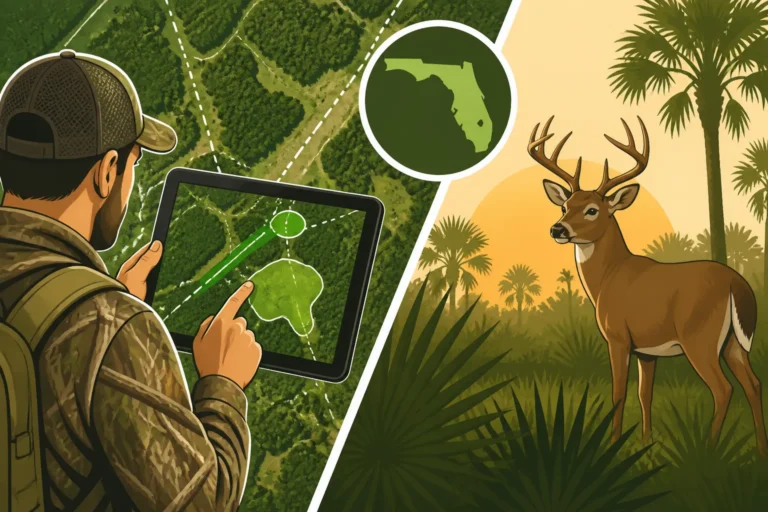
Utilize mapping tools like GoHunt to analyze aerial photos for Florida deer habitat, paying close attention to thick cover, natural funnels, and potential food sources both on and immediately surrounding your property. Even if a prime oak hammock producing acorns is just over the fence, understanding that deer are traveling to it from your property can help you set up an ambush. Look for distinct trails that lead into or out of your parcel, especially those that show signs of consistent use. These trails, even subtle ones in palmetto or dense scrub, are your best bet for intercepting deer as they move. Don't forget to look for bedding areas, even small ones, like where Florida bucks bed in thick palmetto. If deer are bedding there, they'll eventually get up and move, offering an opportunity.
Maximizing Stand Placement
With limited space, you can't afford a bad stand location. Every setup needs to be carefully chosen to maximize your chances while minimizing your impact. The goal is to be in a position to intercept deer moving through, feed on, or bed briefly on your property without alerting them to your presence. This often means focusing on transition areas and pinch points. Think about natural funnels between two palmetto heads or where a fence line might restrict deer movement to a narrow crossing. These are prime locations for a stand, as deer will often be forced through a predictable path.
When selecting a tree for a treestand or brushing in a blind on a field edge, consider not only the shooting lanes but also your approach and exit. Can you get to and from your stand without spooking deer? This might mean wading through a ditch, walking along a fencerow, or carefully navigating a thick briar patch. For smaller properties, a ground blind can be incredibly effective, especially if natural cover is sparse. It allows for quick setup and adjustments, and if properly brushed in, can offer excellent concealment. Remember to scout wind direction religiously. What might be a perfect spot on a north wind could be a deer-spooking disaster on a west wind. Having a couple of options for different wind conditions, even on a small tract, can dramatically increase your success rate.
Legalities and Permissions for Small Private Land
Navigating the legal landscape of private land hunting in Florida is non-negotiable, especially when dealing with smaller parcels often in close proximity to other landowners. Misunderstandings or negligence in this area can lead to severe penalties, loss of hunting privileges, and irreparable damage to your reputation. It's not just about having a license; it's about respecting property boundaries and the rights of others.
Understanding Florida Trespass Law
Florida takes trespass seriously, and ignorance is no excuse. Unlike some states, Florida's laws are clear about what constitutes trespass and the requirements for hunting on private property. Generally, if land is not explicitly public, it is considered private, and you need permission to be on it, especially if you're hunting. Florida law doesn't always require "No Trespassing" signs for land to be considered private; if it's fenced or cultivated, permission is assumed necessary. It's a hunter's responsibility to know whose land they are on at all times. This becomes particularly complex with small, irregular parcels that might have unclear boundaries or partially maintained fences.
Utilizing resources like the Florida FWC App and mapping applications like GoHunt can be invaluable for finding Florida property lines and ensuring you stay within your legal hunting boundaries. These tools, often with GIS overlays, can show you exactly where your property ends and a neighbor's begins. Always double-check these digital maps against physical markers on the ground where possible. The penalties for trespassing can range from fines to jail time, and if hunting is involved, can include seizure of equipment and revocation of your hunting license. It's simply not worth the risk, especially when a little diligence can prevent such issues. For a deeper dive into what Florida's law entails, check out our guide on Florida Trespass and Permission Law.
Securing Written Permission
While verbal permission might seem sufficient, especially from a friendly landowner, written permission is always the safest and most recommended route. This isn't about distrust; it's about clarity and protection for both parties. Memories fade, landowners sell property, or new family members might take over who aren't aware of previous verbal agreements. A written agreement clarifies exactly what you are permitted to do, for how long, and what areas you can access. It protects you from any misunderstandings or disputes down the line, and it gives law enforcement a clear document to refer to if a complaint is made.
A simple letter signed by the landowner, detailing your name, the property description, the dates of permission, and any specific rules (e.g., no ATV use, specific access points, game allowed to harvest) is usually sufficient. Carry a copy of this document with you at all times when hunting that property. Some landowners might be hesitant to provide written permission, but explain that it's for your protection as a responsible hunter and for their peace of mind. Our article, Do You Need Written Permission in Florida?, offers more insights into this crucial aspect. Having this documentation means you can confidently hunt your small tract, knowing you've done everything by the book and minimized potential conflicts with neighbors or authorities.
Gear and Tactics Optimized for Small Tracts
Hunting small private tracts demands a lean, mobile, and low-impact approach. You won't be setting up elaborate camps or driving heavy equipment through your hunting grounds. Instead, think minimalist, stealthy, and efficient. Every piece of gear should serve a purpose, and every tactic should be designed to reduce your footprint and maximize your chances of success without alerting game or neighbors.
Low-Impact Access and Exit
This is perhaps the most critical tactical consideration for small acreage. Deer are incredibly sensitive to human intrusion, and on a small parcel, they don't have many places to go once they feel pressured. Your approach and departure from your stand can make or break your hunt, or even your entire season on that property. The goal is to be a ghost, moving quietly and invisibly. Avoid walking directly through known bedding or feeding areas, especially during daylight hours. Instead, scout specific entry and exit routes that utilize natural cover like ditches, dense brush lines, or low-lying areas.
Consider hunting wind direction not just for the stand, but for your access as well. If the wind is blowing your scent directly into a bedding area on your walk-in, you've already ruined your hunt before you even get settled. Sometimes, the best entry might be a slightly longer walk around the perimeter, or even waiting for a specific wind that allows a quiet approach. For example, if you're hunting a small piece of woods adjacent to a creek, using the creek bed as a silent approach can be highly effective. The key is to avoid walking down obvious deer trails or through areas where deer are likely to be staging before dark or after dawn. On properties that are primarily open, like a small pasture or field, approaching under the cover of darkness or just before sunrise is critical. If deer are already in the field, you're better off waiting for another day or another entry point.
Effective Scent Control and Stealth
On a small tract, scent control isn't just a good idea; it's a necessity. With deer potentially bedding or feeding very close to your stand, even a slight breeze can carry your scent directly to them. This means investing in good scent-eliminating sprays, ozone treatments, and laundering your hunting clothes in scent-free detergents. Store your hunting clothes in airtight containers with natural elements like pine needles or cedar chips to further absorb odors. Every little bit helps. Remember, deer rely heavily on their sense of smell, and on a small, contained property, they're even more likely to be wary of foreign odors.
Beyond scent, absolute stealth in movement and sound is vital. This means walking slowly and deliberately, watching your footing to avoid crunching leaves or breaking twigs. Avoid talking, unnecessary gear adjustments, or any sudden movements while on stand. Choose clothing that is quiet and won't rustle against brush. If you're setting up a ground blind, ensure it's brushed in well and camouflaged to break up your outline, much like you would when using a ground blind on Florida public land. Even subtle movements like checking your phone or shifting in your seat can be picked up by a watchful deer in close quarters. For example, when rattling and grunting Florida bucks on a small parcel, the volume should be kept lower, mimicking a more contained interaction to avoid sounding out of place in a small setting. Small tracts reward the hunter who can blend into their environment and become virtually undetectable.
| Strategy Component | Large Tracts (WMA/Timber) | Small Private Tracts (5-20 acres) |
|---|---|---|
| Scouting Focus | Broad patterns, large-scale travel routes | Micro-patterns, pinch points, bedding micro-refuges |
| Pressure Management | Can move to less pressured areas | Extreme focus on low-impact entry/exit, minimal disturbance |
| Neighbor Relations | Less critical (other hunters) | Absolutely critical for access, recovery, peace of mind |
| Stand Placement | More flexibility, multiple options | Highly strategic, precise; often requires multiple setups for different winds |
| Scent Control | Important, but often mitigated by distance | Paramount; deer are likely very close |
| Gear | Can carry more, ATV access common | Lightweight, mobile, minimalist; often foot access only |
| Retrieval | Can be long, challenging, might use ATV | Shorter distances, but potential neighbor interaction |
Ultimately, hunting small private tracts in Florida demands a higher level of attention to detail and a more nuanced approach than larger, more forgiving landscapes. But for those willing to put in the work, the rewards can be incredibly satisfying. These often-overlooked parcels can hide some fantastic deer, offering intimate hunting experiences that build a deeper understanding of whitetail behavior in compressed environments.
Disclaimer
Please remember that hunting regulations and land access rules can change. Always consult the latest Florida Fish and Wildlife Conservation Commission (FWC) regulations before heading into the field. This guide is for informational purposes only and does not supersede official FWC guidelines or legal advice.