Timber Cuts and Where Deer Move After
It's a common story in Florida: you've spent months scouting a prime piece of woods, found the perfect stand location, and then, seemingly overnight, the chainsaws start humming. Next thing you know, your honey hole is a barren landscape of stumps and tangled brush, and the deer you were counting on seem to have vanished into thin air. It’s incredibly frustrating, like all your hard work has been undone. But here's the secret: timber cuts, while disruptive, aren't always a death knell for deer hunting. In fact, they can create incredible new opportunities if you understand how deer adapt to these dramatic changes in their environment. This guide will walk you through how timber cuts impact deer movement and how you can adjust your hunting strategies to find success in these altered landscapes.
Understanding Florida's Timber Operations
Florida's landscape is diverse, and so are its timber operations. From vast pine plantations in the Panhandle to mixed hardwood-pine stands in Central Florida, logging is a continuous cycle. It's not just about taking trees down; it's about managing forests for future growth, pulpwood, lumber, and even wildfire prevention. Knowing why and how a timber cut happened can give you valuable clues about where the deer might go next and when they'll return.
Different Types of Timber Cuts and Their Immediate Impact
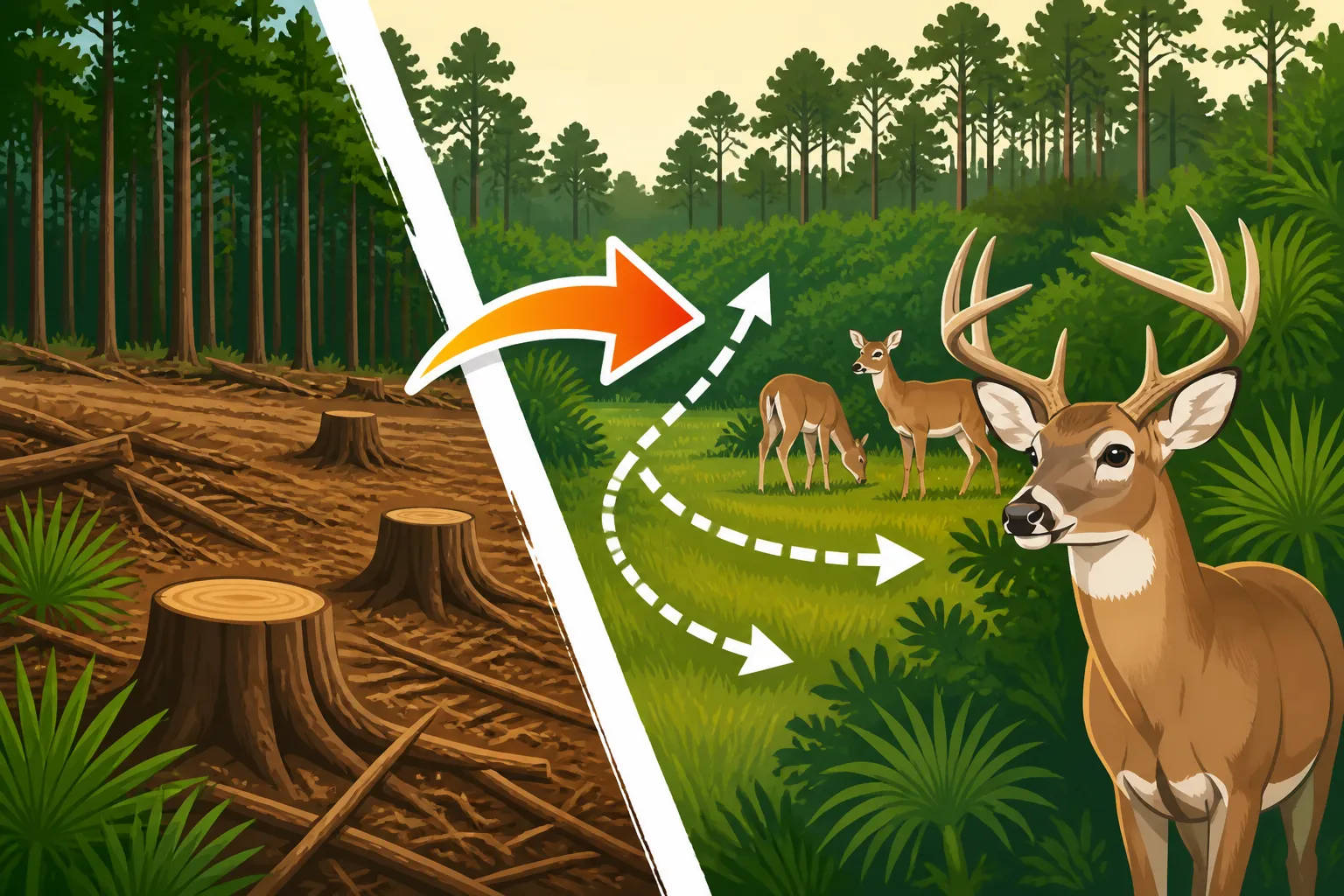
Not all timber cuts are created equal, and understanding the differences is key. A clear-cut, for instance, is the most dramatic, removing nearly all trees from an area. This is common in pine plantations where entire blocks are harvested for pulpwood or sawtimber. When a clear-cut happens, the immediate impact on deer is displacement. Their bedding cover, travel corridors, and often primary food sources are gone, forcing them to move to adjacent intact habitat. It can feel like the world has ended for the local deer herd, and for a short period, it certainly feels that way for them too.
Then you have selective cutting or thinning operations. These are often less visually jarring but still significantly alter the habitat. Selective cuts might remove only certain species or trees of a specific diameter, leaving a more open canopy. Thinning, common in younger pine stands, removes less desirable trees to give remaining trees more room to grow. In these scenarios, deer might not completely abandon the area. Instead, their movement patterns might shift to navigate the newly opened lanes or to exploit areas where brush was disturbed but not completely removed. The change is more nuanced, like rearranging the furniture rather than demolishing the house.
The Short-Term Disruption to Deer Habitat
Regardless of the type of cut, the short-term impact on deer habitat is undeniable. Suddenly, the dense cover that provided security, thermal regulation, and bedding is gone. The forest floor, once shaded, is now exposed to direct sunlight, causing immediate changes to undergrowth. Food sources like acorns or specific browse might be temporarily removed or made inaccessible. This forces deer to seek refuge in adjacent, undisturbed areas. They'll gravitate towards dense palmetto thickets, cypress sloughs, or un-cut hardwood hammocks that offer immediate escape and hiding spots. Where Florida Bucks Bed in Thick Palmetto becomes critical knowledge here.
This initial disruption can last anywhere from a few weeks to several months, depending on the scale of the cut and how quickly new vegetation begins to sprout. During this phase, you might notice a sudden increase in deer sign along the edges of the cut or within nearby cover. It's a period of adjustment for the deer, and it's also a crucial window for hunters to observe and adapt. Understanding these immediate changes can prevent you from abandoning a hunting area prematurely, allowing you to reposition your efforts where deer are temporarily concentrated.
Deer Movement Patterns Post-Cut
The immediate chaos of a timber cut eventually gives way to a new kind of order. Deer, being highly adaptable creatures, don't just disappear forever; they adapt to the altered landscape. Their survival instincts kick in, and they quickly learn to exploit the new conditions, often creating fresh hunting opportunities you might not have considered before.
Initial Relocation and Refuge Areas
In the immediate aftermath of a timber cut, deer will seek out the nearest and most secure cover. This usually means retreating to the edges of the cut area, finding solace in un-cut timber blocks, dense creek bottoms, or the thickest palmetto heads and gallberry patches available. These "refuge areas" become high-traffic zones as deer from the disturbed area converge. You might find deer bedding just inside the tree line, using the remaining standing timber or the very edge of the clear-cut for security while still being able to quickly dart back into deeper cover. Learning Hunting a Funnel Between Two Palmetto Heads or Hunting a Palmetto Flatwoods Edge can be incredibly effective during this transitional phase.
These refuge areas often present excellent ambush points, especially if you can identify natural funnels or travel corridors that lead into or out of them. Deer will be cautious, often moving under the cover of darkness or during low-light conditions, but they will move. Scouting these transition zones diligently after a cut can reveal fresh tracks, rub lines, and scrape activity as bucks re-establish territories. Your mapping app, like onX Hunt, can be invaluable here for identifying these un-cut pockets and travel routes, even if you’re initially devastated by the satellite imagery.
The Emergence of New Food Sources in Regrowth
Here's where the real magic of a timber cut for deer hunting often begins. Once the initial shock wears off and sunlight hits the forest floor, a vibrant explosion of new growth emerges. Within months, depending on soil and moisture, a clear-cut can transform into a smorgasbord of tender young sprouts, forbs, and grasses that are highly palatable and nutritious for deer. Young pine shoots, briars, pokeweed, and various legumes become prime browse. This "early successional habitat" is a deer magnet, often providing more accessible and diverse forage than the mature forest it replaced. Hunting a Clear-Cut Regrowth Edge is a tactic every Florida deer hunter should learn.
As this regrowth progresses from knee-high to waist-high, it doesn't just offer food; it eventually provides excellent bedding cover too. The dense, thorny thickets of young pines, briars, and palmetto can be virtually impenetrable to humans but offer incredible security for deer. They'll start bedding down in these areas, grazing as they go. This shift from reliance on adjacent cover to utilizing the regrowth itself usually happens within one to three years post-cut. Recognizing this ecological progression is crucial. Initially, you hunt the edges; later, you hunt within the cut, targeting internal pockets of food and cover.
Scouting and Hunting Strategies for Timber Cuts
Adjusting your approach to hunting timber cuts isn't just about finding where the deer are, but understanding why they're there and how they're using the new landscape. It requires patience, careful observation, and a willingness to adapt your traditional tactics.
Reading the Landscape: What to Look For
After a timber cut, the entire landscape changes, and so should your scouting eyes. Start by studying aerial maps. Tools like onX Hunt or GoHunt are absolutely essential here. Look for the distinct edges between the cut and the remaining timber, un-cut fingers of hardwoods, creek drains, or isolated islands of mature trees left untouched within the cut. These are your new funnels, pinch points, and security cover. Pay close attention to how deer might move from these refuge areas into the regenerating cut to feed, and then back again. Reading Aerial Photos for Florida Deer can save you countless hours of walking in the wrong places.
Once on the ground, look for fresh sign. New tracks will often be visible along the edges where deer enter and exit the cut. Focus on trails that cut through the thickest, nastiest parts of the regrowth—these are often deer highways, invisible from afar. Look for rub lines on any saplings or small trees remaining, especially as young bucks feel more secure in the new cover. Scrapes might pop up along newly exposed travel routes or adjacent to un-cut timber. Don't be afraid to walk into the cut, especially where the regrowth offers some cover, and look for bedding areas. Deer will often bed on higher ground within a cut, giving them a vantage point, or tucked into the densest pockets of briars.
| Timber Cut Type | Immediate Deer Reaction | Long-Term Deer Use | Hunting Strategy |
|---|---|---|---|
| Clear-cut | Displacement to edges/adjacent cover | Excellent food/bedding in regrowth | Hunt edges/funnels initially; interior later |
| Thinning | Minor disturbance, shift in travel | Increased browse, more open sightlines | Still-hunt lanes, target new browse |
| Selective Cut | Minor displacement, new trails | Patchy food/cover, improved browse | Hunt new openings, identify new travel routes |
| Control Burn | Temporary displacement, new growth | Explosive new browse post-burn | Hunt transition zones, watch for fresh green-up |
Effective Hunting Tactics in Post-Cut Areas
Hunting timber cuts demands adaptable tactics. For bowhunters, still-hunting slowly and deliberately along the edges of a clear-cut or through thinned areas can be highly effective. The broken cover can make traditional stand hunting difficult if deer patterns are erratic, but it also creates opportunities for stalking. Focus on understanding Wind and Thermals in Flat Florida Terrain, as subtle shifts can be amplified in open areas or funnels created by the cut. A good pair of binoculars is a must for glassing openings in the regrowth.
For gun hunters, the added visibility in a clear-cut can be a boon. Setting up a ground blind, especially one that's well-brushed in on a field edge, can give you an excellent vantage point overlooking trails leading into the regenerating vegetation. Using a Ground Blind on Florida Public Land is often more practical than a tree stand in these areas, particularly if the remaining trees are too small or sparse. Consider hunting transition zones where two different types of habitat meet—say, an old growth hammock meets the edge of a year-old clear-cut. Deer will often move along these seams, using the older timber for security and dipping into the new growth for food. Whether you are using a bow or a gun, remember that patience and adaptability are your greatest allies in these dynamically changing environments.
Disclaimer
This article is for general informational purposes only and does not constitute professional advice. Laws, prices and regulations vary by location and change over time. Consult a qualified professional for guidance on your specific situation.