Wind and Thermals in Flat Florida Terrain
Florida, with its seemingly endless flat expanses, often lulls hunters into a false sense of security when it comes to understanding wind and thermals. Many of us, myself included, have spent frustrating hours in a stand, convinced the wind was perfect, only to have a seasoned buck bust us from downwind because we misread the subtle cues of this unique landscape. It’s a common frustration, but mastering how air moves through Florida's diverse habitats is absolutely critical for consistent success, and this guide is here to help you unravel those complexities.
The Unique Challenge of Wind in Florida's Flat Landscape
When most hunters think of wind and thermals, they often picture vast mountain ranges with dramatic updrafts and downdrafts. Florida doesn't have mountains, that's for sure. But don't let the lack of elevation fool you; the Sunshine State presents its own intricate set of challenges when it comes to predicting how air currents will behave. It's not just about a steady breeze; it's about coastal influences, the sheer density of our vegetation, and the constant shifts that can make or break a hunt.
How Florida's Geography Influences Wind Patterns
Even though Florida lacks the dramatic elevation changes found elsewhere, its unique geography plays a massive role in shaping local wind patterns. Think about it: we're a peninsula, surrounded by massive bodies of water – the Atlantic Ocean to the east and the Gulf of Mexico to the west. These bodies of water are constantly influencing our weather, and especially our winds.
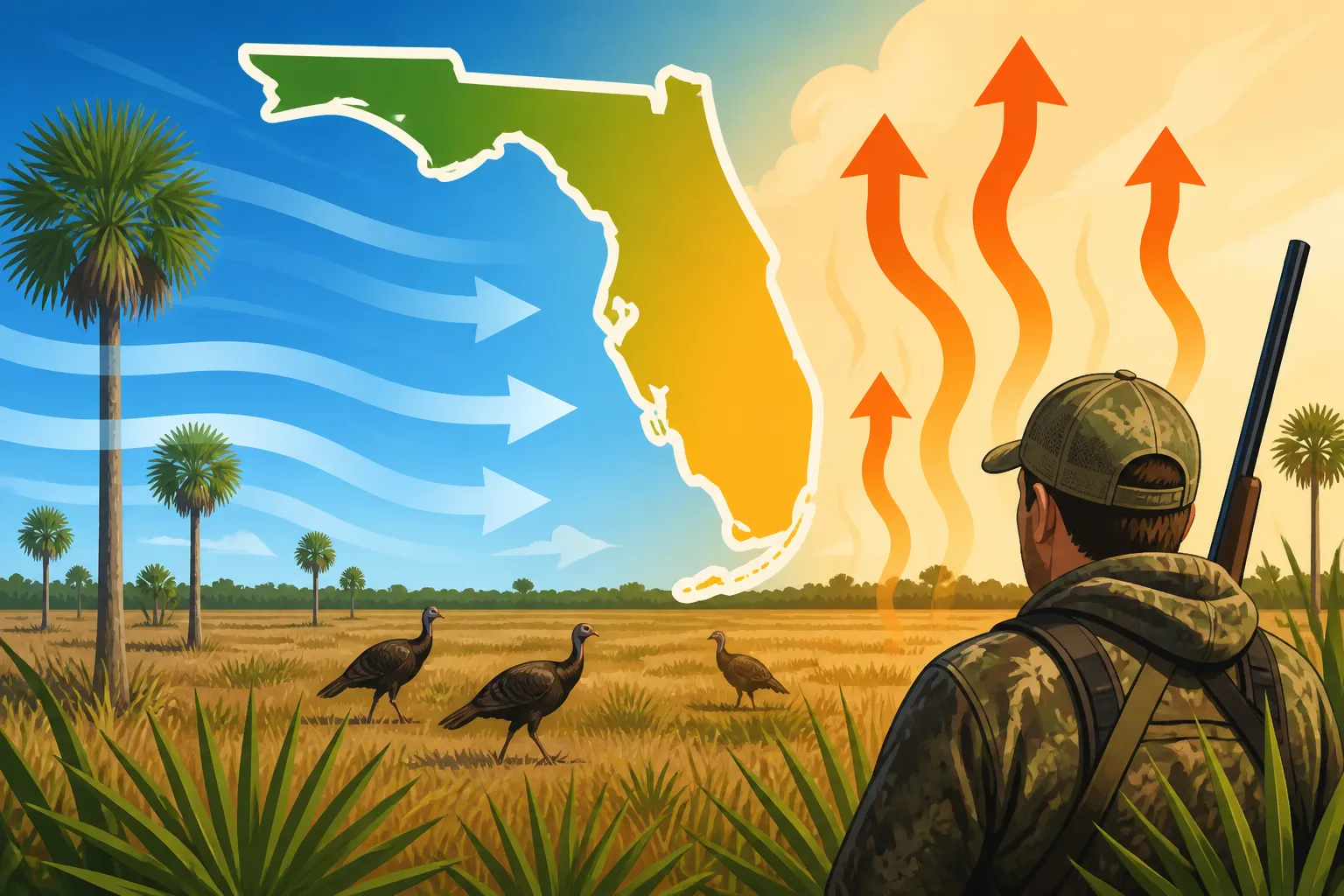
During the daytime, as the land heats up faster than the water, a phenomenon known as a sea breeze often develops. This isn't just a gentle waft; it can be a significant, steady push of air from the coast, sometimes reaching many miles inland. If you're hunting within 20-30 miles of either coast, you absolutely must factor in this daily shift. A morning hunt might start with an inland wind, but by mid-day, that sea breeze can dominate, swinging the wind 90 degrees or more. This is particularly true in areas like Southwest Florida or along the Panhandle's gulf coast. This means what seemed like a perfect wind in the early hours can become a deer-busting disaster by 10 AM if you're not paying attention.
Beyond the coast, Florida's interior is a mosaic of different habitats, each with its own micro-climate effects. We have vast pine flatwoods, dense palmetto scrub, sprawling cypress swamps, and even open agricultural fields. A thick stand of pines can funnel wind in one direction, while an adjacent open field allows it to spread and swirl. Imagine setting up near a transitional edge where a tall pine forest meets an open food plot. The wind might behave predictably within the pines, but as soon as it hits that open area, it can eddy and become unpredictable, especially near the edge where air currents from two different environments collide. Being able to read these subtle shifts is what separates a successful hunter from one who constantly wonders why deer keep "smelling" them.
Predicting Prevailing Winds Versus Local Swirls
We all check the weather app before we head out, right? And usually, those apps give us a pretty good idea of the prevailing wind direction for the day. This is your baseline, your starting point. However, in Florida, relying solely on that broad forecast is often a recipe for disappointment. The devil, as they say, is in the details, and those details are the local swirls and eddies created by the specific topography, no matter how subtle it may seem.
Even a slight rise in elevation, say a natural sandhill in the Central Ridge or a small hammock amidst a flat cypress swamp, can divert and churn the wind. Think about Reading Aerial Photos for Florida Deer and visualizing how air might move around these features. Furthermore, dense vegetation acts like a physical barrier. A mature live oak hammock, for instance, won't just block the wind; it'll force it to go around, over, or even create a vacuum effect on the downwind side, causing unpredictable eddies. I've been in countless situations where the prevailing wind was a steady north, but my wind checker told a different story just 50 yards away, swirling around a cluster of thick palmetto or a small island of oaks.
To truly predict these local swirls, you need to be on the ground, observing. This means carrying a wind-indicator bottle, like one from a brand such as Wildlife Research Center or Tink's, and using it constantly. Throw that powder up every few minutes, especially when you feel a subtle change in the breeze. Pay attention to how leaves are moving, or even the subtle lean of Spanish moss. These small observations, combined with an understanding of the larger prevailing wind, allow you to visualize the path your scent is taking. Apps like GoHunt can provide detailed wind maps that show forecasted direction and speed, which is a great starting point, but they can't account for every single palmetto head or cypress knee creating localized turbulence. You need to combine that tech with old-fashioned fieldcraft.
Deciphering Thermals in Humid, Low-Elevation Environments
Thermals are all about temperature differences, and in Florida's humid, low-elevation environment, they behave differently than in say, the Rockies. While the thermal shifts might not be as dramatic as a mountain range, they are absolutely present and can dictate where deer will move and when. Ignoring them is like ignoring the wind – a fast track to getting busted.
The Basics of Thermal Movement in Flatlands
At its core, thermal movement is simple: warm air rises, and cool air sinks. In Florida, this dynamic still holds true, but it's often more subtle due to our typically high humidity and smaller elevation changes. During the morning hours, as the sun begins to warm the earth, the ground heats up, warming the air directly above it. This warmer air then begins to rise, creating an "updraft." This means that early in the morning, your scent will likely rise and be carried upwards. This effect is often amplified as the sun climbs higher, creating a more pronounced upward thermal pull.
Conversely, in the evenings, as the sun dips below the horizon, the ground quickly begins to cool, especially in open areas. The air directly above the cooling ground also cools, becoming denser and heavier. This cooler, denser air then begins to sink, creating a "downdraft." So, as evening approaches, your scent will likely fall and be carried downwards, hugging the terrain. These daily cycles are critical for planning your entry, stand placement, and exit strategies. For instance, if you're walking into a stand in a low-lying area at dawn, your scent might actually be falling into a deer bedding there, even if the general wind is favorable.
Humidity in Florida plays a fascinating role too. High humidity makes the air feel heavier and can sometimes make these thermal movements less distinct or slower to develop than in arid environments. The air is already laden with moisture, which can act as a thermal buffer. However, this doesn't negate the thermals; it just means you need to be even more observant of subtle changes and understand that they might be less "crisp" than in other parts of the country.
Micro-Thermals and Vegetation's Role
This is where it gets really interesting in Florida. Because our landscape is so diverse, with so many different types of ground cover, you get incredible variations in how quickly different areas heat and cool. These create what I call "micro-thermals," small, localized air movements that can completely throw off your game if you're not paying attention.
Consider a large, open sand patch or an agricultural field. Sand and bare earth heat up incredibly fast under the Florida sun and cool down just as quickly after sunset. This can create strong localized updrafts in the morning and downdrafts in the evening. Now, contrast that with a dense, shaded cypress swamp or a low-lying wet area. These areas retain moisture and warmth differently. Water bodies, like the shallow ponds within a WMA, heat and cool much slower than the surrounding land. This differential heating and cooling between adjacent habitats means air will constantly be moving from warmer to cooler areas, and vice-versa, creating these complex micro-thermals. When Hunting Florida Cypress Swamp Edges, for instance, you might notice air drawing towards the cooler, wetter swamp in the morning, only to reverse course later in the day.
Vegetation itself contributes significantly. A dense canopy of live oaks or a thick block of pine plantation will shade the ground, keeping it cooler and delaying the onset of strong updrafts. Conversely, open palmetto flats or recent clear-cuts will experience rapid heating and cooling. This means that even if you're hunting in generally flat terrain, being situated on the edge of a pine block next to a palmetto field will give you vastly different thermal dynamics than being deep within a shaded hammock. Understanding that your scent might be carried down into the palmetto at dawn, then slowly up and over it as the sun rises, is key. It's about visualizing your scent cone's movement in three dimensions, not just two.
Strategic Hunting Approaches Using Air Movement
Knowing about wind and thermals is one thing, but actually using that knowledge to your advantage in the field is another. This is where meticulous planning, adaptable tactics, and a healthy respect for the air currents really pay off. In Florida, where visibility can be limited by thick cover, making sure your scent is managed correctly is often your number one priority.
Setting Up for Success: Stand Placement and Approach Routes
When you're picking a stand location, you're not just looking for deer sign; you're looking for how the wind and thermals will interact with that sign. For example, if you've found a natural funnel between two palmetto heads or a pinch point where deer are moving from bedding to feeding, you need to think about how the air will carry your scent through that area. You want to place your stand downwind of where you expect deer to approach, but also consider what happens if the wind shifts.
In Florida, with its often unpredictable swirls, sometimes the best strategy is to set up a stand that offers multiple shot opportunities in different wind directions, or, more realistically, to have a few different stand options for different prevailing winds. Imagine you're scouting for deer sign along a sand road, a common travel corridor. You notice heavy traffic where the road passes through a dense oak hammock. For a north wind, you might set up east of the road. For a south wind, west. But what about a swirling wind? You might need to be further off the road, or use a ground blind that provides more scent containment. This is where apps like GoHunt really shine, allowing you to mark multiple stand locations and plan approach and exit routes based on various wind conditions.
Your approach and exit routes are just as critical as your stand placement. You can have the perfect stand, but if you blow out deer on your way in or out because of poor wind management, it's all for nothing. Always plan your entry to be into the wind, or at least cross-wind, relative to where you expect deer to be bedded or feeding early in the morning. For example, if you're hunting Entry Routes Through a Florida Food Plot, you'd want to skirt the edge or approach from a direction where the thermals or wind are carrying your scent away from the plot. The same goes for your exit. If deer are feeding in an area you need to walk past, wait until they move off or plan a route that keeps your scent out of their zone. This might mean taking a longer, more circuitous route, but it’s always worth the extra effort.
Using Technology and Scent Control to Your Advantage
Modern technology has given us some incredible tools, but nothing completely replaces good old fieldcraft. Think of it as enhancing your natural abilities, not replacing them. As mentioned, the GoHunt app is fantastic for looking at forecasted wind direction and speed. It can help you identify terrain features on a map, like creek bottoms or dense cover, that might create predictable thermal or wind funnels. Before I even leave the house, I'm checking GoHunt to get a general idea of the day's conditions, and I often use it to visualize my potential stand locations and how the wind might play out in those specific spots.
However, even the best apps can't account for every single micro-swirl created by Florida's unique vegetation. That's why a simple wind-indicator powder bottle is still your best friend. Use it constantly, every few minutes, to confirm exactly what the air is doing at your level. Watch the powder drift, observe how it swirls around trees or dips into depressions. This real-time feedback is invaluable.
Scent control, of course, goes hand-in-hand with wind and thermal management. No matter how good you are at playing the wind, if you're covered in human odor, you're still at a disadvantage. I'm a big believer in a multi-pronged approach:
- Washing Clothes: Use scent-free detergents. Brands like Dead Down Wind or Scent Killer have been staples in my hunting gear for years.
- Scent-Free Storage: Keep your hunting clothes in airtight bags or containers, away from everyday odors.
- Shower Routine: Shower with scent-free soap before heading out.
- Field Application: Use a scent-eliminating spray on your boots, clothes, and pack before and during your hunt. Even chewing gum can put odor into the air!
- Carbon Gear: While not a silver bullet, carbon-lined clothing, like that from ScentLok or Sitka, can add an extra layer of protection, particularly on those days when the wind is just a little too shifty.
Combining these scent control measures with diligent wind and thermal observation gives you the absolute best chance of remaining undetected by wary Florida whitetails or even a keen-nosed bear.
Overcoming Common Wind and Thermal Traps
Even with the best planning, Florida's environment can throw curveballs. Hunters who understand and adapt to these common "traps" are the ones who consistently fill their tags. It's about being flexible and always expecting the unexpected from Mother Nature.
Adapting to Mid-Day Shifts and Coastal Influences
One of the biggest thermal and wind traps in Florida is the notorious mid-day shift, especially if you're anywhere near the coast. As discussed earlier, the sea breeze phenomenon can completely flip the script. You might start your morning hunt with a perfect west wind, carrying your scent away from a swamp edge where you expect deer to be bedding. But by 10 or 11 AM, as the land heats up, that powerful sea breeze kicks in, swinging the wind around to the east or southeast. Suddenly, your perfect setup is a bust, and your scent is blowing directly into that bedding area.
What do you do then? You have a few options, and being prepared for them is key:
- Relocate: If you have a secondary stand or spot already pre-scouted for an opposing wind, this is often your best bet. Quietly pack up and move to a new location. This requires Scouting Florida Public Land Before Season to identify multiple stand opportunities.
- Adjust Your Position: If moving a long distance isn't feasible, can you adjust your position within your current area? Sometimes dropping down into a slight depression, moving to the other side of a thick palm island, or even climbing a few feet higher in your stand can slightly alter your immediate scent cone.
- Sit It Out: If the shift makes your spot completely unhuntable and you don't have a good alternative, sometimes the best move is to exit quietly and return later in the afternoon when the thermals start to fall and the sea breeze might weaken or reverse. This takes discipline, but it's better than educating deer to your presence.
- Strategic Breaks: For deer, especially in Florida's warmer climate, they often bed down during the hottest parts of the day. This mid-day shift can sometimes coincide with their period of inactivity, giving you a small window to move without as much risk. However, this is never a guarantee.
Always remember that in Florida's warm climate, Hot-Weather Sitting Strategy in Florida means being extra vigilant about scent and understanding that deer might be more nocturnal or move during cooler parts of the day, making wind management even more paramount during legal hunting hours.
Hunting Near Water: Swamps, Rivers, and Lakes
Florida is defined by its water. From the sprawling Everglades to countless lakes, rivers, and cypress swamps, water influences everything, including air movement. Hunting near these features presents unique wind and thermal dynamics that can be tricky to navigate.
Cypress Swamps and Wet Areas: Dense cypress swamps and low-lying wet areas tend to stay cooler and retain moisture longer than surrounding dry land. In the morning, as the sun heats the higher ground, air will often draw towards the cooler swamp, creating a subtle, inward thermal pull. Your scent could be pulled right into that swamp where deer might be bedding. As evening approaches, the swamp may remain relatively warmer than the rapidly cooling dry land, causing air to gently flow out of the swamp. When Hunting Florida Cypress Swamp Edges, for example, always consider how the differential heating and cooling between the water-logged swamp and the drier uplands will influence your scent.
Rivers and Lakes: Larger bodies of water act like massive thermal sinks. During the day, they remain cooler than the land, pulling air from the surrounding shoreline towards the water. If you're hunting along a river or lake edge, particularly on a calm morning, your scent could be carried straight out over the water. This can be an advantage if deer are moving along the bank, as long as you're positioned correctly. In the evening, as the land cools rapidly, the water might stay warmer, causing a gentle breeze to push off the water and onto the land. This is incredibly important for Waterfowl Hunting Florida's Marshes, where understanding how the air moves across open water can mean the difference between ducks circling confidently or flaring at the last second.
To effectively hunt these water-influenced areas, scouting is paramount. Use your wind checker diligently, and observe how birds or leaves move near the water's edge. Often, finding a slight elevation change, even just a few feet, can create a small thermal barrier. Look for points, narrow sections, or areas where the water body narrows, as these can create natural funnels or pinch points that can also influence air movement.
| Time of Day | Typical Wind Behavior (General) | Thermal Trend (General) | Notes for Florida |
|---|---|---|---|
| Pre-Dawn | Light, unpredictable | Falling (Downdraft) | Cool air settles in low areas; scent sinks. |
| Morning | Variable, often light then building | Rising (Updraft) | Ground heats, air rises; coastal sea breeze may begin. |
| Mid-Day | Stronger, often coastal influenced | Strong Updrafts | Sea breeze can dominate; rapid shifts possible. |
| Evening | Decreasing, often reversal | Falling (Downdraft) | Ground cools, air sinks; can reverse coastal breeze. |
| Night | Light, variable | Falling (Downdraft) | Coolest air settles, scent stays low. |
This table provides a generalized overview. Always remember that local micro-climates, vegetation, and specific terrain features will cause variations. Using your wind indicator constantly is the best way to get real-time data.
Disclaimer
Hunting is an inherently dangerous activity. Always prioritize safety, follow all local, state, and federal regulations, and obtain proper licenses and permits. The information provided in this guide is for informational purposes only and should not be considered a substitute for professional instruction or personal judgment. Be aware of your surroundings, inform others of your hunting plans, and be prepared for emergencies.