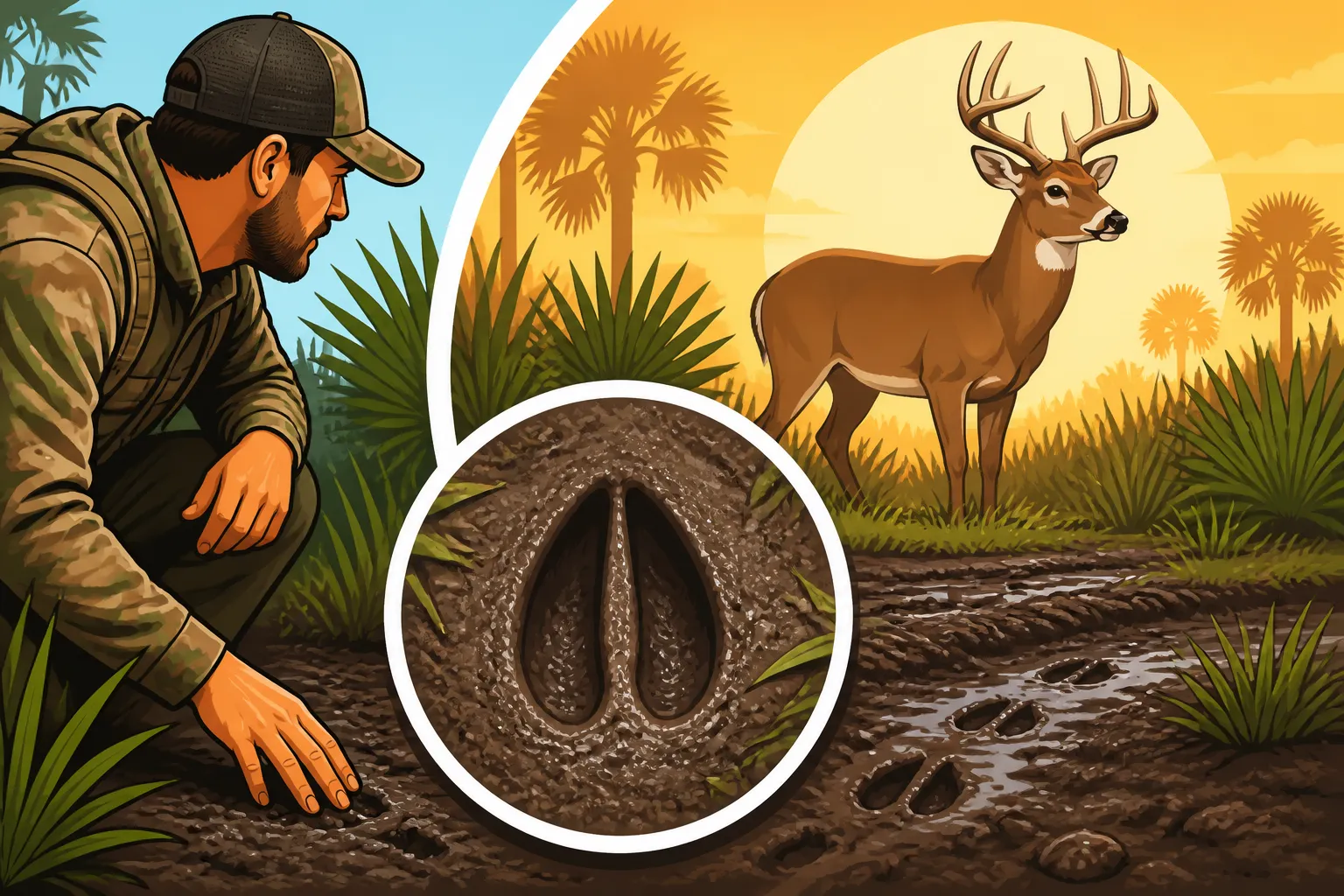
Reading Florida Mud for Fresh Deer Movement
It's incredibly frustrating, isn't it? You spend hours walking through the Florida woods, eyes glued to the ground, searching for that tell-tale sign of a big buck, only to find the "mud" is either too soft, too sandy, or just too wet to give you a clear picture. Our unique landscape here in Florida means that reading deer movement isn't always as straightforward as it might be in other states. This guide is all about helping you cut through that confusion, showing you how to truly interpret the subtle clues in Florida's varied terrain to pinpoint fresh deer activity, even when the ground seems to be conspiring against you.
The Unique Challenge of Florida Mud and Soil
When folks from out of state talk about "mud," they often picture sticky, dark, uniform stuff. But here in Florida, "mud" is a whole different beast. Our diverse ecosystems mean you're rarely dealing with just one type of soil, and each one presents its own set of challenges when you’re trying to read deer sign.
Sand, Clay, and Muck: More Than Just "Mud"
Florida's geology is a wild mix, giving us everything from the sugary white sands of the panhandle to the dark, rich muck of the Everglades, and the reddish, iron-rich clays of the central ridge. Each of these surfaces interacts with a deer's hoof differently, and understanding these nuances is crucial.
Think about a track in deep, dry sand. It might look crisp for a moment, but a gust of wind or even the lightest rain can quickly blur the edges, making it look much older than it truly is. Then there's the sticky, almost glue-like clay you find in some areas; tracks here can hold their shape for a long time, sometimes weeks, especially if the ground dries slowly. It's easy to get fooled into thinking a track is fresh when it's actually days old. And let's not forget the cypress swamps and low-lying areas where the ground is a mix of water and organic matter – a truly challenging environment. Tracks in this soft, waterlogged muck might barely register, or they could quickly fill with water, obscuring any clear details. It’s enough to make even seasoned hunters scratch their heads and wonder if they’re ever going to get a clear read on what’s going on.
The Elusive Nature of Florida Whitetail Tracks
Our Florida whitetails, especially in the central and southern parts of the state, tend to be smaller-bodied than their northern cousins. This means their tracks are often less pronounced, especially on softer ground. A smaller, lighter deer might leave a barely-there impression compared to a hefty northern buck. This subtle nature is compounded by the sheer amount of cover we have. Deer don't have to walk on wide-open trails everywhere; they can often move through palmetto thickets or dense brush, where a clear track line is impossible to find.
Because of this, "fresh" here often means something incredibly subtle. You might not get that perfect, textbook image of a track you see in hunting magazines. Instead, you're looking for a collection of tiny clues. It's about developing an eye for the overall disturbance in the environment, not just the perfectly formed hoofprint. The frustrating truth is that you can walk right over fresh sign if you're not specifically tuned into the kind of subtle evidence our Florida deer leave behind in these challenging conditions.
Deciphering Fresh Deer Movement in Florida Mud
Reading tracks effectively in Florida isn't just about spotting a hoofprint; it's about interpreting a collection of environmental cues that tell a story. It’s a skill developed through patience and a keen eye for detail.
Understanding Track Appearance and Age
When you finally spot a track, the first thing to assess is its age. In Florida, this is rarely black and white. A truly fresh track in moist, firm mud will have very crisp, sharp edges. You won't see any crumbling around the perimeter. If it's in a slightly wet depression, the water inside the print won't have settled and cleared yet; it might still be cloudy or show very subtle disturbances. You also won't see any leaves, twigs, or other debris blown into the print by the wind. If you see a spider web stretching across a track, or if it’s full of clear rainwater, you can bet it’s not fresh enough for immediate action.
In sandy areas, a fresh track might be a bit more rounded, but the key is that the displaced sand will still be "fluffy" and undisturbed by rain or wind. As it ages, the sand compacts, and the edges become less distinct. In muddy sloughs or swamp edges, you might not get a perfect outline at all. Instead, look for the displacement of mud, a subtle depression, and perhaps even a bit of water that hasn't fully settled back into the disturbance. It's a game of millimeters and micro-observations.
Here's a quick guide to differentiating fresh from old tracks in Florida's varied terrain:
| Feature | Fresh Track (within 6-12 hours) | Older Track (12+ hours to several days) |
|---|---|---|
| Edges | Crisp, sharp, well-defined, no crumbling. | Rounded, crumbly, blurred, less distinct. |
| Displaced Soil | Appears moist, undisturbed, "fluffy" in sand. | Drier, compacted, settled. Sand might be wind-swept or rained on. |
| Water Content | If wet, water may be cloudy, still settling, or absent. | If wet, water is clear, settled, often contains debris. |
| Debris | None inside the print. | Leaves, twigs, dust, spiderwebs, or insect activity evident. |
| Overall Look | Stands out distinctly from surrounding ground. | Blends in more with the surrounding environment, less noticeable. |
Reading Ancillary Sign: More Than Just Hoofprints
Often, the tracks themselves might be faint, especially where the ground is either too hard or too saturated. This is where learning to read the "ancillary sign" becomes absolutely critical for Finding Sign in a Florida Oak Hammock. A deer rarely walks without leaving other subtle disturbances. Look for small twigs or branches that have been freshly snapped at hoof height, indicating a deer pushed through. Pay attention to leaf litter: if it’s scuffed or pushed aside in a distinct pattern, even without a clear track, that’s a strong indicator.
Fresh scat is another golden clue. Its appearance – moisture content, color, and how it’s scattered – can tell you a lot about how recently a deer was there. Even a faint, musky scent of deer can hang in the air in humid conditions, particularly in thick cover. Don't underestimate the power of your nose, especially around bedding areas or active travel corridors. The combination of these smaller, often overlooked details, when woven together, can paint a much clearer picture than a single, isolated track ever could.
The Impact of Water and Weather
Florida's weather is a constant factor in track interpretation. A heavy rainstorm can erase tracks entirely or, paradoxically, make them incredibly easy to read in freshly softened soil. The challenge is knowing how long those tracks will last. In soft, sandy soil, a single hard rain can wash away all evidence. In denser clay, tracks might persist for days, even weeks, after a rain, but they’ll become progressively less distinct around the edges.
Standing water in low-lying areas, like sloughs or floodplains, creates a unique scenario. Tracks made in shallow water will rapidly fill with water again, obscuring crispness. However, if you see mud that has been recently disturbed under the water, or a fresh track on the bank leading into the water, that’s your key. Humidity plays a role too; high humidity means tracks stay moist longer, potentially preserving their appearance but also making it harder to discern subtle drying patterns. Always consider the recent weather history when evaluating track freshness. Did it rain last night? How much? Has the sun been out all day, drying things up? These questions are just as important as the tracks themselves.
Strategic Scouting for Muddy Deer Sign
You can’t just stumble upon fresh tracks in Florida; you have to know where to look and when. Strategic scouting, especially in our often-wet environments, is paramount.
Focusing on Key Terrain Features
Deer in Florida, like deer everywhere, are creatures of habit and efficiency. They’ll often use the path of least resistance or areas that offer both cover and food. In muddy conditions, certain terrain features become natural funnels or crossing points where you're most likely to find clear, readable sign. Look for pinch points between two swamps, narrow strips of dry ground between sloughs, or the edges of dense palmetto heads that force deer into a more confined path. Creek crossings are absolute magnets for tracks, as are areas where deer move from dense cover to a food source.
Utilizing modern mapping tools, like those offered by GoHunt, can be incredibly helpful here. You can identify low-lying areas, potential crossings, and transitions between different habitat types from your couch, saving you countless hours of unproductive walking. Focus your ground scouting efforts on these identified areas. A well-used crossing point over a muddy creek or a soft edge of a cypress head could be where Hunting a Cypress Head at Last Light or Hunting Florida Cypress Swamp Edges becomes much more productive.
Timing Your Scouting Efforts
The best time to scout for fresh deer sign, particularly in muddy or soft conditions, is usually right after a rain event. A good, soaking rain refreshes the ground, making old tracks disappear and new tracks stand out sharply. If you can get out within 12-24 hours after a significant rain, you'll be looking at the clearest picture of recent deer movement. This is also when deer movement tends to pick up, as the cooler temperatures and refreshed vegetation can spur activity.
Consider the time of day, too. Deer are most active at dawn and dusk. Scouting during these periods might give you a better chance to see tracks that were just laid down. However, don't discount midday scouting, especially in Florida's warmer climate where deer activity can be highly influenced by temperature. Understanding Hot-Weather Sitting Strategy in Florida will inform when deer are moving and thus when new tracks are likely to be laid. A lot of the time, deer will bed down in the thickest, coolest cover during the heat of the day, emerging towards evening, so focusing on tracks in morning travel routes or evening feeding areas can be very telling.
Interpreting Track Direction and Travel Patterns
Once you've found a fresh track, the next step is to figure out which way the deer was going. Deer tracks are asymmetrical: the two front toes are usually pointed slightly inward, and the hind part of the hoof is wider. This subtle difference can tell you direction. The more crucial step, however, is to follow a line of tracks, even if it's just a few steps. This helps confirm direction and starts to reveal a travel pattern.
Are the tracks heading purposefully in one direction, perhaps to a food source or bedding area? Or are they meandering, indicating feeding or browsing activity? Look for consistent patterns of movement, such as tracks following a specific ridge line, a hard-bottom edge through a swamp, or a particular game trail. These patterns reveal travel corridors that deer use regularly. Mapping these out, perhaps by dropping pins on your GoHunt app, helps you identify exactly where to set up your stand or plan your stalk. You're trying to piece together the deer's daily routine, and consistent track patterns are a huge part of that puzzle. This is where Reading Aerial Photos for Florida Deer becomes invaluable, as you can overlay these ground observations with broader landscape features.
Practical Tips for Tracking and Confirmation
Reading mud is a science and an art, but there are always ways to refine your technique and increase your chances of success, especially in the often-confounding Florida environment.
Using Technology to Aid Your Search
We live in an age of incredible tools that can make our lives as hunters much easier, and that includes interpreting deer sign. GPS apps, like those provided by GoHunt, allow you to mark specific tracks or areas of interest, helping you build a comprehensive map of deer activity. You can note the date, time, estimated freshness, and direction of travel directly on your phone. This spatial data can reveal patterns you might otherwise miss.
Trail cameras, especially those with cellular capabilities, are another game-changer. Set them up in areas where you're finding consistent, fresh sign, particularly near funnel points or known crossings. Seeing a picture of a deer walking through those tracks you just found confirms activity and can give you a precise timeframe. This is critical for knowing Where to Hang a Camera on a Sand Road or on a muddy trail. Don't forget the utility of the Scouting With the Florida FWC App, which can help you understand WMA boundaries and regulations while you’re out there. Simple photography on your phone can also be incredibly useful; take pictures of tracks and other sign to review later, compare, or even send to a trusted mentor for a second opinion.
Learning from Experienced Florida Trackers
There's no substitute for experience, especially when it comes to something as nuanced as reading deer sign in Florida's unique habitats. If you have the opportunity, spend time in the field with a seasoned Florida hunter. They'll show you things that no book or article ever could – the subtle nuances of local soil, how deer move through specific types of palmetto or cypress, and the almost intuitive "feel" for fresh sign. Many of the best lessons aren't taught in a classroom, but through hours spent walking the woods.
Joining a local hunting club or participating in a WMA work day can connect you with these experienced individuals. Observe how they move, where they focus their attention, and what details they pick up on. Ask questions. "Why do you think this track is fresh?" or "What does this broken twig tell you?" Their insights, often rooted in years of chasing Florida whitetails, are invaluable. These shared experiences are a big part of Florida Deer Camp Traditions.
Patience and Persistence in Challenging Conditions
Ultimately, hunting in Florida demands patience and persistence, and reading deer sign in our "mud" is no exception. There will be days when the sign is scarce, confusing, or seemingly nonexistent. The ground might be too hard, or too wet, or too cut up by hog activity to make sense of anything. Don't get discouraged.
It's about continuous learning and adapting. Every time you're in the woods, even if you don't find what you're looking for, you're learning something new about how deer use that particular piece of ground. Sometimes, it’s about having the grit to keep pushing beyond the obvious, to go where others might give up, which is how you end up Finding Ground That Sees Fewer Hunters. The more time you spend observing, the better you'll become at recognizing those subtle clues that unlock deer movement. Whether you're trying to simply locate deer or are engaged in Tracking a Deer in Sandy Florida Soil after a shot, or even attempting Blood Trailing After Dark in Florida or Recovering a Deer From a Cypress Slough, these skills will serve you well. Stick with it, keep honing your observation skills, and those Florida deer will start revealing their secrets.
Disclaimer
Please note that hunting regulations, seasons, and licensing requirements can change. Always consult the latest Florida Fish and Wildlife Conservation Commission (FWC) regulations before planning any hunting trip. This content is for informational purposes only and is not a substitute for official FWC guidelines.