Hunting an Osceola Gobbler in Palmetto Scrub
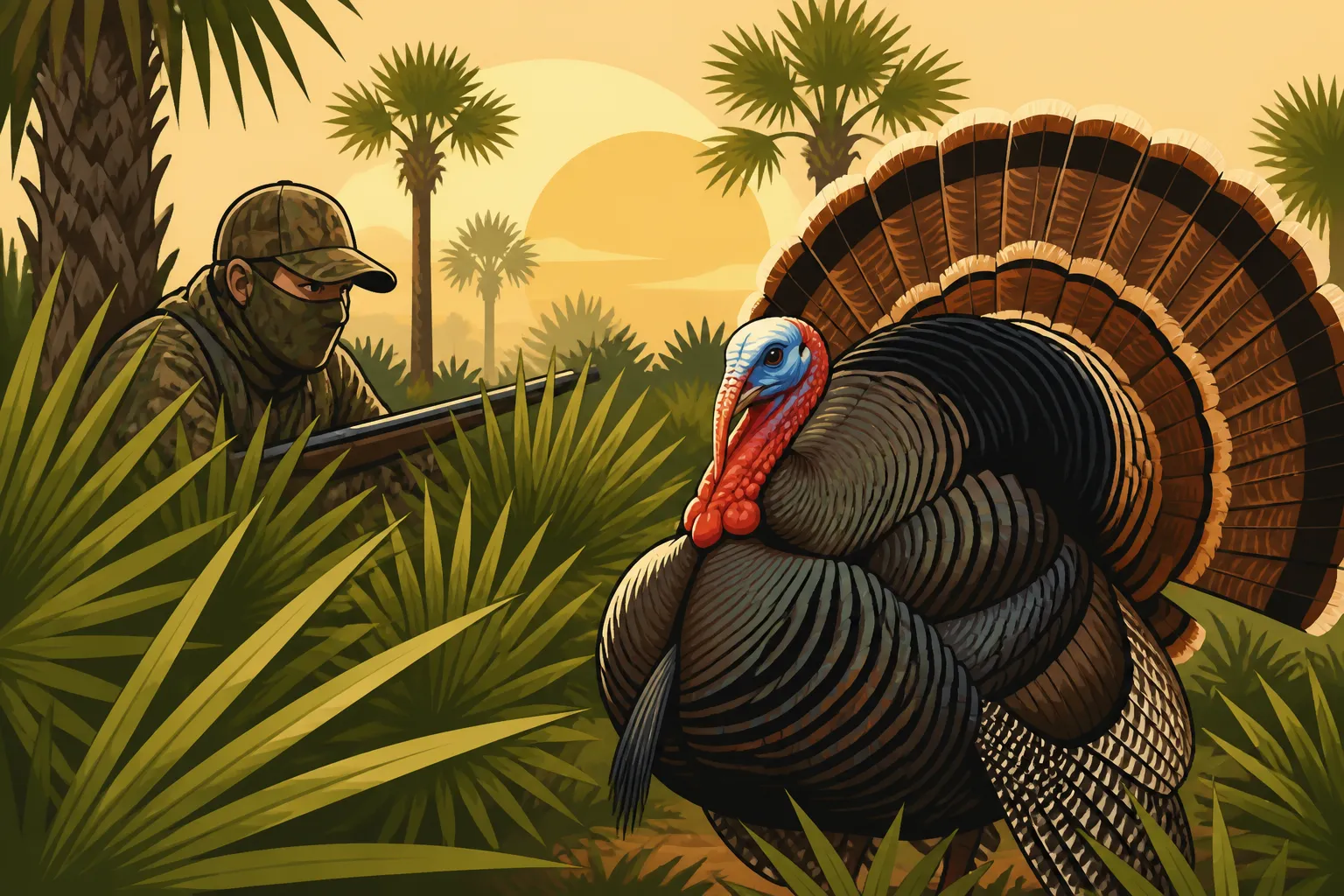
Hunting a Florida Osceola gobbler can be one of the most exhilarating and challenging pursuits in the Sunshine State, especially when those wily birds call the dense palmetto scrub home. The sheer impenetrability of this habitat, combined with the often-wary nature of Osceolas, can leave even seasoned hunters scratching their heads. This comprehensive guide is designed to cut through the confusion, offering practical strategies and insights to help you navigate the unique challenges of hunting these iconic turkeys in Florida's most formidable cover.
Understanding Osceola Gobblers and Their Palmetto Scrub Habitat
Florida's Osceola turkeys are a distinct subspecies, revered by turkey hunters nationwide, and for good reason. They are generally smaller, darker, and often more challenging than their Eastern counterparts. When they inhabit palmetto scrub, the game changes entirely, demanding a deep understanding of their behavior and how they interact with this specific environment. The frustration of hearing a gobbler sound off just yards away, yet being unable to see or get a shot at him, is a common experience in this thick stuff.
The Unique Behavior of Osceolas in Scrub
Osceolas in palmetto scrub are masters of concealment. Unlike turkeys in more open pine flatwoods or hardwood hammocks, they rely heavily on the dense vegetation for security. They don't need to cross vast open fields, making them less visible and harder to intercept. These birds tend to be more vocal on the roost but can go completely silent once they hit the ground, especially if they sense pressure. Their movements are often confined to existing trails, game paths, or subtle openings within the scrub, creating natural funnels that can be exploited if you know how to read the terrain. You'll find that their daily routines are dictated by the cover; they rarely expose themselves unnecessarily, preferring to sneak through the shadows. Understanding this intrinsic desire for cover is paramount to anticipating their movements. When considering Osceola Turkeys in Peninsular Florida, it becomes clear that their adaptations to their habitat are what make them so special, and so difficult to hunt.
Identifying Prime Palmetto Scrub Features
Not all palmetto scrub is created equal when it comes to holding turkeys. Prime scrub habitat will often feature a mix of mature palmettos, saw palmettos, and often interspersed oak hammocks, cypress heads, or pine islands. Look for areas where the palmetto isn't uniformly dense, but rather has natural openings, game trails, or slightly elevated ridges. These subtle changes in elevation or cover density can serve as strut zones or travel corridors. Water sources, even small ones, are also critical, providing both drinking water and insect foraging grounds. Pay close attention to areas where palmetto abuts a more open pine flatwood or an agricultural field; these edges are often transition zones where gobblers might stage before moving into open areas or simply use as travel routes. The sheer vastness of Florida’s public lands can be daunting, but with practice, you can begin to pinpoint these high-percentage areas.
Seasonal Movements and Roosting Habits
Osceolas, like all wild turkeys, have distinct seasonal patterns, but in palmetto scrub, these are even more pronounced. During the spring breeding season, gobblers will establish territories, often centered around roosting areas and strutting grounds. Identifying these key locations is half the battle. They typically prefer tall pine trees or cypress trees for roosting, often located near water or in dense clusters that offer protection. Birds will often fly down into the thickest part of the palmetto, sometimes gobbling only a few times before going silent. Their morning routine often involves flying directly from the roost into dense cover where they can begin their strutting and calling without feeling exposed. Later in the season, when the leaves are thicker and the pressure is higher, they might even roost deeper within the palmettos themselves, making it even harder to pinpoint them. Keeping tabs on Florida Turkey Gobbling Activity Timing can help you understand when to expect these shifts.
Essential Scouting Techniques for Palmetto Scrub
Scouting is undoubtedly the most critical component of successfully hunting Osceola gobblers in palmetto scrub. Without it, you're essentially walking around in a labyrinth, hoping to stumble upon a bird. The density of the cover means you can't rely solely on in-season observations; pre-season intelligence is what truly tips the scales in your favor.
Pre-Season Aerial Reconnaissance
Before you ever step foot in the woods, spend significant time poring over aerial maps. Tools like GoHunt are invaluable for this. Look for variations in the palmetto canopy, identifying patches that appear denser or sparser. Trace the edges of different habitat types—where scrub meets pines, where it meets swamps, or where it borders fields. Pinpoint potential roost sites: clusters of tall pines or cypress trees, especially those near water or elevated areas. Look for any visible game trails or natural corridors that might wind through the palmetto. GoHunt allows you to mark waypoints, measure distances, and even identify property boundaries, which is crucial on mixed public and private land. This digital legwork can save you countless hours of aimless wandering and help you develop a strategic plan for your hunts. It's not just about seeing the trees, but understanding the larger ecosystem, which Scouting Florida Public Land Before Season delves into further.
Boots-on-the-Ground Sign Reading
Once you've narrowed down potential areas on your maps, it's time for some boots-on-the-ground recon. This is where you confirm your theories and gather fresh intelligence. Look for physical turkey sign: droppings, tracks in sandy patches or mud, and primary strut marks. Pay close attention to trails where palmetto fronds are broken or bent, indicating turkeys have pushed through. Find dusting bowls – bare patches of sand or dirt where turkeys clean themselves. Perhaps the most critical sign in scrub is roosting evidence: whitewash, dropped feathers, and droppings concentrated under roost trees. This tells you exactly where birds are spending the night. It's often difficult to see deep into the palmetto, so focus on the fringes, natural openings, and any higher ground that offers a vantage point. Take your time, move slowly, and listen for any distant gobblers or even the subtle scratching of birds foraging.
Locating Roosts and Strut Zones
Finding active roosts is your golden ticket in palmetto scrub. Once you have a potential roost location from aerial maps, try to visit it near dusk or dawn in the weeks leading up to the season. Listen for fly-up cackles at sunset or fly-down thumps at sunrise. On hunting day, arriving well before first light and listening for morning gobblers on the roost can be the difference between success and frustration. These birds will often gobble vigorously from the limb, but once on the ground, they may clam up entirely. Strut zones in palmetto scrub are often harder to define than in open fields. Look for areas where the canopy is slightly more open, allowing sunlight to penetrate, or a small flat rise within the scrub. These areas might not be manicured fields but subtle clearings where a gobbler feels comfortable displaying. Often, these strut zones are very close to roosting areas, providing the gobbler with a quick escape route into the dense cover if needed.
Calling Strategies for Pressured Birds in Thick Cover
Calling an Osceola gobbler out of palmetto scrub is an art form. These birds are often heavily pressured, especially on public land, and the dense cover makes it hard for your calls to project. You need a mix of aggression and subtle finessing, knowing when to push and when to back off.
Aggressive Calling to Cut Through Cover
When you know a gobbler is deep in the palmetto, sometimes you have to get aggressive to even get his attention. Loud, sharp yelps, cuts, and cackles can pierce the dense vegetation, letting him know a "hot hen" is nearby. Use a box call or a loud diaphragm call for this. The goal isn't necessarily to bring him running straight in, but to get him to commit to your general direction or at least give away his position. Once he responds, ease off the aggressive calling. You've made contact, now you need to convince him to close the distance. This initial burst of volume is critical because sound doesn't travel as far in thick scrub as it does in open hardwoods. If he hangs up, consider moving slowly and stealthily to a new position, then try another series of aggressive calls. Don't be afraid to break out those Run-and-Gun Turkey Tactics on Florida Public Land, but adapt them for the dense cover.
Soft Calling and Patience in Tight Quarters
Once you've made contact and a gobbler is heading your way, or even just showing interest, switch to softer, more seductive calls. Clucks, purrs, and soft yelps on a slate or diaphragm call sound more natural and inviting. The key is to make him believe the hen is nearby, perhaps just out of sight, and he needs to come find her. Patience is paramount. A gobbler in palmetto scrub might take a long time to cover even a short distance, picking his way through the vegetation. He's also acutely aware of his surroundings. Set up where you can see a small opening, even if it's just a 10-yard shooting lane. Let him gobble on his own; you don't need to answer every time. Often, the softest calls, mimicking a contented hen, are what finally draw him into range. Remember, he wants to see you, so don't be predictable with your calls. Sometimes the best call is no call at all, just waiting him out.
Decoy Placement for Palmetto Scrub Encounters
Using decoys in palmetto scrub requires careful consideration. Unlike open fields where a full-strut tom decoy can work wonders, in dense scrub, less is often more. A single hen decoy, or perhaps a jake and a hen, placed strategically in a small opening or along a travel corridor can be incredibly effective. The goal is to provide a visual cue that a gobbler can see through the thick cover, giving him something to focus on as he approaches. Place your decoy so it's visible from the likely direction of the turkey's approach, but also ensures you have a clear shot at his head and neck if he comes in to investigate. Don't place it too far from your position; in dense cover, 10-15 yards is often ideal. This maximizes your chances of a close shot while still giving the turkey something to see. For specific tips, check out Decoy Placement for Pressured Osceola Birds.
Gear and Weaponry Considerations for Palmetto Scrub Hunts
Hunting in palmetto scrub isn't like hunting anywhere else. The terrain is brutal on gear, the bugs are relentless, and the shots can be fleeting. Having the right tools for the job can make all the difference in your comfort, safety, and success.
Shotgun and Ammunition Choices for Close-Range Shots
In the dense confines of palmetto scrub, shots are typically close-range. A 12-gauge or 20-gauge shotgun loaded with heavy-hitting turkey loads will serve you well. Many hunters favor a tighter choke, like a super-full or even extra-full, to maintain a dense pattern for precise head and neck shots, even at very close distances. Pattern your shotgun beforehand with your chosen ammunition to understand its performance at various ranges. You want a consistent, tight pattern at 20-30 yards. Since many shots will be taken at birds that pop up unexpectedly in small windows, a shotgun that handles well and comes to the shoulder smoothly is an advantage. Consider a shorter barrel for easier maneuverability through the thick stuff.
Camouflage and Bug Protection
Camouflage is critical, but perhaps even more so is bug protection. Florida's palmetto scrub is home to a robust population of mosquitoes, ticks, and chiggers. Wearing lightweight, breathable camouflage that fully covers your skin is essential. Long sleeves, long pants, and gloves are a must. Consider using a head net or a full facemask to keep bugs off your face. Treated clothing (like Permethrin-treated gear from brands such as Gamehide or Badlands) can offer an extra layer of defense against insects. Don't forget bug spray for any exposed skin. The discomfort from bugs can quickly distract you, compromising your focus and patience, which are two things you absolutely need when hunting wary Osceolas.
Navigation and Recovery Tools
Navigating palmetto scrub can be disorienting. A reliable GPS device or a mapping app like GoHunt on your phone is non-negotiable. Mark your vehicle, your initial setup point, and any key sign you find. The scrub looks remarkably similar in every direction, and it's easy to get turned around, especially when you're focused on a gobbler. A compass is also a good backup. For recovery, bring flagging tape to mark the last known spot of a shot bird, and a bright flashlight or headlamp. Given the density, even a stone-dead bird can be incredibly difficult to find. A small, lightweight game cart might be useful if you're on established trails, but deep in the palmetto, it's often a drag-by-hand affair.
Setting Up and Ambushing Gobblers in Dense Palmetto
The setup is everything when a gobbler is approaching through thick palmetto. You need to maximize your visibility and shooting lanes while remaining completely hidden. This often requires improvisation and quick decision-making.
Concealment and Shot Lanes
When a gobbler is responding, scan your immediate area for the best setup. Look for a thick palmetto clump or a downed tree that can provide excellent back cover, breaking up your outline. The most important aspect is to identify the most likely approach route for the turkey and then select a setup that offers a clear, unobstructed shooting lane in that direction. This might only be a small window, perhaps only a few yards wide. Clear away any small twigs or debris that might make noise if you need to shift slightly. Remember, the turkey expects to see a hen, so being concealed but having a direct view of his likely path is key. Many hunters choose to sit directly on the ground, leaning against a large palmetto clump or tree, to stay as low profile as possible.
The Importance of the Initial Setup
Your first setup, when you're initially calling to a gobbler, is paramount. You want to pick a spot that allows you to hear well, offers decent concealment, and provides at least one or two potential shooting lanes. Think about where the turkey is most likely to come from. If he's on the other side of a particularly dense patch of scrub, try to position yourself near an opening or trail that leads into that patch. Avoid setting up in an area with extremely limited visibility in all directions, as you might get busted before you even know he's there. Being able to see even a little further into the scrub than the turkey can see you is a huge advantage. This careful consideration before the first call is often what dictates the success or failure of the entire hunt. Often, this means Setting Up Against a Big Live Oak or a large palmetto fan that offers excellent coverage.
Adapting to a Bird's Approach in Thick Cover
Turkeys in palmetto scrub rarely follow a script. A gobbler might circle widely, approach silently, or get hung up just out of sight, gobbling his head off. You need to be ready to adapt. If he's hung up, try subtle changes in your calling – soft clucks or purrs, or even going silent for a few minutes. If he's circling, determine which way he's going and try to adjust your body position or, if absolutely necessary, make a slow, quiet pivot to face him, using the cover to your advantage. If you hear him coming through the dense scrub but can't see him, remain absolutely still and let him close the distance. He might literally appear out of nowhere. The biggest mistake is moving too soon or trying to force a shot through heavy cover. Wait for a clear, ethical shot at his head and neck. Patience and discipline are your best friends here.
| Key Strategy | Application in Palmetto Scrub | Common Mistake to Avoid |
|---|---|---|
| Aggressive Calling | Use loud, sharp calls to penetrate dense cover and get initial response. | Overcalling once the bird is interested, sounding unnatural. |
| Soft Calling | Employ clucks and purrs to entice close-range birds. | Only using loud calls, scaring off wary gobblers. |
| Decoy Placement | Use a single hen or jake/hen combo in small openings (10-15 yds). | Placing decoys too far away or in impenetrable cover. |
| Concealment | Sit against dense palmetto/tree; find clear shooting lanes. | Choosing a setup with no shooting lanes or poor back cover. |
| Patience | Wait for birds to pick through cover; they move slowly. | Moving too soon or giving up because the bird isn't visible. |
| Scouting | Utilize GoHunt for aerial views, look for roosts & trails. | Relying solely on in-season luck without pre-scouting. |
Post-Shot Procedures and Recovery in Challenging Terrain
Even after a successful shot, the hunt isn't over. Recovering a downed turkey in palmetto scrub can be just as challenging as getting a shot. The dense vegetation can swallow a bird whole, making it easy to lose sight of it, even if it goes down immediately.
Marking the Spot and Waiting It Out
The moment you pull the trigger, keep your eyes glued to where the turkey was standing and where it falls. Pick out a specific palmetto clump, a tree, or any distinct landmark. Mark that exact spot in your memory or on your GPS. Even if the bird is flopping, resist the urge to immediately charge in. Give the bird a few minutes, especially if it's still moving. This allows the bird to expire fully and minimizes the chance of a "runner." If the turkey makes it into even thicker cover before collapsing, those few minutes can be crucial in ensuring it doesn't get up and disappear completely. The silence after the shot can be unnerving, but those few moments of waiting are critical for a successful recovery.
Tracking a Turkey in Dense Palmetto
Tracking a turkey in palmetto scrub is tough. There's often not much blood trail to follow, and the bird can seem to vanish. Start at your marked spot. If you don't find the bird immediately, expand your search in concentric circles. Look for disturbed leaves, broken palmetto fronds, or any displaced vegetation. Feathers, especially body feathers, are a great indicator. If you find blood, even a single drop, mark it with flagging tape and scan ahead for the next sign. It's often helpful to have a hunting partner to help grid search an area. Work slowly and methodically. If the bird ran, try to determine its direction of travel. In some cases, a well-trained dog might be useful, though this is not common for turkey hunting in Florida. A good quality light source is important if daylight is fading, as tracking a bird after dark in this environment is extremely difficult.
Field Dressing and Transporting Your Gobbler
Once you've recovered your hard-earned gobbler, the next step is field dressing. In hot Florida weather, getting the bird cooled down quickly is essential for meat quality. Many hunters prefer to breast out the bird immediately to reduce bulk and allow for rapid cooling. If you're taking the whole bird, remove the guts. Keep the beard and spurs intact for documentation and trophies. Place the meat or bird in a game bag to keep it clean and protect it from flies. Transporting a whole turkey out of dense palmetto can be a real workout, especially if you're deep in the woods. A sturdy backpack or a dedicated turkey vest with a game bag can make the haul easier. Consider having a cooler with ice readily available at your vehicle to immediately chill the meat. Remember, Florida requires you to report your harvest, so have your information handy to do so via the FWC app or website. For more details on this, check out Florida Deer Reporting Requirements, which, while focused on deer, highlights the importance of harvest reporting for all game.
Disclaimer
Hunting is an inherently dangerous activity. This guide provides information for educational purposes only. Always consult and strictly adhere to all current Florida Fish and Wildlife Conservation Commission (FWC) regulations, local laws, and safety guidelines. Obtain all necessary licenses and permits before hunting. The author and publisher are not responsible for any incidents, injuries, or legal issues that may arise from the use of this information.