Mottled Ducks in Florida Marshes
Hunting Florida’s marshlands for the elusive Florida mottled duck presents a unique set of challenges that can test the patience of even veteran waterfowl hunters. Between navigating treacherous mud flats, dodging thick clouds of mosquitoes, and trying to distinguish these wary resident birds from lookalike mallard hens at dawn, it is easy to return to the boat ramp empty-handed. This guide delivers actionable, field-tested tactics to help you identify mottled duck habitat, fine-tune your decoy and calling spreads, choose the right marsh gear, and ethically harvest one of the Sunshine State’s most prized native game birds.
Understanding Florida Mottled Duck Biology and Habitat
Unique Traits of a Year Round Resident
Unlike the overwhelming majority of waterfowl species that fill Florida’s skies during the late fall and winter months, the Florida mottled duck stays put year-round. Often referred to by local hunters as the Florida duck or black duck, this species spends its entire life cycle within the peninsula’s freshwater and brackish wetland ecosystems. Because they never make a multi-state migration, these birds develop an intimate, hyper-local knowledge of their home range. They know every isolated pond, every airboat trail, and every patch of maidencane, making them exceptionally wise to human presence.
By the time the regular duck season opens, native mottled ducks have already survived months of alligator activity, habitat changes, and summer storms. They do not flock in the massive rafts typical of migratory ring-necked ducks or teal. Instead, you will almost always find them traveling in pairs, small family groups, or as solitary birds picking their way through shallow vegetation. Understanding this non-migratory lifestyle is critical: these birds are not fresh, naïve migrants dropping blindly into a massive spread of plastic decoys. They are resident survival experts that notice when a single blade of grass looks out of place.
Identifying Mottled Ducks versus Mallards and Black Ducks
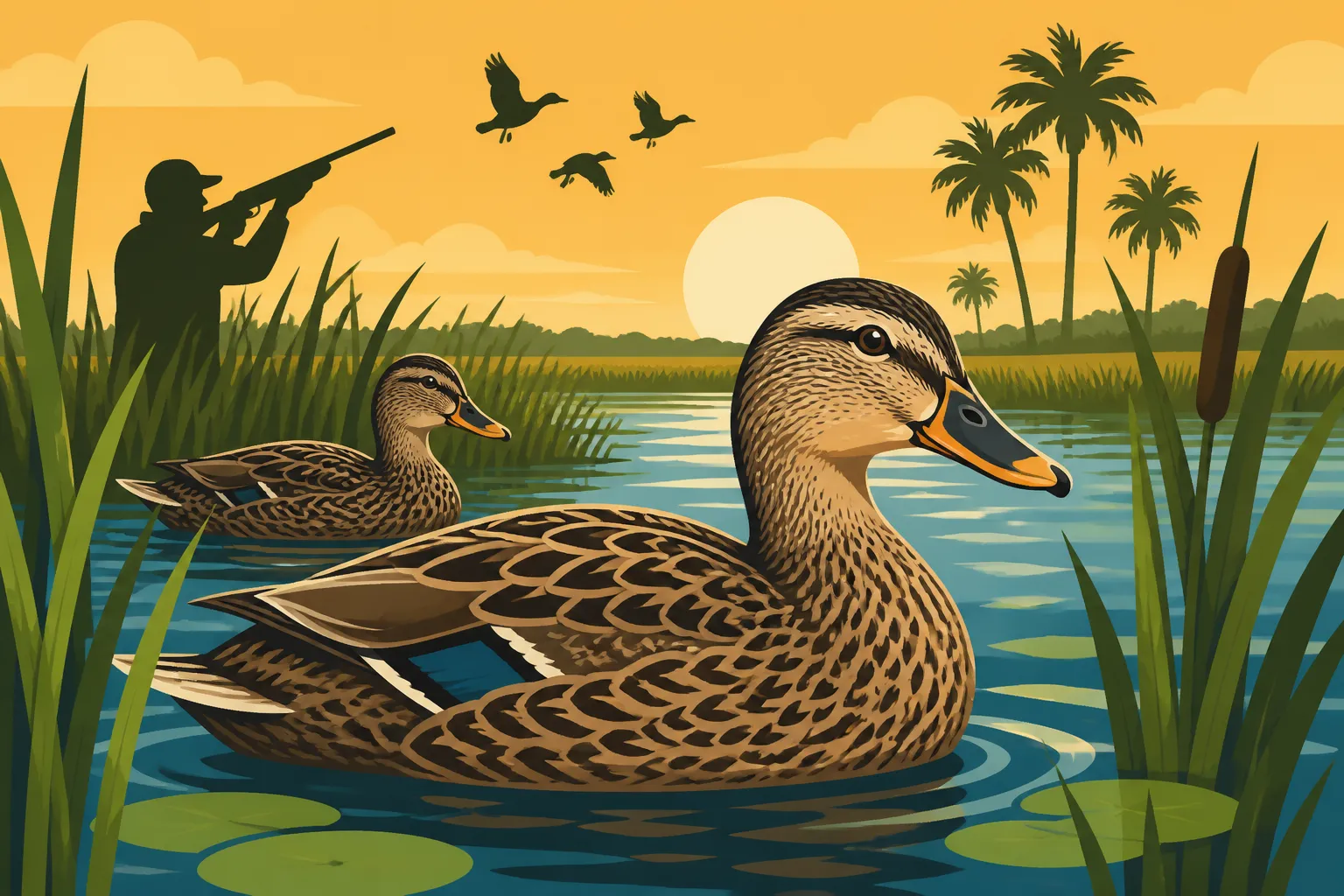
Misidentifying a mottled duck in low-light conditions can lead to an immediate wildlife violation, given the strict harvest limits in place to protect the native population. Both male and female mottled ducks closely resemble hen mallards and American black ducks, featuring a chocolate-brown body with buff-colored edging on their feathers. However, careful observation reveals subtle, distinct markers. The most reliable field mark on a mottled duck is its speculum—the iridescent wing patch—which is dark blue-purple and bordered by black, noticeably lacking the bright white stripes that flank the speculum of a mallard hen.
| Physical / Behavioral Feature | Florida Mottled Duck | Hen Mallard | American Black Duck |
|---|---|---|---|
| Speculum Coloration | Purple-blue with black borders; no white stripes | Violet-blue bordered by distinct white bars | Dark violet-purple with thin black/white edge |
| Bill Color (Drakes) | Bright olive-yellow to yellow with a black basal spot | Dull olive to yellow-green without basal spot | Olive-green to yellow, dark mottling |
| Cheek and Neck Tone | Unstreaked, pale buff to plain cream-colored | Heavily streaked, brownish-buff | Darkly streaked gray-brown |
| Flock Size & Behavior | Singles, pairs, or small pockets (2-6 birds) | Large migratory flocks, highly vocal | Small to medium migratory groups |
Drakes feature a bright yellow to olive-yellow bill marked by a distinct black spot at the base, known as the pigment spot, where the bill meets the feather line. Hens possess an olive-green to dull orange bill, often speckled with dark blotches along the top edge. Furthermore, the cheeks and throat of a mottled duck are significantly paler and smoother in appearance than the heavily streaked head of a mallard hen. Taking an extra second to verify these features over the bead of your shotgun ensures you maintain legal compliance and support species management efforts.
Core Habitats Across Peninsular Florida
Mottled ducks are distributed across the peninsular portion of Florida, rarely venturing far into the Panhandle. They thrive best in vast, shallow, freshwater marsh systems, prairie ponds, flooded pastures, and agricultural drainage canals. Prime habitat includes the expansive Kissimmee River Basin, the Upper St. Johns River marshes, and the shallow conservation areas surrounding Lake Okeechobee. They rely heavily on floating mats of vegetation, moist-soil plants like smartweed and millet, and submerged aquatic vegetation like hydrilla.
Brackish coastal marshes and mangrove fringes along the Gulf Coast and Atlantic Intracoastal Waterway also support healthy pockets of birds, particularly during dry winter periods when inland prairie ponds shrink. Mottled ducks prefer water depths between two and twelve inches—deep enough to paddle and forage, but shallow enough to easily tip up and reach aquatic seeds, snails, and small invertebrates. If you are scouting a body of water where a flat-bottom boat floats effortlessly without touching bottom vegetation, you are likely fishing in water that is too deep for primary mottled duck feeding grounds.
Scouting Florida Marshes and Key Locations
Navigating Public Waterfowl Areas and WMAs
Finding productive ground for mottled ducks requires a willingness to explore deep into Florida’s public land network. Public Wildlife Management Areas (WMAs) and National Wildlife Refuges (NWRs) offer exceptional habitat, but they also come with heavy hunting pressure. Areas like the Stormwater Treatment Areas (STAs) in South Florida, the TDA and Blue Cypress units in the St. Johns river system, and coastal refuges like Merritt Island feature managed water levels that draw native birds like a magnet.
Because public areas see significant traffic, successful hunters learn to focus on hard-to-reach pockets within those systems. Getting away from the primary boat ramps and main airboat channels is non-negotiable. Look for small, hidden “holes” tucked back inside dense stands of cattails, willow heads, or sawgrass. Taking time to cross-reference Waterfowl Hunting Florida’s Marshes with state quota hunt application deadlines ensures you land access to high-draw, limited-entry areas that keep hunter density low and bird movement high.
Leveraging Digital Mapping and Scouting Tools
Before throwing your gear into the truck, efficient marsh scouting starts on a screen. Satellite imagery lets you identify hidden potholes, water control structures, and vegetated transition zones that cannot be seen from a sand road or boat channel. Platforms like GoHunt provide updated land ownership overlays, topo maps, and high-resolution aerial imagery that reveal shallow marsh terrain where mottled ducks retreat during high-pressure days.
Using GoHunt allows you to measure distances across broad marsh flats, pinpoint isolated ponds hidden within private ranch boundaries bordering public ground, and identify potential access points along canal levees. By analyzing historical satellite layers on GoHunt, you can track how water levels expand and contract across specific WMAs from summer to late winter. Identifying these hydrological trends ahead of time saves valuable fuel, protects your lower unit, and prevents you from hauling a boat into a dried-out mud flat at 4:00 AM.
Reading Water Levels and Natural Feed Sources
Florida marsh ecosystems are dictated entirely by water movement. A spot that held hundreds of ducks during a rainy November can turn into a cracked mud basin by mid-December if water managers open a control gate. Mottled ducks follow water shifts relentlessly. When water levels rise, birds scatter into newly flooded pastureland and palmetto edges to feed on terrestrial insects and freshly submerged seeds. When water levels drop, they concentrate into remaining deep sloughs and canal bends.
To consistently locate birds, spend your pre-season scouting trips looking for active sign rather than just flying ducks. Search shallow mudbanks for fresh tracks, dropped breast feathers floating along windward reed lines, and churned-up bottom sediment where birds have been tipping up to feed. Keep an eye out for natural food sources like duckweed, sago pondweed, and smartweed. If you find an isolated marsh pocket loaded with natural feed and clean, knee-deep water, you are sitting on a prime spot for a dawn hunt. For more insights on pattern recognition in the field, read up on Reading a Marsh for a Morning Flight.
Tactical Decoy and Calling Strategies for Pressured Birds
Less Is More with Micro Decoy Spreads
The most common mistake hunters make when targeting Florida mottled ducks is setting out large, migratory-style decoy spreads. Throwing three dozen bright mallard decoys out into a Florida marsh is a fast way to flare native birds. Mottled ducks do not form massive rafts, and they quickly associate big, crowded decoy spreads with hunting pressure. When targeting these resident birds, your decoy strategy should center on realism, minimalism, and precise placement.
| Decoy Strategy Element | Standard Migratory Duck Setup | Specialized Mottled Duck Setup |
|---|---|---|
| Spread Size | 24 to 60+ decoys (mixed species) | 2 to 6 high-quality decoys maximum |
| Decoy Species Selection | Mallard, Pintail, Wigeon, Teal blocks | Mottled Duck, Black Duck, or Hen Mallards |
| Decoy Placement | Massive “V” or “J” hook with landing pocket | Tight pair or single tucked close to cover |
| Motion Technology | Multiple spinning-wing motorized decoys | Subtle jerk string or manual splash rig |
A micro-spread consisting of just two to six high-end decoys is vastly more effective. Set out a single pair or two small groups separated by fifteen yards of open water. Use high-contrast mottled duck or black duck decoys with dark body paint, as bright greenhead mallard drakes look completely out of place in a native Florida marsh. Placing a solitary decoy right along the edge of a reed line simulates a relaxed, feeding bird. If you want to add variety to your spread while maintaining a natural presentation, consider combining tactics discussed in Decoying Wood Ducks in a Cypress Slough.
Calling Techniques for Ultra Wary Florida Natives
When it comes to calling mottled ducks, aggressive hail calls and loud power calling will clear the sky faster than a thunderstorm. These birds spend their entire lives listening to the natural, quiet ambient sounds of the marsh. They know what a calm, unpressured duck sounds like, and heavy calling instantly raises red flags. Put away the loud competition calls and focus on soft, subtle vocalizations.
Limit your calling to gentle, single quacks, soft feeding chuckles, and lazy two- or three-note greeting calls. If a pair of mottled ducks is heading in your direction, let them work without touching the call at all. Only use a soft quack if the birds appear to be drifting past or turning away from your spread. Pay close attention to the wind and their flight path; often, a completely silent approach with just a touch of motion on a jerk line is all it takes to lock their wings for final pass-shooting distance.
Concealment in Low Profile Marsh Vegetation
Hiding from a bird that possesses exceptionally sharp vision and knows every bush in the marsh requires extreme attention to detail. Florida’s open prairie marshes offer very little overhead cover, meaning human profiles stand out dramatically against the horizon. Standing up in a bright, bare aluminum boat or wearing mismatched camouflage patterns will spoil a hunt before legal shooting light even arrives.
Match your camouflage specifically to the local vegetation. Mossy Oak Shadow Grass Blades, Realtree Max-5, or specialized marsh patterns blend seamlessly into dry cattails, maidencane, and dead cordgrass.
- Cut live, native vegetation near your hunt site to break up the hard outlines of your boat, kayak, or layout blind.
- Ensure all shiny surfaces, including gun barrels, outboard cowlings, and face skin, are completely covered or painted.
- Position your setup so the rising sun is at your back, casting heavy shadows across your hide and blinding incoming birds as they bank into the wind.
- Keep all hunters and working retrievers completely still until the shot is called, as motion is the primary trigger that flares wary resident birds.
Gear and Boat Setup for Deep Swamp Navigation
Choosing Between Mud Boats, Airboats, and Kayaks
Accessing prime mottled duck territory in peninsular Florida demands specialized watercraft capable of navigating shallow, vegetated, and muddy environments. The right choice depends heavily on the specific WMA or public waterway you plan to hunt, as well as seasonal water levels.
| Watercraft Type | Draft Depth Required | Vegetation Capabilities | Ideal Hunting Environment |
|---|---|---|---|
| Airboat | 0 to 2 inches (runs dry ground) | Navigates dense sawgrass, lily pads, floating tussocks | Deep Everglades, broad marsh prairies, STAs |
| Surface Drive / Mud Boat | 3 to 6 inches of mud/water | Powers through soft mud, hydrilla, light reeds | Shallow lake edges, flooded timber, ditch networks |
| Duck Skiff / Kayak | 2 to 4 inches | Paddles silently through tight timber and reed pockets | Hard-to-reach quota areas, non-motorized zones |
Airboats represent the ultimate tool for broad marsh coverage, allowing hunters to glide over floating tussocks, shallow mud, and dense sawgrass. For detailed rules on operating these high-powered craft in public waters, review Everglades WMA Airboat Access. However, airboats are loud and require dedicated maintenance. Surface drive mud motors mounted on shallow-drive aluminum hulls offer a excellent middle ground, capable of pushing through thick hydrilla and soft mud without clogging a traditional water-pump outboard. For quota areas with motor restrictions, a stealthy, camouflage duck kayak or light skiff remains an unbeatable, low-cost tool for slipping into quiet potholes undetected.
Essential Waterfowl Gear for Hot and Humid Swamps
Waterfowl hunting in Florida is a far cry from the freezing, ice-breaking hunts common in the northern flyways. Early and mid-season hunts frequently feature temperatures in the 70s and 80s, high humidity, and relentless insect activity. Heavy neoprene waders will quickly lead to overheating and exhaustion. Instead, invest in lightweight, breathable stockingfoot waders paired with durable wading boots, or wear quick-drying brush pants and non-slip water shoes when hunting out of a boat.
Thermacell mosquito repellent units are just as critical as your shotgun and ammunition. A working Thermacell can mean the difference between sitting perfectly still or constantly swatting bugs while ducks pass overhead. Additionally, salty coastal air and heavy swamp humidity accelerate rust on firearms. Wipe down your shotgun with a high-grade gun oil before and immediately after every hunt, and choose corrosion-resistant gear whenever possible.
Shot Size and Load Selection for Marsh Conditions
Mottled ducks are large, hardy birds with thick feathering and dense muscle mass. Because you are restricted to a strict daily bag limit, making every shot count with clean, lethal harvests is both an ethical and practical priority. Non-toxic shot is mandatory for all waterfowl hunting, but selecting the proper load balance for close-range marsh shooting takes some thought.
- Steel Shot: #2 or #3 steel shot pushed at high velocities (1,400+ FPS) provides adequate pattern density and lethal energy for shots within 35 yards.
- Bismuth Shot: #4 or #5 bismuth offers higher density than steel, allowing for cleaner kills at extended ranges and superior performance through tight choke tubes.
- Tungsten Polymer (TSS): #6 or #7 TSS delivers extreme kinetic energy and dense patterns, though at a significantly higher cost per box.
- Choke Selection: An Improved Cylinder or Light Modified choke is ideal for close-range work over micro decoy spreads in tight marsh pockets.
Testing your shotgun on a paper target at 20, 30, and 40 yards with your chosen load is essential. A dense, uniform pattern ensures quick, humane harvests and reduces the risk of long sails into thick marsh grass where bird recovery becomes extremely difficult.
Managing Harvest Regulations and Conservation Efforts
Navigating Strict Daily Bag Limits
Because Florida mottled ducks face unique habitat pressures and potential population fluctuations, state and federal wildlife agencies manage them under strict harvest guidelines. For many years, management frameworks have limited hunters to a daily bag limit of just one mottled duck per person. Furthermore, state regulations often prohibit the harvest of mottled ducks during the early days of the statewide duck season to prevent over-harvesting before migratory ducks arrive in full force.
Always double-check the current rule handbook published by the Florida Fish and Wildlife Conservation Commission (FWC) before heading into the marsh. Take time to review overall harvest guidelines outlined in Florida Waterfowl Season and Zones and confirm exact possession limits using Florida Duck Daily Bag Limit. Keeping track of changing season dates and specific WMA regulations prevents costly legal infractions and ensures the long-term sustainability of native duck populations.
Hybridization Challenges with Domestic Mallards
One of the most significant long-term biological threats to the pure Florida mottled duck is genetic hybridization with feral, domestic mallards. Released or escaped farm mallards often establish feral populations near urban areas, golf courses, and suburban retention ponds. As these feral birds spread into surrounding wild marsh habitats, they interbreed with native mottled ducks, producing fertile hybrid offspring.
Over time, this hybridization dilutes the pure genetic lineage of the Florida mottled duck. Hunters play a key role in conservation by reporting unusual sightings and supporting habitat preservation initiatives. FWC researchers continuously monitor genetic integrity through wing collection surveys and field sampling. Knowing how to identify true native birds versus feral hybrids—which often display faint white wing bars, oversized bodies, or blotchy green feathering on the head—helps keep wildlife managers informed on population health.
Processing and Cooking Native Florida Duck
Harvesting a native Florida mottled duck is a badge of honor for any Southern waterfowler, and the reward extends directly to the dinner table. Unlike diving ducks that feed heavily on small fish and crustaceans, mottled ducks consume a diet rich in aquatic seeds, submerged vegetation, and freshwater snails, resulting in mild, highly flavorful meat.
- Field-dress the bird as quickly as possible, especially during warm-weather hunts, by cooling the carcass in an ice chest immediately after harvest.
- Pluck the skin on the breast and legs if the bird has good fat reserves, as duck fat holds exceptional flavor when properly rendered.
- Age the cleaned bird in a cold, dry refrigerator (34°F to 38°F) for two to three days to tenderize the muscle fibers.
- Sear the breast fillets in a hot cast-iron skillet to medium-rare (130°F to 135°F internal temperature) to preserve moisture and rich game flavor.
- Serve alongside traditional Southern sides like wild rice, roasted acorn squash, or a sweet jalapeño-plum glaze.
Treating your harvest with care in the field and kitchen completes the cycle of an authentic Florida marsh hunt. To learn more about preparing native wild game, check out our recommendations for the Best Eating Game in Florida.
Planning Your Florida Mottled Duck Trip
Executing a successful hunting trip for native mottled ducks requires merging mapping technology, biological understanding, and local logistics. Whether you are traveling across the state or heading to your local WMA, structuring your hunt around proper scouting and gear prep ensures a smooth experience.
| Scouting & Preparation Step | Primary Focus / Action Item | Recommended Tools & Resources |
|---|---|---|
| 1. Digital Scouting | Identify shallow water, pothole structures, and access boundaries | GoHunt app, satellite overlays, FWC WMA maps |
| 2. Physical Reconnaissance | Check actual water levels, verify feed availability, look for sign | Airboat, mud boat, or kayak; binoculars |
| 3. Permit & Compliance Check | Confirm quota status, season dates, and bag limits | FWC licensing portal, HIP certification |
| 4. Gear & Concealment Prep | Match camouflage to marsh grass, service shallow-draft motors | Thermacell, high-velocity non-toxic loads, jerk rigs |
Step-by-Step Field Execution Plan
- Conduct Off-Site Research: Use GoHunt three to four weeks before your trip to cross-reference public land boundaries with recent rainfall data. Identify three distinct marsh zones (primary, secondary, and deep-water backup options) in case water levels drop unexpectedly.
- Scout Without Disturbance: Visit your chosen WMA two afternoons prior to your hunt. Observe bird flight corridors from a distance using optics rather than running your boat directly through roosting holes.
- Set Up Early and Light: On hunt day, arrive at your hide position well before first light. Keep your decoy footprint minimal—no more than four high-contrast decoys paired with a manual jerk line.
- Practice Extreme Discipline: Verify every bird visually as it approaches. Confirm the absence of bright white wing bars and wait for the duck to enter clear, effective range before taking your shot.
- Care for Your Catch: Immediately retrieve downed birds, place them in a cool shade line or dry cooler, and wipe down your hunting gear to protect it from harsh marsh elements.
By building your hunt around low-impact scouting, precise identification, and light-pressure hunting tactics, you can consistently enjoy the thrill of calling an elusive Florida mottled duck into close range. If your fall calendar includes targeting multiple migratory species during early split windows, combine these strategies with techniques from our guide on Early Teal Season Tactics in Florida.
Disclaimer
This article is for general informational purposes only and does not constitute professional advice. Laws, prices and regulations vary by location and change over time. Consult a qualified professional for guidance on your specific situation.