Florida Dove Population Trends
For many Florida hunters, the opening day of dove season isn't just about wingshooting; it's a cherished annual tradition, a social event, and the unofficial start to the fall hunting calendar. But anyone who has chased doves across the state knows that some years feel like boom times, with birds showering down into harvested fields, while other seasons leave you wondering where all the birds went. Understanding the ebb and flow of Florida's dove populations is key to consistently finding success and appreciating the broader ecological picture. This comprehensive guide will explore the various factors influencing dove numbers across our diverse landscape, from natural environmental shifts to the vital role of human management.
Understanding Florida's Huntable Dove Species
When we talk about dove hunting in Florida, we're primarily focused on a couple of key species, though others certainly grace our skies. Each has its own characteristics, preferred habitats, and migratory patterns that influence where and when you'll encounter them. Knowing the difference can make a real impact on your scouting efforts and your success in the field.
Mourning Dove: The Statewide Staple
The mourning dove is, without a doubt, the bread and butter of Florida dove hunting. These sleek, fast-flying birds are found in every county, adapting to a wide range of habitats from suburban backyards to vast agricultural fields. Their distinctive mournful cooing is a familiar sound, and their flight on opening day can be nothing short of acrobatic, challenging even the most seasoned wingshot. Their populations are generally robust, a testament to their adaptability and prolific breeding cycles, often nesting multiple times throughout the spring and summer.
However, "robust" doesn't mean static. Mourning dove populations can fluctuate locally based on food availability. They are primarily seed-eaters, feasting on the abundant wild seeds of weeds like ragweed, croton, and pokeberry, as well as waste grains in agricultural areas. A dry summer might reduce natural seed production, while an early harvest could concentrate birds in specific cut fields. This is why scouting before the season, perhaps using a tool like GoHunt to pinpoint promising agricultural zones or public hunting areas, is so crucial – what was a hotspot last year might just be a fly-over this season if the food source shifted.
White-winged Dove: A Growing Presence
While once primarily a species of the southwestern United States and Mexico, the white-winged dove has steadily expanded its range eastward, establishing a significant presence in Florida, especially in the central and southern parts of the state. These birds are slightly larger than mourning doves and, as their name suggests, display prominent white patches on their wings during flight, making them easily identifiable. They tend to favor urban and suburban environments more than mourning doves, often nesting in ornamental trees and feeding in residential areas, but they also flock to agricultural fields, particularly those with sunflowers or corn.
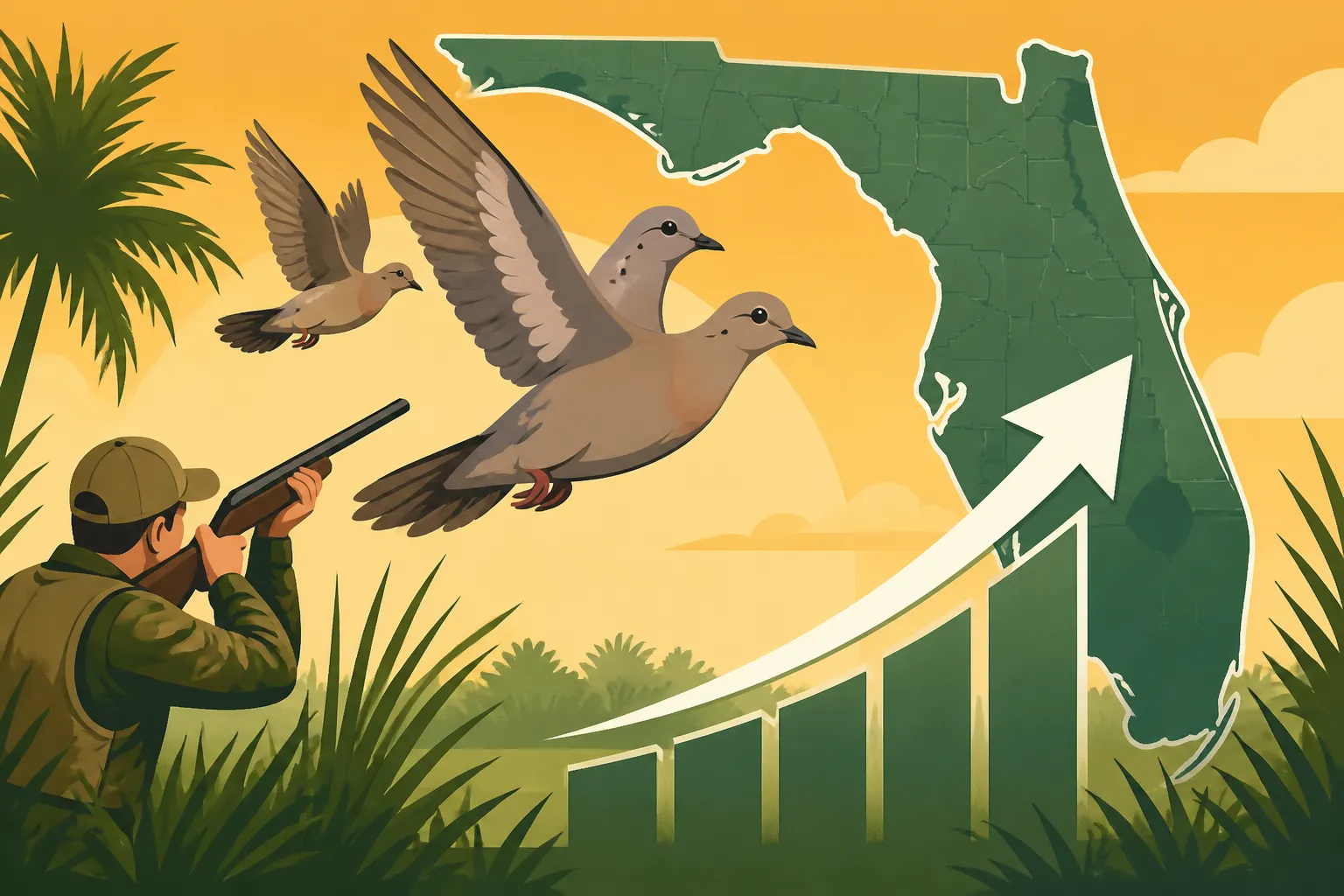
The white-winged dove's expansion into Florida represents an interesting population trend. Their numbers have been steadily increasing, offering new opportunities for hunters. This growth is likely linked to changes in habitat, climate, and perhaps even their ability to outcompete other species in certain niches. For hunters, this means keeping an eye out for these striking birds, especially in areas closer to development or where specific crops are grown. They add an exciting dimension to the traditional dove hunt, often flying in different patterns and offering unique shooting challenges.
Other Doves: Eurasian Collared and Common Ground
While mourning and white-winged doves are the main targets for hunters, other dove species contribute to Florida's overall avian tapestry. The Eurasian collared-dove, an invasive species, has exploded in population across the state since its arrival decades ago. These larger, pale doves are often seen in urban and suburban settings, but they also frequent agricultural areas. Because they are non-native and considered invasive, there are generally no bag limits or closed seasons on Eurasian collared-doves, though hunters should always confirm current regulations. Their presence can sometimes dilute the overall hunting experience if they dominate a field, but they do offer additional wingshooting opportunities.
Then there's the diminutive common ground-dove, a tiny, fast-flushing bird found throughout Florida. These are usually solitary or found in small pairs, much smaller than mourning doves, and are rarely hunted due to their size and preference for dense ground cover. While not a game species, their presence is a good indicator of healthy understory habitat. Understanding the diversity of doves in Florida helps us appreciate the specific targets we pursue and how each species contributes to the larger ecological picture.
Factors Influencing Dove Populations
Florida's wildlife populations are a dynamic blend of constant change, and doves are no exception. Their numbers are not just a static figure but ebb and flow with a complex interplay of environmental factors. For hunters, understanding these influences helps in predicting good seasons and appreciating the broader conservation efforts at play.
Habitat Availability and Quality
The single most critical factor for healthy dove populations is access to suitable habitat, which for these seed-eaters means plenty of food and reliable nesting and roosting cover. Doves thrive in areas that offer a mosaic of open feeding grounds – think agricultural fields, pastures, or natural clearings – interspersed with dense trees or thickets for roosting and nesting. A prime dove field isn't just a place with seeds; it's a place where birds feel safe to land, feed, and escape quickly if danger arises.
Changes in land use are a constant reality in Florida. Urban sprawl, shifts in agricultural practices (e.g., from corn and sunflowers to sod farms or citrus groves), or even intensive timber harvesting can significantly alter dove habitat. If vast tracts of land that once provided abundant waste grain or native weeds are converted, local dove numbers will inevitably decline or shift. Conversely, deliberate habitat management, such as planting food plots specifically for doves, rotational disking of fallow fields to encourage native seed-producing plants, or prescribed burns that open up the understory, can create dove magnets. This kind of careful management is often what makes certain public land areas or private leases exceptional for Pass-Shooting Doves on a September Field.
Weather Patterns and Their Impact
Florida's weather is notoriously unpredictable, and these patterns can have a profound effect on dove populations, often in ways that are hard to foresee. Drought conditions, for instance, can reduce the growth of wild seed-producing plants, leading to a scarcity of natural food sources. This can force doves to travel further for food, concentrate them in fewer areas, or even impact their reproductive success if food is scarce during nesting season.
Conversely, excessively wet conditions can also pose challenges. Prolonged heavy rains during nesting can lead to nest failure, especially for ground-nesting doves. They can also rot seeds in the fields, making food less available. Even localized severe weather events, like strong thunderstorms or hurricanes, can temporarily displace birds and destroy habitat, though doves are generally resilient and will repopulate quickly if the core resources return. Understanding the seasonal weather patterns, not just on a statewide level but even in your specific hunting zone, is a key part of figuring out where the birds might be concentrated or dispersed.
Predation and Disease Challenges
While healthy adult doves are generally quick enough to evade many predators, their nests and young are vulnerable. Common predators include snakes, raccoons, opossums, feral cats, and various raptors. High predator populations in a specific area can certainly impact nesting success and, over time, contribute to local population dips. However, this is usually a localized issue and rarely impacts statewide trends significantly due to the doves' high reproductive rate.
Diseases, on the other hand, can have a more widespread impact. Trichomoniasis, often referred to as "roup," is a common protozoal disease that can be fatal to doves and pigeons. It's often transmitted around communal water sources or feeding areas. Avian pox is another viral disease that can cause lesions, particularly around the eyes and mouth, impairing a bird's ability to feed and fly. While disease outbreaks can cause localized mortality events, continuous monitoring by wildlife agencies helps to track these issues. When a large die-off occurs, it's a stark reminder of the delicate balance of nature and the importance of responsible management.
Monitoring and Management Efforts
Ensuring healthy and sustainable dove populations for future generations of hunters and wildlife enthusiasts doesn't happen by accident. It's the result of dedicated efforts by state and federal wildlife agencies, working in concert to monitor numbers, manage habitats, and set thoughtful regulations.
Florida's Dove Survey Methods
Understanding dove population trends starts with accurate data, and wildlife biologists employ a variety of methods to gather this crucial information. The most prominent is the national Mourning Dove Call-Count Survey, conducted annually across the country, including in Florida. During this survey, trained observers drive predetermined routes early in the morning, stopping at regular intervals to count the number of doves heard cooing and seen flying. This standardized methodology allows biologists to track long-term population trends, evaluate the health of the breeding population, and identify areas of decline or growth.
Another vital tool is dove banding. Biologists capture doves using specialized traps, place a small, individually numbered metal band on their leg, and then release them. When a banded dove is harvested by a hunter, and the band number is reported (often through a federal bird banding lab), it provides invaluable data on survival rates, harvest rates, migratory patterns, and even how far individual birds travel. This kind of hands-on data collection is essential for understanding the actual dynamics of the population, far beyond what simple counts can tell us. If you ever harvest a banded bird, reporting it is a critical contribution to conservation.
The Role of Habitat Management
While surveys give us the "what," habitat management addresses the "how" – how do we support healthy dove populations? In Florida, this often involves active intervention to create and maintain optimal conditions, particularly on public lands like Wildlife Management Areas (WMAs) and State Forests. Land managers employ several techniques tailored to doves' needs. This can include planting specific food crops like sunflowers, millet, or corn, which are then either harvested or bush-hogged just before or during the season to make waste grain available.
Beyond cultivated fields, natural habitat management is also key. Prescribed burning, a common practice in Florida's pine flatwoods and scrub habitats, removes dense undergrowth, allowing native seed-producing plants to flourish. Disking fallow fields mimics natural disturbances, encouraging the growth of "weed" species that doves adore. Water sources, whether natural ponds or managed impoundments, are also crucial, especially during dry periods. Effective habitat management, often guided by data from GoHunt mapping platforms that help visualize land use and cover types, can concentrate birds, making certain public areas veritable hotspots for Hunting Florida's Four Deer Zones and other species that benefit from similar ecosystems, including doves.
Hunting Regulations and Conservation
Hunting regulations are more than just rules; they are carefully crafted conservation tools designed to ensure the sustainable harvest of game species while maintaining healthy populations. For doves, Florida's regulations typically focus on season dates, daily bag limits, and possession limits. These limits are not arbitrary; they are set based on population data derived from surveys and banding studies, ensuring that the annual harvest does not negatively impact the overall breeding population. For instance, if surveys indicate a decline in regional populations, bag limits might be adjusted downward, or season lengths shortened, to reduce pressure.
Florida often has specific dove season zones or split seasons, which further fine-tune hunting pressure. The Early Teal Season Opener, for example, is distinct from the regular duck season, much like how dove seasons are structured to allow for regional variations in migratory patterns and breeding cycles. Hunters are also required to possess a Florida hunting license and a Florida Migratory Bird Certification, which helps fund conservation efforts directly through license sales. By participating in regulated hunting and reporting harvests when required, hunters become direct contributors to the ongoing conservation and management of Florida's dove populations. It's a partnership between sportsmen and wildlife agencies that has proven incredibly effective over generations.
Regional Differences in Dove Numbers
Florida is a large, diverse state, and it’s no surprise that dove populations don’t look the same everywhere. From the pine forests of the Panhandle to the sprawling agricultural fields of Central Florida and the unique subtropical zones of the south, dove numbers and the hunting experiences they offer vary significantly.
Panhandle and North Florida Abundance
The Florida Panhandle and the northern regions of the state often boast some of the most consistent and robust dove populations. This area benefits from a climate and agricultural landscape more akin to the Southeast's prime dove country, with extensive acreage dedicated to row crops like peanuts, corn, and sunflowers. When these fields are harvested, they leave behind a bounty of waste grain that attracts doves in droves. Additionally, the prevalence of native seed-producing plants in the region's pine timberlands and old fields provides excellent natural forage.
Hunting in these northern counties, like Jackson, Walton, or Madison, often means access to large private land leases or managed public dove fields on WMAs where active habitat work ensures plenty of birds. Hunters here frequently experience good flights of both mourning doves and, increasingly, white-winged doves, especially during the early season. These areas often experience more pronounced migratory pushes later in the season as cooler weather to the north sends birds southward. If you're looking for high-volume shooting and traditional dove field experiences, the Panhandle is often where it's at, offering ample opportunities for Hunting an Eastern Gobbler in Panhandle Pines and fantastic dove hunting.
Central Florida's Agricultural Lands
Central Florida offers a different, yet equally compelling, dove hunting scenario. While not as extensive as the Panhandle's row crops, this region is home to vast stretches of sod farms, cattle pastures, and citrus groves, alongside pockets of corn, peanuts, and other agricultural crops. Doves here often adapt to feeding on grass seeds in pastures or overlooked waste grain in smaller fields. The sheer acreage of open land, combined with ample roosting cover in tree lines and cypress heads, provides a good foundation for local dove populations.
Counties like Polk, Osceola, and Highlands can offer excellent dove hunting, particularly on private leases or specific WMAs known for their dove management programs. Hunters often find success scouting for recently mowed hayfields or fields where silage has been cut. The key here is often pinpointing those specific, temporarily abundant food sources. While there might not be the same broad migratory influx as in the Panhandle, central Florida maintains a healthy resident population, supplemented by some localized migratory movements, making it a reliable destination for Hunting a Green Field Planted for Deer and consistent dove flights.
South Florida's Unique Challenges
South Florida presents the most unique set of challenges and opportunities for dove hunting. With its more tropical climate, extensive wetlands (like the Everglades and Big Cypress), and intense urban development along the coasts, traditional dove habitat is scarcer. However, doves are incredibly adaptable. Pockets of agricultural land, particularly around Lake Okeechobee with its sugarcane, vegetable farms, and cattle ranches, can hold surprisingly large numbers of birds.
In this region, mourning doves are still prevalent, and white-winged doves have a very strong foothold, often utilizing urban fringes and suburban feeders before flying out to agricultural areas to feed. Hunting opportunities might be more limited to specific managed fields or private land permissions. Hunters often have to work harder to find concentrated birds, focusing on smaller, intensely scouted areas. The reward, however, can be unique flights of white-wings in addition to mourning doves. It's a testament to the doves' resilience that they thrive even in these highly developed or wetland-dominated landscapes.
Here's a quick overview of Florida's primary huntable dove species:
| Species | Primary Habitat Preference | Typical Size | Distinguishing Marks | General Population Trend in FL | Hunting Availability |
|---|---|---|---|---|---|
| Mourning Dove | Open fields, agricultural areas, suburban lawns, woodlands | Medium | Long, pointed tail; black spots on wings; "mournful" coo | Stable to slightly fluctuating | Widespread |
| White-winged Dove | Urban areas, citrus groves, agricultural fields, scrub | Medium-Large | Prominent white wing patches in flight; bluer eye ring | Increasing & Expanding | Central/South FL & Panhandle |
| Eurasian Collared-Dove | Urban/suburban areas, agricultural fields, feedlots | Large | Black half-collar on neck; pale gray plumage | Rapidly Expanding | Widespread (Unregulated) |
What Hunters Can Expect (and Do)
As hunters, we're not just consumers of wildlife; we're also active participants in its conservation. Understanding dove population trends helps us make informed decisions, improve our success in the field, and contribute to the health of the resource we cherish.
Scouting for Productive Fields
The most critical step in a successful dove season, no matter the broader population trends, is thorough scouting. Doves are creatures of habit when it comes to feeding, roosting, and watering, but those habits can shift dramatically based on local conditions. A field that was a magnet one week might be barren the next if a food source runs out or new disturbance occurs. You need to identify fields that have been recently harvested, mowed, or otherwise disturbed, exposing seeds. Look for signs of bird activity: whitewash on fences or power lines, doves flying in and out, and birds on wires overhead.
Don't just drive by; park and watch the field for a while, perhaps in the early morning or late afternoon, to observe flight patterns. Are birds landing to feed? Are they flying over, heading to another area? Pay attention to water sources nearby, as doves need to drink regularly. Utilizing modern mapping tools, like those found on the GoHunt platform, can be incredibly beneficial. These tools allow you to study satellite imagery, identify potential food plots or agricultural fields, and even see property lines to ensure you're scouting legal areas. This kind of advanced preparation helps narrow down your search and maximizes your chances, especially in regions like the Florida Panhandle Pine Plantations where habitat can be vast and varied.
Contributing to Conservation Efforts
Every hunter has a role to play in conservation, and it goes beyond simply buying a license. One of the most direct ways you can help with dove population monitoring is by reporting banded birds. If you harvest a dove with a leg band, follow the instructions on the band (usually a website or phone number) to report the band number, where and when you harvested the bird, and your contact information. This data is invaluable to biologists trying to understand migration, survival, and harvest rates, ensuring future generations can enjoy the same opportunities.
Beyond reporting bands, consider volunteering for habitat improvement projects on local WMAs or private lands. These efforts might involve planting dove-friendly food plots, conducting prescribed burns, or clearing invasive vegetation. Supporting organizations that advocate for wildlife habitat and responsible land use also contributes significantly. Remember, healthy dove populations are a direct result of healthy ecosystems, and every action, no small, helps maintain that balance.
Looking Ahead: Future Trends
Predicting future dove population trends is complex, as it involves a blend of environmental science, land-use planning, and societal changes. However, several factors suggest that doves will likely remain a strong and adaptable game species in Florida. Their high reproductive rate and ability to utilize a wide variety of habitats, including disturbed and even urban fringe areas, make them resilient to many pressures. The continued expansion of white-winged doves into new areas of the state suggests a dynamic and evolving population.
Challenges, however, will persist. Ongoing urban development will continue to fragment habitat, particularly in prime agricultural areas. Changes in agricultural practices, driven by economics and market demands, could alter food availability. Climate change may also introduce more extreme weather events, which could impact nesting success or food resources. The good news is that wildlife agencies and dedicated conservationists are continuously working to mitigate these challenges through proactive habitat management, scientific monitoring, and responsive hunting regulations. By staying informed, actively participating in conservation, and practicing ethical hunting, we can ensure that the tradition of chasing doves on a Florida autumn afternoon remains vibrant for years to come.
Disclaimer
This article is for general informational purposes only and does not constitute professional advice. Laws, prices and regulations vary by location and change over time. Consult a qualified professional for guidance on your specific situation.