Florida Coyote Attacks on Livestock
Living in Florida, we often picture sun, beaches, and maybe even a few alligators, but for many folks who raise livestock, another wild animal presents a serious and often heartbreaking challenge: the coyote. These adaptable canids, once rarely seen in much of the state, have expanded their range, leading to increasing conflicts with farmers and homesteaders. This guide aims to shed light on why coyote attacks on livestock are on the rise in Florida and, more importantly, what practical steps you can take to protect your valuable animals.
Understanding the Rise of Coyotes in Florida's Ecosystem
It's easy to feel frustrated when you lose an animal to a coyote, and sometimes it feels like they just appeared out of nowhere. The truth is, coyotes have been steadily moving into Florida for decades, and their presence has really become undeniable in recent years.
How Coyotes Became Established in the Sunshine State
Coyotes are incredibly resourceful animals, known for their ability to thrive in a wide variety of habitats, from deserts to dense forests, and even urban fringes. Their expansion into Florida wasn't a sudden invasion but rather a gradual migration from the western and northern states, taking advantage of contiguous landscapes and a lack of significant natural predators that once kept their populations in check in other regions. They are truly opportunistic creatures, and Florida, with its diverse ecosystems and abundant prey, offered them a welcoming new home.
As they moved across the country, following deer populations and taking advantage of human-altered landscapes, they simply found Florida to be ripe for colonization. It's a testament to their resilience and adaptability that they've made themselves so comfortable here, and now they're a permanent fixture in our wildlife landscape. Understanding this natural progression helps us understand why they're here to stay, and why managing their interactions with livestock is so crucial.
The Impact of Growing Coyote Populations on Wildlife
While our focus here is on livestock, it's worth remembering that coyotes primarily prey on wild animals. Their diet is incredibly varied, consisting mostly of small mammals like rabbits, rats, and mice, but they're also known to take fawns, wild turkeys, and even adult deer, especially during times of vulnerability. Coyotes and Predators in Florida are a significant component of the ecosystem, filling a niche that was left open after the extirpation of the red wolf.
However, as their populations grow and spread, the pressure on native wildlife can increase. This sometimes leads to a ripple effect where, if natural prey becomes scarce, or if an easy opportunity arises, coyotes will turn their attention to more readily available food sources, including domestic animals. This shift in behavior is often what brings them into direct conflict with Florida's livestock owners, highlighting the need for proactive management strategies. Florida Predator Impact on Fawn Recruitment is one area where coyote presence has been studied closely.
Common Scenarios of Coyote Attacks on Florida Livestock
The sting of a coyote attack on your livestock isn't just financial; it's often deeply emotional. You put time, effort, and care into raising these animals, and to lose them to predation can be truly devastating. Knowing what to look for, and which animals are most at risk, can help you prepare and prevent future incidents.
Vulnerable Livestock Species and Their Risks
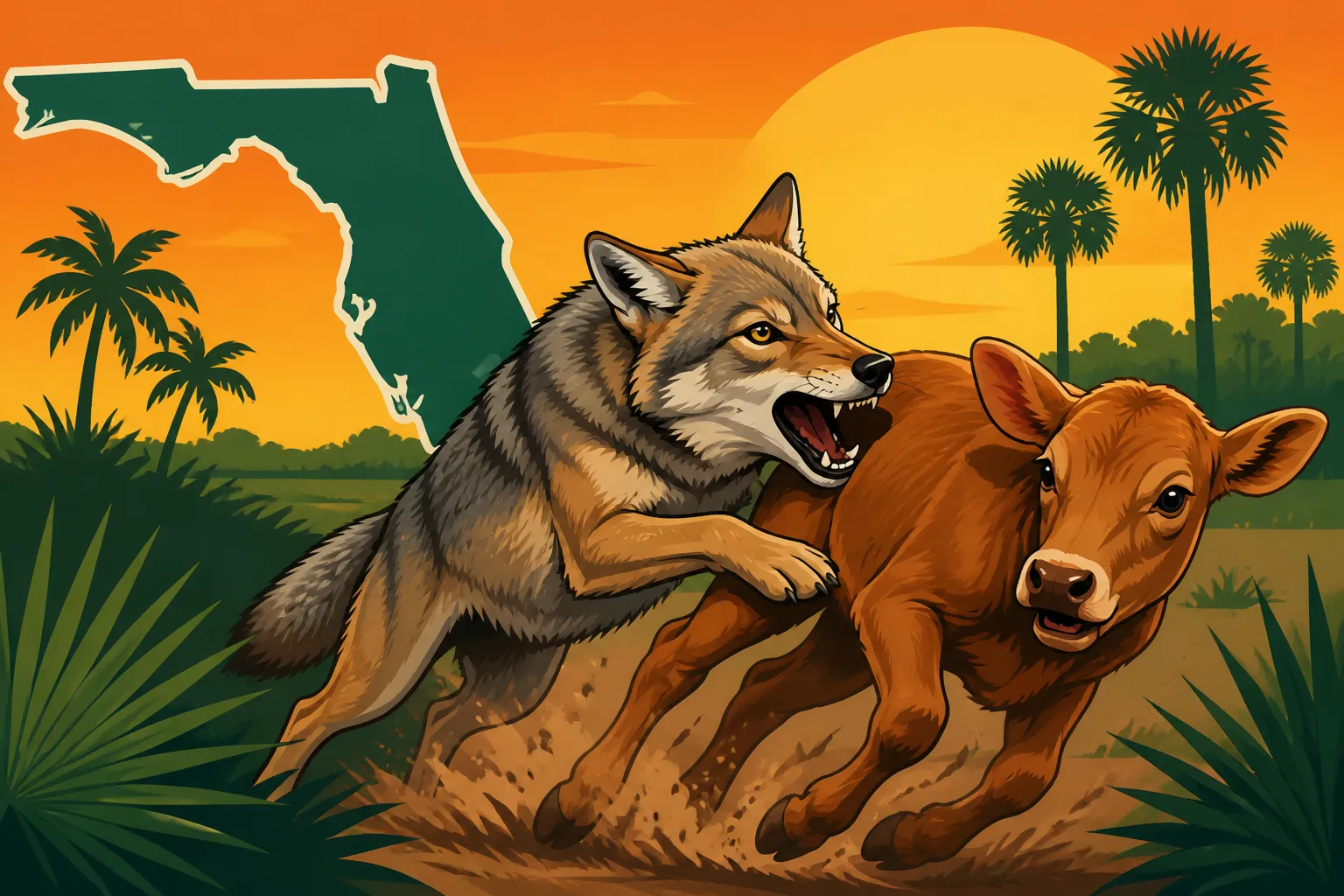
Coyotes are opportunistic hunters, meaning they'll go for the easiest meal they can find. Unfortunately, this often puts smaller, less-defended livestock squarely in their crosshairs. Young calves are particularly vulnerable, especially if they're left in pastures away from the protection of the herd or at night. Goats and sheep, with their relatively small size and often docile nature, are also prime targets, and it's not uncommon for coyotes to pick off lambs and kids.
Poultry, including chickens, ducks, and turkeys, are almost universally at risk. Their inability to defend themselves against a swift, intelligent predator like a coyote, coupled with often inadequate nighttime enclosures, makes them easy prey. Even smaller domestic pets, especially if left unattended, can fall victim. The key is to recognize that any animal smaller and less capable of self-defense than a full-grown cattle beast is potentially at risk, particularly during periods of low light when coyotes are most active.
Identifying Signs of Coyote Predation
When you find a lost or injured animal, it can be tough to determine the cause. Was it a coyote, a domestic dog, or something else entirely? Learning to read the signs can provide crucial clues. Coyote attacks often show specific patterns: typically, they'll target the throat, attempting to sever the windpipe or jugular. You might see puncture wounds in the neck area. For smaller animals like poultry, there might be signs of struggle, disarray, and feathers scattered, with the carcass often carried away or partially consumed.
Look for tracks around the carcass; coyote tracks are typically more oval than a domestic dog's, with claw marks often visible and the two middle toes slightly ahead of the outer ones. Scat might contain hair and bone fragments. Unlike some other predators that might only kill for sport or consume a small portion, coyotes will often consume a significant amount of the carcass, sometimes even carrying it off entirely. A thorough inspection of the scene, considering bite marks, tracks, and feeding patterns, is essential in confirming coyote involvement.
Proactive Measures to Protect Your Livestock from Coyotes
Dealing with coyote predation after it happens is a tough pill to swallow. The best offense is a good defense, and that means implementing proactive strategies to make your property less appealing and your livestock less vulnerable.
Effective Fencing and Enclosure Strategies
When it comes to keeping coyotes out, your first line of defense is often fencing, but not just any fence will do. Coyotes are smart, agile, and persistent. A simple four-strand barbed wire fence might keep cattle in, but it won't deter a determined coyote. For smaller livestock like sheep, goats, or poultry, a woven wire fence, often called "field fence" or "no-climb," is a much better option. This type of fence should be at least five to six feet high, as coyotes can jump.
Even better, consider burying the bottom six to twelve inches of the fence into the ground or bending it outwards in an "L" shape and securing it with heavy objects or more wire. This prevents them from digging underneath, a common tactic. Electric fencing, either as a standalone perimeter or as a hot strand added to an existing fence, can be incredibly effective. A few well-placed hot wires at nose height and halfway up the fence can deliver a memorable deterrent shock. For poultry, creating secure night pens with solid roofs and hardware cloth or sturdy welded wire on all sides, including the floor, is paramount. Remember, a chain-link fence can sometimes be climbed, and chicken wire is often too flimsy for serious predator pressure.
Utilizing Livestock Guardian Animals (LGAs)
Another highly effective, and often heartwarming, strategy is to employ livestock guardian animals, or LGAs. These specially bred and trained dogs (and sometimes other animals like llamas or donkeys) live with your herd or flock and are instinctively protective. Breeds like Great Pyrenees, Anatolian Shepherds, and Akbash dogs have been used for centuries to protect livestock from predators. They bond with the animals they're guarding, seeing them as their family, and will actively confront and deter coyotes.
Introducing an LGA puppy to your livestock at a young age allows for proper bonding. These dogs are not pets in the traditional sense; their job is to stay with the livestock. While a good LGA is an investment, the long-term protection they offer can be invaluable, drastically reducing predation losses. You can find a lot of great information on sourcing and training LGAs through various agricultural extension offices and online communities. When planning your predator control strategy, resources like GoHunt can offer insights into wildlife behavior and land management that can indirectly support your LGA's effectiveness.
Strategic Pasture Management and Deterrents
Beyond physical barriers and guardian animals, smart pasture management can go a long way in deterring coyotes. One of the simplest and most effective strategies is to bring smaller, more vulnerable livestock, like lambs, kids, or poultry, into secure barns or pens at night. Coyotes are primarily nocturnal, and removing the easy nighttime target significantly reduces their success rate.
Removing attractants from your property is also crucial. Carcasses of deceased livestock should be promptly removed or properly disposed of, as they act as a strong magnet for scavengers, including coyotes. Don't leave pet food outside overnight, and secure your garbage. Lights, especially motion-activated ones, can also be a deterrent around barns and enclosures. Some farmers even use radio stations or other noise-makers left on low overnight to create a human presence, making coyotes wary. Think about where your animals are grazing; avoiding dense brush lines or deep woods where coyotes can easily hide and ambush can also help. Entry Routes Through a Florida Food Plot or other natural landscape features can also be relevant to understanding predator movement.
Lethal and Non-Lethal Coyote Control Methods in Florida
While preventative measures are paramount, sometimes you need to actively manage coyote populations that have become problematic. Florida offers various legal avenues for both non-lethal deterrence and, when necessary, lethal control.
Non-Lethal Deterrents and Hazing Techniques
Sometimes, all it takes is making your property consistently uncomfortable for coyotes without resorting to lethal force. Hazing is a technique where you make loud noises, throw objects (not at the animal, but in its direction), or spray water when you see a coyote. The goal is to make them associate humans with an unpleasant experience, reinforcing their natural wariness. This can be effective in teaching individual coyotes to avoid your area.
Auditory deterrents, like specialized sirens or propane cannons, can be used temporarily, but coyotes are intelligent and can habituate to constant noise. Visual deterrents, such as flagging or reflective streamers tied to fences, can also offer short-term success. The key with any non-lethal method is consistency and variety. If a coyote always hears the same siren or sees the same streamer, it will eventually learn to ignore it. Changing things up, combining different deterrents, and maintaining that "unpleasant" experience will yield better long-term results.
Legal Hunting and Trapping as a Management Tool
In Florida, coyotes are classified as an unprotected species, which means you can hunt them year-round, day or night, and there's no bag limit. This offers landowners and hunters a significant tool for managing problem animals. If coyotes are actively predating on your livestock, legal hunting can be an effective way to remove the individuals causing damage. Night Hunting Rules for Florida Coyotes exist, and understanding them is crucial if you plan to hunt after dark.
Trapping is another highly effective method for removing specific problem coyotes, especially when done by experienced individuals. Florida has regulations regarding trapping, including Florida Trapping License Requirements and specific types of traps that are allowed. It's often best to consult with a professional trapper or your local FWC office to ensure you're operating within the law and using the most humane and effective methods. Using resources like GoHunt can provide useful insights into localized game movement, including predator activity, which can be invaluable when planning your trapping or hunting efforts. Understanding the movements of animals and using this intelligence can help you predict where and when to focus your efforts. Coyote Calling Florida Ranch Land is a common tactic, and sometimes success there means less pressure on your flock.
| Method | Pros | Cons | Best Use Case |
|---|---|---|---|
| Woven Wire Fencing | Physical barrier, long-lasting | Costly to install, may require digging to deter burrowing | Perimeter for small livestock, poultry runs |
| Electric Fencing | Effective deterrent shock, psychological barrier | Requires maintenance, power source, animals need to learn | Adding to existing fences, temporary enclosures |
| Livestock Guardian Animals | Active, continuous protection, bonded with livestock | Requires training/bonding time, ongoing care, not pets | Consistent protection for herds/flocks |
| Secure Night Pens | Safest for small, vulnerable animals, simple to implement | Requires nightly effort, limited to smaller animals | Poultry, young calves, goats, or sheep overnight |
| Hazing & Noise Deterrents | Non-lethal, humane, can shift coyote behavior | Coyotes can habituate, requires consistency, limited range | For occasional sightings, near homes/barns |
| Hunting/Trapping | Removes problem individuals, immediate impact | Requires skill/knowledge, permits, public perception | Targeted removal of persistent predators |
Working with a local trapper who understands Florida Fox and Bobcat Trapping Season as well as coyotes can be a significant benefit. Ultimately, a multi-faceted approach, combining several of these strategies, usually offers the best long-term success in reducing coyote attacks on your Florida livestock.
Disclaimer
This article is for general informational purposes only and does not constitute professional advice. Laws, prices and regulations vary by location and change over time. Consult a qualified professional for guidance on your specific situation.