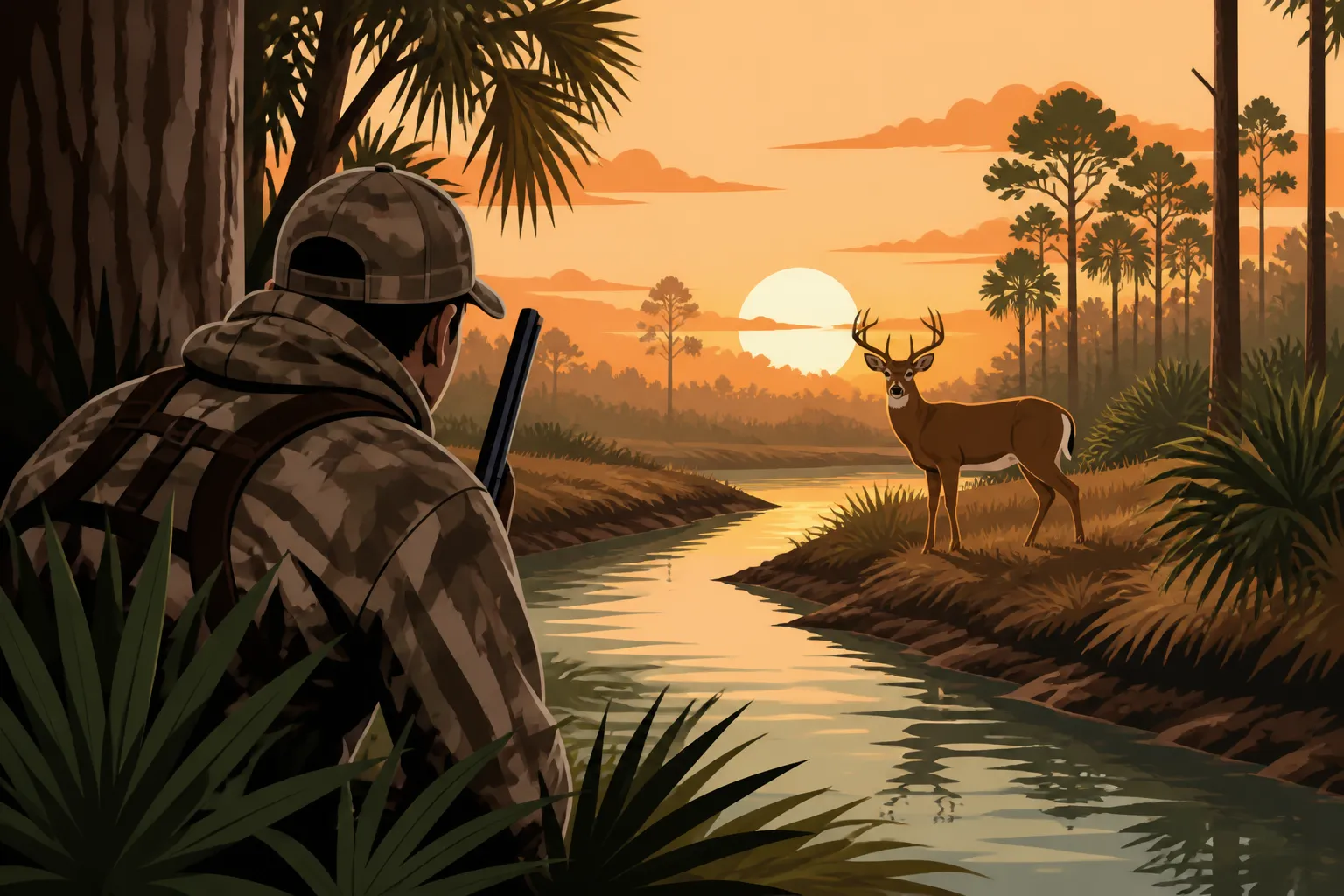
Working a Creek Bottom for Late-Season Deer
As Florida's late deer season drags on, many hunters start to feel that familiar frustration. The woods often seem devoid of movement, the deer have gone nocturnal, and those early-season hotspots are now just quiet memories. It feels like every deer has either vanished or developed x-ray vision and an Olympic sprint speed. But don't despair! When the easy pickings are gone and the crowds thin, the forgotten havens like creek bottoms can become your most valuable late-season deer grounds, offering consistent water, vital cover, and often overlooked food sources that concentrate weary whitetails. This guide will walk you through how to unlock the potential of these crucial, often overlooked, natural travel lanes and sanctuaries.
Why Creek Bottoms Become Late-Season Deer Magnets
When the palmetto flatwoods dry out and the acorns are long gone, Florida's creek bottoms transition from just another habitat feature to absolute lifelines for deer. They offer a unique combination of resources that become incredibly valuable as the season progresses and conditions get tougher. Deer, much like us, are looking for comfort and sustenance, and these areas deliver both.
Consistent Water and Thermal Cover
One of the biggest draws of a creek bottom, especially in the often-dry late season, is the reliable water source. While a small puddle in a low spot might dry up after a few rainless weeks, a flowing creek or even a series of deep pools along its course provides consistent hydration. This is particularly critical during those periods when Florida experiences a stretch of unseasonably warm days, making deer need water more frequently. Imagine a deer, parched from a long day bedded down, not having to travel far to get a drink. That creek offers exactly that convenience.
Beyond water, creek bottoms inherently provide exceptional thermal cover. The banks themselves, often steeper than the surrounding flat terrain, offer a natural shield from biting winds that can sweep across open country after a cold front. More importantly, the vegetation along these corridors is usually much denser. You'll find a thick canopy of oaks, maples, and cypress trees, often intertwined with a jungle of greenbrier, muscadine vines, and dense undergrowth like wax myrtle and young palmettos. This creates a shaded, sheltered environment that holds warmth better on cool nights and offers respite from the sun on warm afternoons. Deer can bed down in these thickets, feeling secure and protected from the elements, making these areas ideal spots for bucks to ride out the day. It's a natural fortress, which is why when you're Hunting Deer After a Cold Front, these locations can be exceptionally productive.
Persistent Food Sources and Travel Corridors
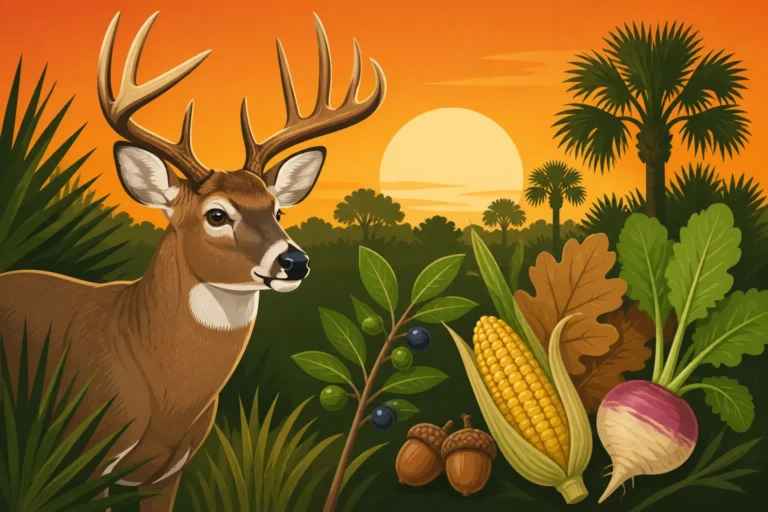
While many of the early-season food sources like widespread acorns or planted food plots might be depleted or unappealing by late season, creek bottoms often harbor a surprising bounty. Hardwood hammocks lining these waterways can hold oak varieties that drop acorns later in the fall, or even water oaks that continue to offer mast well into winter. Beyond acorns, the thick tangle of vines and bushes provides a constant supply of browse. Greenbrier, a common sight in Florida's creek beds, stays green through the colder months, offering nutritious forage. Muscadine grapes, while past their fruiting peak, still have palatable leaves. The diverse plant life in these damp, rich soils often means there's always something green and edible, even when other areas are barren. This makes understanding Late-Season Food Sources for Florida Whitetails absolutely paramount for success.
Deer are creatures of habit and efficiency. They gravitate towards paths of least resistance that also offer security. Creek bottoms naturally serve as discreet travel corridors. The dense vegetation along the banks provides excellent concealment from predators and hunters alike, allowing deer to move with a sense of safety. They can skirt open areas, using the creek as a hidden highway from bedding to feeding areas, or simply from one bedding area to another. These low-lying areas, especially where the creek might meander or create small islands of high ground, can act as natural funnels, concentrating deer movement into predictable patterns. This makes them prime locations for intercepting a mature buck making a cautious late-season move.
Mastering the Art of Creek Bottom Scouting
You can't effectively hunt a creek bottom without understanding it first. This isn't just about looking for tracks; it's about interpreting the landscape, predicting deer movement, and recognizing the subtle cues that only the most dedicated scouts pick up on. Successful late-season hunting starts long before you ever carry a weapon into the woods.
Reading the Terrain and Water Levels
Before you even step foot in the woods, pull up your aerial maps. Satellite imagery from tools like GoHunt can reveal the twists, turns, and varying widths of a creek bottom. Look for areas where the creek narrows, forming natural pinch points that force deer into a smaller area. Identify crossings – these could be fallen logs, shallow stretches, or even slightly elevated banks that deer prefer to use. Pay close attention to how the topography changes along the creek. Are there slightly higher ridges adjacent to the water, or small islands within the flood plain? These are often preferred bedding locations. You can also get a good feel for the type of vegetation, identifying potential thickets that offer exceptional cover.
Once on the ground, assessing water levels is crucial in Florida. A creek that's a trickle in October might be a raging torrent or a flooded swamp in December after a heavy rain. You'll need to know which parts are consistently traversable for deer and for yourself. Look for mud lines on trees, indicating historical high-water marks. Fresh tracks in soft mud near the water's edge are gold, showing recent activity. If the creek is too wide or deep for deer to cross easily, they'll stick to established crossing points, making these areas hotspots. Pay attention to how the creek system connects to larger water bodies like ponds or sloughs, as these connections can extend the natural travel corridors. When you're Scouting Florida Public Land Before Season, these are the details that build a complete picture of deer movement.
Interpreting Late-Season Deer Sign
Deer sign in the late season can be more subtle than the obvious rut-induced rubs and scrapes of October. You'll need a keen eye and a good understanding of what to look for. Fresh tracks are your most important clue. In the soft, damp soil of a creek bottom, tracks are often clear and easy to read. Look for large, deep tracks indicating a mature buck, especially if they're moving purposefully along the bank. You might even find where a buck has pawed at the mud near a crossing, or left a faint rub on a small sapling at the edge of the thicker cover.
While large, aggressive rub lines might be a thing of the past, you'll often find smaller, less conspicuous rubs on saplings and bushes along travel routes within the creek bottom. These indicate bucks still marking territory or simply conditioning their antlers. Scrapes, too, will be less common and less pronounced, but don't discount them. A subtle scrape under an overhanging branch near a bedding area or a funnel can indicate a buck checking for does, even if the primary rut is over. Keep an eye out for fresh droppings and browse lines on low-hanging branches and vines, which confirm active feeding. The key is to look for fresh activity, differentiating between old sign from earlier in the season and recent visits. Knowing how to interpret these clues is essential for understanding Where Florida Bucks Bed in Thick Palmetto and other dense cover adjacent to the creek.
Understanding Wind and Thermals in Creek Environments
Florida's flat terrain can make predicting wind tricky, and creek bottoms add another layer of complexity with their own micro-thermals. Understanding Wind and Thermals in Flat Florida Terrain is critical here. Air tends to funnel down creek beds, especially in the early morning as cool air sinks, and then rise up the banks as the sun heats the surrounding ground. This can lead to swirling, unpredictable winds that can betray your position if you're not careful.
Always check the wind thoroughly before you enter a creek bottom. Use a wind checker constantly as you move. A slight breeze at ground level might be swirling completely differently just ten feet up. Your best bet is often to hunt crosswind to the creek, positioning yourself where your scent blows across the main travel corridor rather than directly down it. On those still, cold mornings, expect thermals to carry your scent downhill along the creek. As the day warms, those thermals will reverse, carrying scent upwards. This means morning hunts might favor setting up on the leeward side or slightly above the creek, while evening hunts might call for a setup on the windward side as deer move down to feed and water. Using an app like GoHunt can help visualize terrain and predict wind direction more accurately, especially when combined with real-time weather data.
Effective Hunting Strategies for Creek Bottoms
Hunting creek bottoms requires a different mindset and approach than open woods or food plots. It's often intimate, challenging hunting, but incredibly rewarding when you connect with a late-season buck that thought he was safe.
Stand Placement for Success
Setting up a tree stand in the dense canopy of a creek bottom can be a challenge. Mature trees might be too sparse, or the cover so thick that visibility is severely limited. However, if you can find a suitable tree, ideally one that allows you to see down a stretch of the creek and provides a clear shot at a crossing or a funnel point, it can be deadly. Look for trees that are on the edge of the creek bottom, slightly elevated, giving you a vantage point over the thick stuff without being directly in it. The goal is to maximize your view into the deer's travel lane while minimizing your profile.
More often, a ground blind or carefully chosen ambush spot will be your best bet. Deer in late season are incredibly wary, and the natural cover of a creek bottom lends itself well to hunting from the ground. Find a spot where a natural blowdown, a cluster of palmettos, or a dense thicket can break up your outline. Then, take the time to Brushing In a Blind on a Field Edge – or in this case, a creek edge – by using natural materials like palmetto fronds, branches, and vines to truly disappear into the landscape. You want to be invisible, not just camouflaged. Position yourself downwind of likely travel paths, keeping in mind the tricky thermals. If the creek bottom is wide, consider setting up on a subtle rise within it, allowing you to see further into the low ground without being silhouetted.
Still-Hunting and Stalking the Edges
Still-hunting is perhaps the most effective method for creek bottoms, demanding patience, stealth, and acute awareness. This isn't a sit-and-wait game; it's a slow, deliberate chess match with the deer. Move at a snail's pace, taking only a few steps, then pausing for several minutes to observe and listen. Use binoculars to pick apart every shadow, every clump of palmetto, searching for the flick of an ear, the horizontal line of a deer's back, or the subtle movement of a tail. You're trying to spot the deer before it spots you, which is no small feat in such dense cover. This skill is critical for any hunter, whether you're trying Still-Hunting Florida Palmetto Flatwoods or a thick creek bottom.
Stalking is an extension of still-hunting, used when you've spotted a deer and need to close the distance for a shot. The key here is to use the terrain to your advantage. Crawl, crouch, or use the dense vegetation as cover, always keeping the wind in your favor. The soft, damp ground of a creek bottom can sometimes make for quieter footfalls, but watch out for crunchy leaves or snapping twigs. Move when the deer's head is down or obscured, freezing completely when it looks up. It’s challenging, nerve-wracking work, but the payoff of outsmarting a late-season buck on his home turf is immense.
Calling and Decoying Considerations
While rattling and grunting are often associated with the rut, a more subtle approach can still be effective in late-season creek bottoms. Bucks, though not actively breeding, are still social animals and might respond to the sound of another deer. A soft grunt or an occasional doe bleat might pique a buck's curiosity, especially if he's cruising for any lingering does. Don't overdo it; less is definitely more in pressured, late-season conditions. A few soft calls, followed by long periods of silence and observation, are usually best. Think about how Grunt Calls in a Florida Oak Hammock might translate to the creek bottom—subtle, natural, and not too aggressive.
Decoys are generally less practical in the dense, often limited visibility of a creek bottom. The thick vegetation makes it hard for a deer to see a decoy from a distance, and hauling one through swampy terrain is a chore. However, if you've found an exceptionally open area within the creek bottom, perhaps a small natural clearing or a dry, sandy rise, a single doe decoy might be sparingly effective, especially if paired with subtle calls. Ensure the decoy is positioned downwind of where you expect the deer to approach, and that you have a clear shooting lane. For the most part, in these thick environments, your stealth and observational skills will outweigh the benefits of a decoy.
Essential Gear and Safety in Creek Environments
Hunting creek bottoms, especially in Florida, comes with its own set of gear requirements and safety considerations. The environment can be unforgiving, so being prepared is not just smart, it's essential for a safe and successful hunt.
Footwear and Clothing for the Swamp
Forget your casual hunting boots. When working a creek bottom, especially in Florida, waterproof footwear is non-negotiable. Whether it's knee-high rubber boots or a good pair of chest waders if you anticipate deeper crossings, keeping your feet dry is paramount for comfort and preventing issues like trench foot. Look for boots with good traction, as creek banks can be muddy and slippery. Muck Boots and Lacrosse are popular brands that offer reliable options for wet conditions.
Layering is also key for clothing. Florida's late season can swing from surprisingly cold mornings to warm afternoons. Start with a moisture-wicking base layer, add an insulating mid-layer, and top it with a quiet, waterproof outer shell. This allows you to shed or add layers as the temperature changes, keeping you comfortable and quiet. Blaze orange requirements vary by WMA and private land rules, so always check the specific regulations for your hunting area, but wearing sufficient How Much Blaze Orange Florida Requires is always a smart safety choice.
Navigation and Communication
It's incredibly easy to get turned around in the dense, labyrinthine environments of a creek bottom. A GPS unit or a reliable mapping app on your phone (like GoHunt) is an absolute must. Download offline maps before you head out, as cell service is often nonexistent in remote creek systems. Mark your entry point, your stand locations, and any significant deer sign. Knowing Reading Aerial Photos for Florida Deer is a great start, but having that information on a GPS unit while in the field is a game-changer.
Always carry a fully charged phone, but don't rely on it as your sole navigation tool. A compass and a physical map (especially if hunting on public land like a WMA) can be life-savers if your electronics fail. Tell someone exactly where you're going and when you expect to be back. Consider carrying a small personal locator beacon (PLB) if you're venturing deep into truly remote areas. This isn't overkill; it's smart planning for when you're navigating complex terrain or when Recovering a Deer From a Cypress Slough takes longer than expected, potentially leading to you being out after dark.
Dealing with Florida's Wildlife
When you're sneaking through a Florida creek bottom, you're entering the domain of some of the state's most iconic, and sometimes dangerous, wildlife. Snakes, particularly water moccasins and rattlesnakes, are common in these damp environments. Always watch where you step, and consider snake boots or snake gaiters for added protection. Alligators are also prevalent in and around Florida's creeks and rivers. While generally shy, they can be aggressive if surprised or if you get too close to a nest. Be aware of your surroundings, especially if you're near larger, permanent water sources.
Beyond reptiles, the insect population in Florida's creek bottoms can be relentless. Mosquitoes and biting flies can make an otherwise perfect hunt unbearable. Carry effective insect repellent, and consider wearing bug-proof clothing. Don't forget a basic first-aid kit with bandages, antiseptic wipes, and pain relievers for minor cuts, scrapes, or insect bites. Being prepared for these "residents" of the creek bottom is just as important as being prepared for the deer.
Late-Season Creek Bottom Food Sources
To truly maximize your success in Florida's creek bottoms during the late season, it helps to know what specific food sources might still be available. While every creek is different, these are some common items to keep an eye out for.
| Food Source | Type | Availability (Late Season) | Deer Preference | Location in Creek Bottom |
|---|---|---|---|---|
| Live Oak Acorns | Hard Mast | Often into Dec/Jan | High | Upland edges, slightly elevated banks |
| Water Oak Acorns | Hard Mast | Often into Dec/Jan | High | Damp soils, near water's edge |
| Greenbrier | Browse | Year-round | Medium-High | Thickets, undergrowth, tangled vines |
| Muscadine Vines | Browse/Fruit | Leaves year-round | Medium | Climbing trees, dense canopies |
| Wax Myrtle | Browse/Berries | Berries sometimes last | Medium | Dense thickets, edges of water |
| Blackberry/Dewberry | Browse | Green leaves year-round | Medium | Openings, disturbed areas, creek banks |
| Cypress Cones | Soft Mast | Can persist | Low-Medium | Near cypress trees, edges of sloughs |
| Switchgrass | Forb/Grass | Green blades can persist | Medium | Open sunny areas, drier banks |
This table highlights that while acorns are often the star, persistent browse like greenbrier and muscadine leaves are crucial in sustaining deer when other food sources dry up. Bucks will continue to seek out these reliable food options, especially in the security of a creek bottom.
Disclaimer
Hunting involves inherent risks, including injury or death. Always prioritize safety, follow all local and state regulations, and ensure you have proper training and licensing. The information provided here is for educational purposes only and should not replace professional guidance or official safety instructions. Always check the latest Florida Fish and Wildlife Conservation Commission (FWC) regulations before any hunting activity.