How Far to Walk From a Forest Road
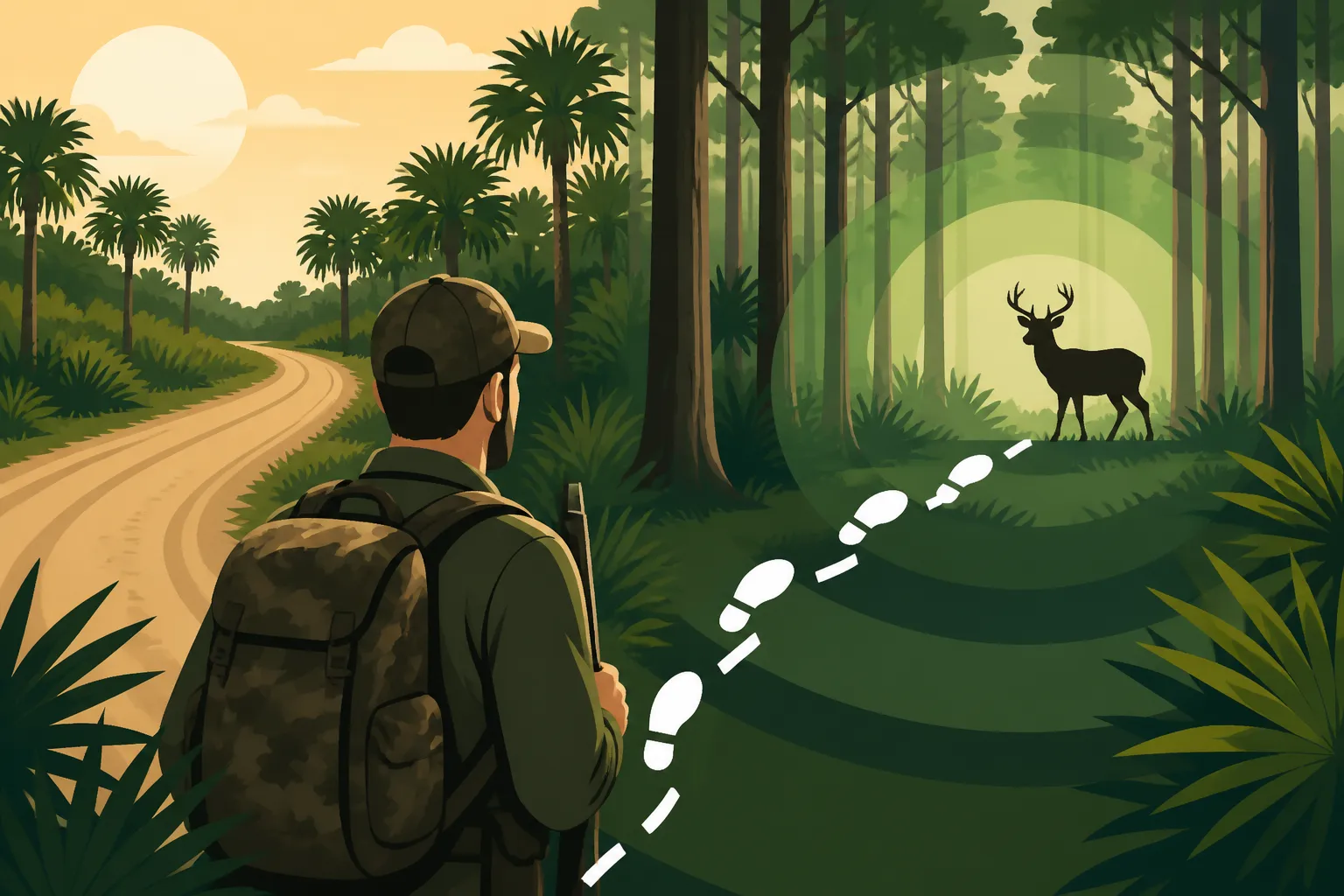
It's a common dilemma for hunters hitting Florida's public lands: you pull up to a forest road, see a few trucks already parked, and immediately wonder if there's any point in walking much further. Many of us grapple with the frustration of finding good sign near the road, only to have the deer vanish once opening day arrives, driven deeper into the woods by human activity. This guide is here to help you navigate that exact challenge, offering strategies and insights on how far to walk from a forest road to significantly increase your odds of encountering less pressured deer, regardless of whether you're chasing whitetails, hogs, or even turkeys.
The Psychology of Pressure and Proximity
Understanding why certain distances from a road are more productive starts with understanding hunter behavior and deer psychology. Most hunters, understandably, are creatures of convenience. They want to get into the woods, set up, and get out with minimal effort. Deer, being incredibly intelligent and adaptable creatures, quickly learn to use this predictability to their advantage.
The "Road Hunter" Mentality
Let's be honest, we've all been a "road hunter" at some point, even if it was just for a quick scout or to check a camera. The allure of easy access, a short walk, and the comfort of being close to your truck is powerful, especially in Florida's often hot, humid, and buggy conditions. This mentality leads to a concentration of hunting pressure within a relatively short distance of forest roads, trails, and access points. Hunters might park, walk 100-300 yards, and set up a stand or still-hunt a short loop before heading back to the truck for lunch or to call it a day.
This concentration means deer that consistently use these areas during daylight hours quickly become educated. They learn to associate vehicle sounds, human voices, and the distinct scent of hunters with danger. While you might see plenty of tracks crossing a sand road in the middle of the week, those same deer will often have vanished into thicker cover or shifted their patterns to nocturnal movement once the weekend hunters arrive. It’s not that deer don’t exist near roads, it’s that the huntable deer—the ones moving during legal shooting hours—are far more scarce in these easily accessible zones.
Deer's Adaptation to Human Activity
Deer are masters of adaptation. In areas with high human traffic, their behavior changes dramatically. Instead of browsing openly during the day, they might shift their primary feeding and movement to the twilight hours or under the cover of darkness. Their bedding areas, which might normally be in relatively open cover during periods of low pressure, will transition to the thickest, nastiest palmetto heads, cypress swamps, or pine plantations they can find, often deep inside a block of woods where they feel truly secure.
Think about it: a deer isn't going to spend its daylight hours bedded down 50 yards from a forest road if trucks are driving by every hour, or if hunters are crunching through the palmettos nearby. They'll push further back, finding sanctuary in places that most people deem "too hard to get to." This adaptive behavior is precisely why understanding how far to walk from a forest road is crucial for success, especially on public lands where pressure is a constant factor. They essentially create their own "safety zones" by simply moving beyond where most humans are willing to go.
Understanding the "Sweet Spot" Distance
While there's no magic number, we can generally break down the proximity to a forest road into different zones, each with its own characteristics regarding deer presence and hunting pressure. Finding your "sweet spot" means understanding these zones and how they interact with the specific terrain you're hunting.
The 0-to-1/4 Mile Zone: The Gauntlet
This is the immediate area adjacent to a forest road or primary access trail. It's the most heavily hunted zone, and for good reason—it's the easiest to reach. Whether it's the first 100 yards or up to a quarter-mile, this is where you'll find the most boot tracks, the most spent casings, and often, the most frustrated hunters.
While this zone can sometimes produce, especially in areas where cover is exceptionally thick or during quiet weekdays, relying on it consistently can be tough. Deer here are typically highly educated and will often move only at night or during brief, wary periods at dawn and dusk. If you do hunt this zone, your tactics need to be precise: focus on pinch points, thick transition lines, or tiny pockets of overlooked cover. You're often hunting a deer that knows it's being hunted. It's also a good area for Scouting With the Florida FWC App to identify potential overlooked cover.
The 1/4 to 1 Mile Zone: The "Edge Effect"
As you push beyond a quarter-mile and venture towards the mile mark, you start to enter what I like to call the "edge effect." This is where the sheer volume of hunter traffic begins to drop off significantly. Many hunters are simply unwilling or unable to commit to a walk of this distance, especially when carrying gear, or if they’re just out for a quick evening hunt.
This zone is often where you'll begin to find more consistent deer sign during daylight hours. Deer might not bed here, but they often feel comfortable enough to feed, browse, and travel between deeper bedding areas and nocturnal feeding grounds. The further you get into this zone, the more relaxed the deer tend to be. This is often where you can start seeing fresh scrapes and rubs, indicating more active daylight movement. Pay close attention to Reading Florida Mud for Fresh Deer Movement in these areas, as less human disturbance can mean clearer tracks. It takes effort, but the rewards often start to show up here.
Beyond 1 Mile: The Deep Woods Advantage
This is where the real magic happens for those willing to put in the work. Beyond one mile, and certainly beyond 1.5 to 2 miles, you are often entering truly unpressured territory. The number of hunters who penetrate this far into Florida's public lands is minuscule. The deer here often exhibit more natural movement patterns, feeding and moving throughout the day, and their bedding areas might be less dense simply because they feel a higher degree of security.
Reaching these areas requires dedication, physical fitness, and good planning. But the payoff can be huge: you're more likely to encounter mature animals that haven't been relentlessly pursued, and their behavior will be much more predictable based on natural factors like food, water, and breeding, rather than constant human avoidance. This is where you can truly implement strategies like Finding Ground Others Walk Past and capitalize on deer that haven't had a dozen sets of eyes on them. It might mean a longer, tougher pack-out, but many dedicated hunters will tell you it's worth every single step.
Factors Influencing Optimal Walking Distance
The "sweet spot" isn't static; it shifts based on a variety of environmental and seasonal factors. What works in an open pine forest might not work in a dense cypress swamp, and what's effective on opening day might be useless in late season.
Terrain and Cover Type
Florida's landscape is incredibly diverse, and the type of terrain and cover you're hunting will significantly impact how far deer feel they need to travel to escape pressure.
- Dense Palmetto and Scrub: In areas dominated by thick palmetto, gallberry, or dense scrub, deer don't need to walk as far to find sanctuary. A thick palmetto head a mere 300 yards off a road can feel like a mile to a deer, offering complete concealment. Hunters are often unwilling to bust through such dense vegetation, creating natural "no-go" zones relatively close to access points. If you're willing to crawl through the thorny stuff, you might find deer bedding surprisingly close. Consider strategies like Where Florida Bucks Bed in Thick Palmetto in these environments.
- Cypress Swamps and River Bottoms: These wet, often impenetrable areas also provide excellent cover. Deer will use the edges of swamps or even bed on small, dry islands within them to escape pressure. A cypress swamp might only be a quarter-mile from a road, but accessing it can feel like an expedition. These are often overlooked pockets, and understanding how to navigate them, perhaps by Hunting a Florida Green Swamp Slough, can pay dividends.
- Open Pine Forests and Plantations: In more open pine flatwoods or managed pine plantations (common in the Panhandle, for example, like in Hunting Florida Panhandle Pine Plantations), deer need to travel further to find security. With less natural concealment, they'll push deeper into thicker clear-cuts, creek bottoms, or unthinned sections of forest. In these areas, the one-mile-plus rule often holds even truer, as there are fewer immediate hideouts.
Using mapping tools like onX Hunt or GoHunt to analyze satellite imagery can be a game-changer here. You can identify those thick, dark green patches that scream "bedding area" and estimate their distance from the nearest road, then plan your approach accordingly.
Season and Hunting Pressure
The timing of your hunt and the prevailing pressure levels are huge determinants of deer movement relative to roads.
- Opening Day vs. Late Season: On opening day, especially a weekend opener, nearly every easily accessible patch of woods will have hunters. Deer scatter, pushing deeper, faster. This is when the "beyond a mile" strategy is most critical. As the season progresses and pressure wanes (especially on weekdays), deer may become slightly more relaxed and begin to filter back into areas closer to roads, particularly if food sources are abundant there. Hunting Pressure on Florida Public Land is an ever-present concern, and it shifts dramatically throughout the season.
- Weekdays vs. Weekends: This is a no-brainer for public land hunters. Weekends see a surge in hunter numbers, driving deer further into hiding. Weekdays, on the other hand, can offer a brief respite, allowing deer to utilize areas closer to roads. If you have the flexibility, hunting during the week can dramatically reduce the distance you need to walk to find unpressured game.
Food and Water Sources
Deer are driven by their stomachs and thirst. The location of primary food and water sources can sometimes override their instinct to avoid roads, at least temporarily.
- Acorn Crops: A bumper crop of acorns, especially from certain oak species, can be an irresistible draw. If a productive oak hammock is near a road, deer may still frequent it, but often under the cover of darkness or during brief, wary daylight forays. Hunters targeting these areas need to be extremely patient and set up precisely with the wind in mind. Late-Season Food Sources for Florida Whitetails can pull deer into unexpected places.
- Food Plots: On private land, or on some public lands with managed food plots, deer will be drawn to these cultivated food sources. However, on public land, these plots often see heavy pressure. If you're hunting an area with a food plot, consider where deer are bedding (likely far from the plot) and how they access it. Look for funnel points or thick cover along their travel routes, rather than sitting directly on the plot. Entry Routes Through a Florida Food Plot become critical intelligence.
- Consistent Water: In a dry spell, a reliable water source (pond, creek, swamp edge) can be a magnet. If these are close to a road, deer will use them, but again, often cautiously. If the water is deeper in, it adds another reason for deer to be further from the roads.
Tools and Tactics for Deeper Penetration
Committing to walking further requires not just physical effort but also smart planning and the right tools. Making your deep woods excursions productive and safe is paramount.
Mapping Technology is Your Best Friend
In today's hunting world, digital mapping apps like onX Hunt and GoHunt are indispensable, especially when planning to walk significant distances from a forest road. They are your virtual scout, allowing you to "walk" the terrain from your couch.
- Pre-Scouting: Before you even leave home, use these apps to analyze aerial imagery. Look for those thick, dark green blocks of timber, isolated palmetto islands, or hidden creek bottoms that are a mile or more from the nearest accessible road. Mark potential bedding areas, travel corridors, and pinch points.
- Offline Maps: Crucially, download your maps for offline use. Florida's public lands often have spotty to non-existent cell service, and you absolutely cannot rely on streaming maps when you're a mile or two deep in the woods.
- Public/Private Boundaries: These apps clearly delineate public land from private, preventing accidental trespassing when you're pushing boundaries. This is especially useful when hunting areas with fragmented land ownership.
- Tracking and Waypoints: Use the tracking feature to monitor your actual walking distance and path. Drop waypoints on fresh sign, potential stand locations, or even landmarks you want to revisit. This is invaluable for finding your way back in the dark and refining your strategy over time. Scouting With the Florida FWC App is a great complementary tool, offering specific WMA information.
Lightening Your Load
If you're planning to walk a mile or more into the woods, every ounce in your pack matters. A heavy pack can quickly drain your energy, making those last few hundred yards feel like miles.
- Essential Gear Only: Be ruthless in your packing. Do you really need that extra water bottle, or can you get by with a filter? Is that heavy rangefinder necessary for bowhunting at 30 yards? Focus on safety (first-aid kit, communication device, headlamp) and bare hunting essentials.
- Modular System: Consider a modular pack system where you can strip down to a lighter day pack once you reach your destination, leaving bulkier items at a designated camp spot if you're multi-day hunting.
- Physical Conditioning: This might be the most overlooked aspect. Training in the off-season, whether it's long walks, hiking with a weighted pack, or simply hitting the gym, will pay huge dividends when it comes to pushing deeper into the woods with energy to spare. Don't underestimate the Florida heat and humidity; staying hydrated and in shape is critical.
Strategic Entry and Exit
Walking further is only half the battle; how you get in and out of your hunting spot can make or break your success. The goal is to be as stealthy and unobtrusive as possible, minimizing your impact on the deer you're trying to hunt.
- Wind Direction is King: Always, always consider the wind. Plan your approach route so that your scent isn't blowing into your target area or across known deer travel routes. In flat Florida terrain, understanding Wind and Thermals in Flat Florida Terrain is crucial, as even subtle shifts can ruin a hunt.
- Silent Movement: This means taking your time, lifting your feet rather than dragging, and choosing quiet paths. Avoid crunching through dry palmetto fronds or noisy leaf litter if possible. Sometimes, even wading through a shallow, muddy slough can be quieter than pushing through dry scrub.
- Non-Linear Approaches: Avoid walking in a straight line from the road directly to your spot. Deer quickly pick up on linear human movement. Instead, use terrain features, thick cover, or old logging roads to create a less predictable, more circuitous route. This keeps deer guessing and makes it harder for them to pattern your movements.
- Dawn and Dusk Stealth: The critical times for deer movement are also when you're likely to be entering or exiting the woods. Be extra vigilant during these periods. Use a dim headlamp set to a red light to preserve your night vision and minimize your visible signature. Using a Ground Blind on Florida Public Land or Brushing In a Blind on a Field Edge can help conceal your presence upon arrival.
Remember, the goal isn't just to walk far, but to walk smart. Every step should be part of a calculated plan to put you in front of a less pressured animal.
Summary of Walking Distance Strategies
| Distance from Forest Road | Expected Hunting Pressure | Expected Deer Behavior | Recommended Tactics |
|---|---|---|---|
| 0 – 1/4 Mile | Very High | Highly wary, nocturnal | Hunt pinch points, thick cover. Very early/late season. Precise setups. |
| 1/4 – 1 Mile | Moderate to High | Wary, but more daylight movement. | Target travel corridors, secondary bedding areas. Stealthy entry/exit. |
| 1 Mile + | Very Low | More natural, relaxed movement. | Ideal for mature animals. Requires physical effort and smart mapping. |
Ultimately, how far you walk from a forest road is a personal decision based on your fitness, time, and hunting style. But for those willing to go the extra distance, Florida's public lands often hold unpressured gems that many hunters simply walk past.
Disclaimer
This article is for general informational purposes only and does not constitute professional advice. Laws, prices and regulations vary by location and change over time. Consult a qualified professional for guidance on your specific situation.