Coyote Calling Florida Ranch Land
Getting consistent success calling coyotes on vast Florida ranch land can feel like chasing a ghost. These smart, adaptable predators often seem to know your next move, frustrating even seasoned hunters who are trying to manage their populations and protect livestock or local deer herds. This guide dives deep into proven strategies and essential knowledge to help you outsmart Florida's coyotes and increase your calling success on ranch properties.
Understanding the Florida Coyote on Ranch Land
Coyotes, though not native to Florida, have become deeply entrenched across the state, particularly thriving in diverse habitats like ranch lands. Their intelligence and adaptability make them a formidable challenge, but understanding their behavior is the first step toward effective calling.
Coyote Behavior and Habitat on Ranches
Florida ranch lands offer a unique mosaic of habitats that coyotes exploit to their full advantage. These properties often feature expansive pastures for cattle, interspersed with dense stands of palmetto, cypress sloughs, oak hammocks, and drainage ditches. This varied terrain provides everything a coyote needs: abundant prey, crucial cover for denning and travel, and constant access to water.
During the day, you'll often find them hunkered down in the thickest cover – a dense palmetto head, a overgrown fencerow, or the edge of a cypress swamp – especially when temperatures climb. They're excellent at using elevation changes, even subtle ones common in Florida, to survey their surroundings without being seen. When it comes to hunting, their diet on ranch land is incredibly diverse. While they’re often seen as threats to young calves, they also readily prey on deer fawns, wild hogs, rabbits, and small rodents, making them a consistent presence wherever these food sources are plentiful. Their travel corridors often follow natural breaks in the landscape: fence lines, old logging roads, creek bottoms, and the edges where open pasture meets dense cover. They use these pathways for efficient movement, whether patrolling for food or moving between den sites.
Population and Distribution in Florida
Coyotes are relatively new to Florida, having expanded their range southward from states like Georgia and Alabama, likely arriving in the state around the 1970s. Since then, their population has boomed, and they are now found in all 67 counties, from the Panhandle down to the Everglades. Ranching operations across the state have become prime coyote territory, as the mix of open country and dense pockets of cover provides ideal conditions for their expansion.
Estimates suggest a robust and healthy coyote population across Florida, making them a consistent presence for ranchers and hunters alike. You can learn more about the Florida Coyote Range and Density to get a better grasp of where they are most prevalent. The impact on game species, especially deer and turkey, is a significant concern for many landowners. Coyotes are efficient predators of fawns, especially during the spring birthing season, and can also impact turkey poults. For this reason, many landowners are eager to reduce coyote numbers, and calling is a highly effective method. Their presence means hunters often find themselves engaged in predator control efforts, which can benefit local deer and turkey populations.
Essential Gear for Ranch Land Calling
Successfully calling coyotes on Florida ranch land isn't just about showing up with a call. It's about having the right tools to scout, locate, call, and ultimately harvest these wily predators. The right gear can significantly increase your odds of success.
Optics and Scouting Tools
On vast ranch properties, your eyes are your most important tool, and quality optics greatly extend their reach. A good pair of 10×42 binoculars is non-negotiable for scanning distant pastures, tree lines, and palmetto heads for any flicker of movement. Coyotes can often approach silently and quickly, and spotting them early gives you a critical advantage in setting up your shot. For really expansive areas, a spotting scope might seem like overkill, but it can be invaluable for identifying distant animals or confirming coyote presence from a vantage point before committing to a stand.
Beyond just seeing, modern scouting tools are essential. GPS-enabled mapping apps like GoHunt are a game-changer for navigating large ranches, marking access points, property lines, and potential calling stands. You can pinpoint where you observed coyote sign, mark past successes, and even identify subtle topographical features that coyotes might use for travel or bedding. Trail cameras, deployed on likely travel corridors or around known denning areas, provide invaluable intelligence on coyote presence, travel times, and even specific individuals. They help you understand their patterns when you're not there, allowing you to choose the most opportune times and locations for your stands. You can also apply principles from Reading Aerial Photos for Florida Deer to pinpoint potential coyote habitat.
Calls and Decoys
The heart of coyote calling lies in your ability to mimic their prey or their own kind. Both electronic and mouth calls have their place, each with distinct advantages and disadvantages.
Electronic Calls: These are incredibly versatile, offering a wide array of sounds from rabbit distress to pup-in-distress, coyote howls, and even bird sounds. Brands like Foxpro or Primos Alpha Dogg are popular choices among serious callers. The ability to place the call away from your position, often 50-100 yards upwind, helps draw the coyote's attention away from you, masking your exact location. This can be particularly effective on pressured animals that might associate human sound with danger. Electronic calls also allow for consistent, realistic sounds over a long period without tiring your lungs.
Mouth Calls: These include diaphragm calls, open-reed calls, and closed-reed calls, all operated manually. They demand more skill and practice to master but offer unparalleled realism and subtle inflections that electronic calls sometimes lack. They are also silent to deploy and don't require batteries, making them reliable in any conditions. You can quickly switch between different distress sounds or vocalizations. Many successful callers use a combination, starting with an electronic call for volume and range, then switching to a mouth call for precise, subtle finishes as the coyote gets closer.
Decoys: Motion decoys are incredibly effective at drawing a coyote's attention away from your position and giving them a visual target. A simple spinning-tail decoy, like those from Mojo Outdoors, mimicking a dying rabbit or bird, can be placed near your e-caller. The visual stimulation often seals the deal for a wary coyote that might be hesitant to commit based on sound alone. It provides the final piece of the puzzle, making your setup appear even more realistic.
Firearms and Ammunition
Choosing the right firearm and ammunition is crucial for clean, ethical harvests. On vast Florida ranch land, shots can range from tight, close-quarter engagements in palmetto thickets to long-range across open pastures.
For longer shots, centerfire rifles are the go-to. Popular calibers include the .223 Remington, .22-250 Remington, and .204 Ruger. These cartridges offer flat trajectories and high velocity, which are excellent for precise shot placement on coyotes. The key is to use ammunition designed for varmints, typically featuring lightweight, frangible bullets that expand rapidly, ensuring humane kills. For closer encounters, particularly in dense cover or when anticipating quick shots, a 12-gauge shotgun loaded with buckshot (like #4 Buck) can be devastatingly effective. A good pattern ensures multiple pellets hit the target, bringing down a running coyote quickly.
More and more hunters are also recognizing the benefits of suppressors (silencers) where legal. Not only do they protect your hearing, but they also reduce recoil and muzzle flash, making follow-up shots easier. More importantly, they can prevent spooking other coyotes in the area, allowing for multiple calling stands on the same property without alerting every animal to your presence. Always check local and state regulations regarding suppressor use. Florida Legal Firearms for Deer Hunting provides general firearm guidelines, which can often be a starting point for coyote hunting legality, though coyotes have far fewer restrictions.
Camouflage and Scent Control
Coyotes have incredible eyesight and an even more incredible sense of smell. Ignoring these facts will guarantee failure. Your camouflage needs to effectively break up your outline and blend into the specific environment of Florida ranch land. Patterns that mimic palmetto, scrub oak, and dappled sunlight are ideal. Darker, heavier patterns designed for dense northern forests often stick out like a sore thumb in Florida's lighter, more open scrub. Wearing gloves and a face mask is non-negotiable; your skin reflects light and your face is an obvious give-away.
Scent control is equally, if not more, critical. A coyote's nose is thousands of times more sensitive than a human's. They can pick up your scent from hundreds of yards away, even a faint residue left on vegetation. Start with scent-eliminating laundry detergent for your hunting clothes. Shower with scent-free soap and shampoo before heading out. Use scent-eliminating sprays on your clothes, boots, and gear. Pay particular attention to your boots, as you'll be walking through their territory. The wind is your ultimate scent control partner; always try to position yourself downwind or crosswind from where you expect the coyote to approach. Even with perfect scent control, a direct upwind approach by a coyote will almost always end your hunt.
Strategic Calling Techniques for Florida Ranches
Calling coyotes on Florida ranch land requires a nuanced approach, blending knowledge of their behavior with strategic deployment of your gear. It's not just about making noise, but making the right noise, at the right time, in the right place.
Locating Prime Calling Stands
Finding the perfect spot to set up your call is paramount. On vast ranch lands, simply pulling off the road and calling rarely works for long. You need to identify key areas where coyotes travel, feed, or bed down. Look for natural pinch points—areas where dense cover funnels into a narrow corridor, or where two sections of woods meet a wide-open field. These are natural travel routes for coyotes. Dry creek beds, drainage ditches, and old tractor paths that run through cover are also excellent locations.
Pay attention to any elevated positions, even subtle ones common in Florida's generally flat landscape. A small rise, the edge of a timber cut, or even an old spoil pile can give you a better vantage point, allowing you to see approaching coyotes sooner. When scouting, look for fresh coyote tracks, scat, and especially denning areas if it's spring. A clear understanding of Reading Aerial Photos for Florida Deer can also guide you in identifying these prime locations, as deer and coyotes often share similar habitat preferences for cover and travel.
Crucially, always consider the wind. This is where Wind and Thermals in Flat Florida Terrain truly comes into play. You want the wind blowing from where you expect the coyote to come, past you, and away from your calling setup. This carries your scent away from the approach path and toward where you want to shoot them, making them feel safer as they approach the sound of your call. Never set up with the wind at your back, blowing your scent directly into the area you're calling.
Calling Sequences and Duration
There's no single "magic" calling sequence, as coyotes can respond differently depending on pressure, time of year, and their hunger levels. However, a general strategy involves starting conservatively and escalating as needed.
Starting Out: Begin with softer, non-threatening sounds. A few soft, whimpering rabbit distress calls, or even some subtle bird sounds, can pique their interest without immediately signaling danger. Play these for 3-5 minutes.
Escalation: If nothing responds, gradually increase the volume and intensity. Transition to more frantic rabbit distress, or perhaps some high-pitched pup distress calls, making it sound like a young coyote in trouble. This often appeals to a coyote's parental instinct or territorial aggression. Play these for another 5-7 minutes.
Challenge/Territorial Calls: If still no response, or if you've had coyotes hang up out of range, consider adding some coyote vocalizations. Howls (lone howls, challenge howls) can elicit a response from territorial males looking to defend their turf. This works especially well during the pre-rut and rut seasons. Mix in some barks and yips to create a realistic scenario.
The general rule of thumb for a stand is 20-30 minutes. Coyotes can often take their time to approach, circling downwind to catch a scent. Don't give up too early! Many experienced callers have harvested coyotes in the final minutes of a stand. However, if nothing has shown interest after 30 minutes, it's usually time to move on to your next setup. Understanding how sound travels in Florida's dense habitats is key; the principles for Rattling Volume in Thick Florida Scrub or Grunt Calls in a Florida Oak Hammock can also inform your coyote calling strategy, emphasizing that thick cover can muffle sounds.
Adapting to Pressure and Weather
Coyotes are incredibly intelligent and learn quickly. If a specific area has been called heavily, those coyotes become "call-shy." They might approach cautiously, circle wide, or simply ignore calls they've heard too often.
Dealing with Pressure: On pressured ranch lands, be less aggressive with your calling. Use quieter, shorter sequences. Focus more on distress calls rather than bold challenge howls, as these might spook wary animals. Try new sound combinations or switch to mouth calls for a more authentic, less "canned" sound. Sometimes, sitting silent for extended periods, only making very soft mouse squeaks or bird chirps, can draw in a curious coyote that expects danger from louder calls. Also, consider changing your stand locations more frequently to avoid burning out a spot.
Weather Considerations: Florida's weather, especially the heat, plays a significant role. During hot, humid days, coyotes are often less active during midday. Focus your efforts during the cooler parts of the day: early morning, late evening, or even Night Hunting Rules for Florida Coyotes. A Hot-Weather Sitting Strategy in Florida will often include less aggressive calling and focusing on shaded, breezy areas. After a cold front, coyotes can become very active as they forage aggressively to make up for lost time, offering excellent calling opportunities. Rain can sometimes dampen sound, but a light drizzle can also mask your approach and scent, making coyotes less wary.
Safety, Ethics, and Landowner Relations
Hunting coyotes on private ranch land comes with specific responsibilities, especially regarding safety, ethical practices, and maintaining a positive relationship with the landowner. Ignoring these can jeopardize your access and the reputation of hunters.
Respecting Property and Livestock
The absolute golden rule of hunting private land is clear communication and respect. Always ensure you have explicit, current permission from the landowner to hunt their property. Do not assume renewed permission year after year without asking. When you secure permission, clarify the exact boundaries you can hunt, any areas that are off-limits, and preferred access routes. Many landowners appreciate a heads-up before you come out, or a text when you arrive and leave. This builds trust and ensures you’re not perceived as trespassing. Consider reviewing Asking a Florida Landowner for Permission for more tips on this crucial step.
On ranch land, livestock is paramount. Never, under any circumstances, shoot near cattle, horses, or any other domestic animals. Ensure you have a clear shot at the coyote with a safe backdrop that will not endanger livestock or property infrastructure (like barns, fences, or irrigation systems). If a coyote is near livestock, it's often best to let it pass rather than risk hitting a cow or a fence. Also, be mindful of where you park your vehicle, how you drive on ranch roads, and always close any gates you open. Your goal is to be a welcome guest, not a nuisance. If an accidental kill of a non-target animal occurs (though rare with careful shot selection), immediately report it to the landowner and offer appropriate restitution.
Night Hunting Considerations
Night hunting for coyotes can be highly effective, as coyotes are primarily nocturnal, but it comes with stricter regulations and increased safety concerns. In Florida, specific rules govern Night Hunting Rules for Florida Coyotes. Generally, coyotes are considered nuisance wildlife and can be hunted at night on private lands with a landowner's permission, often requiring artificial light. Always verify the most current regulations with the FWC before planning a night hunt.
When hunting at night, safety is amplified. Positive target identification is critical; never shoot at sounds or shadows. Use quality lights – red or green lights are often preferred as they disturb the animal's natural vision less than white light, allowing you to see their eyes reflecting. Always use a weapon-mounted light or a powerful spotlight to confirm your target before taking a shot. Hunt with a partner for added safety, ensuring one person is scanning while the other is ready to shoot. Be acutely aware of your surroundings, backdrops, and any potential human activity on or near the ranch. Night hunting requires extreme discipline and attention to detail.
Ethical Hunting Practices
Ethical hunting dictates that we strive for a quick, humane kill on every animal. For coyotes, this means using appropriate firearms and ammunition, aiming for vital organs, and only taking shots within your effective range. Avoid "hail Mary" shots at running coyotes or those at extreme distances, as these often lead to wounded animals and prolonged suffering. If you do wound an animal, make every reasonable effort to track and recover it.
While coyote hunting serves a legitimate purpose in managing populations and protecting livestock or game species, it's important to remember that coyotes are still wildlife. Treat them with respect, even if you are actively culling their numbers. This includes proper disposal of carcasses (if not retained for fur), especially on private land where a landowner might have specific preferences. Understanding the role coyotes play in the ecosystem, even as nuisance animals, is part of being a responsible hunter. Also, be aware of general Florida wildlife regulations, as outlined in Florida Wildlife Violation Penalties, to ensure you are always hunting legally and responsibly.
Post-Hunt Strategies and Continuous Improvement
The hunt doesn't end when the shot is fired. Analyzing your performance and continuously scouting are crucial for long-term success in coyote calling on Florida ranch land. It's about learning from every stand, whether it resulted in a harvest or not.
Analyzing Stand Success and Failure
After each calling stand, whether a coyote came in or not, take a few minutes to debrief. This reflective process is incredibly valuable for refining your techniques. Ask yourself:
- Wind: Was the wind consistent? Did it swirl unexpectedly? Was my scent truly being carried away from the approach path? Often, a coyote "hanging up" downwind means they caught your scent.
- Location: Did I choose the best stand for visibility and cover? Could I have positioned myself better to use terrain features or shadows?
- Call Sequence: What calls did I use? In what order? For how long? Did the coyote respond? If so, how? Did they come in fast, or did they circle widely? Did they sound off but never show?
- Coyote Reaction: If a coyote showed up, how did it approach? Did it come in confidently, or was it wary? Did it stop short of my shooting lane? If it didn't show, why do I think that was?
Using a mapping app like GoHunt to mark your stands, successes, failures, and even where coyotes approached from can create a powerful database of information over time. You might start noticing patterns: certain call types work better in specific wind directions, or particular thickets consistently hold coyotes. This self-analysis is how you evolve from just a caller to a truly skilled predator hunter.
Ongoing Scouting and Adaptation
Coyote behavior, like that of any wildlife, changes throughout the year based on breeding cycles, prey availability, and hunting pressure. Successful predator hunters are perpetual scouts.
Year-Round Scouting: Even in the off-season, drive or walk the ranch boundaries and interior roads, looking for fresh coyote sign. Tracks in dusty roads, scat, and even visual sightings can tell you where they're active. If you locate denning areas in the spring, make a note of them for future reference, though you should avoid disturbing dens directly. Pay attention to game trails; where deer and hogs are moving, coyotes are likely not far behind.
Seasonal Adaptations:
- Spring/Summer: Focus on pup distress calls, as adults will be protective of their young. Also, food availability can be high with fawns and turkey poults, so sometimes aggressive calling is needed to draw them off abundant natural prey. This is also when you might hear more coyote vocalizations.
- Fall: As young coyotes disperse and deer fawns grow, coyotes become more focused on larger prey. Distress calls remain effective, but aggressive challenge howls can also work as territories are established.
- Winter: Food can be scarcer, making coyotes more responsive to distress calls. This is often a prime time for success.
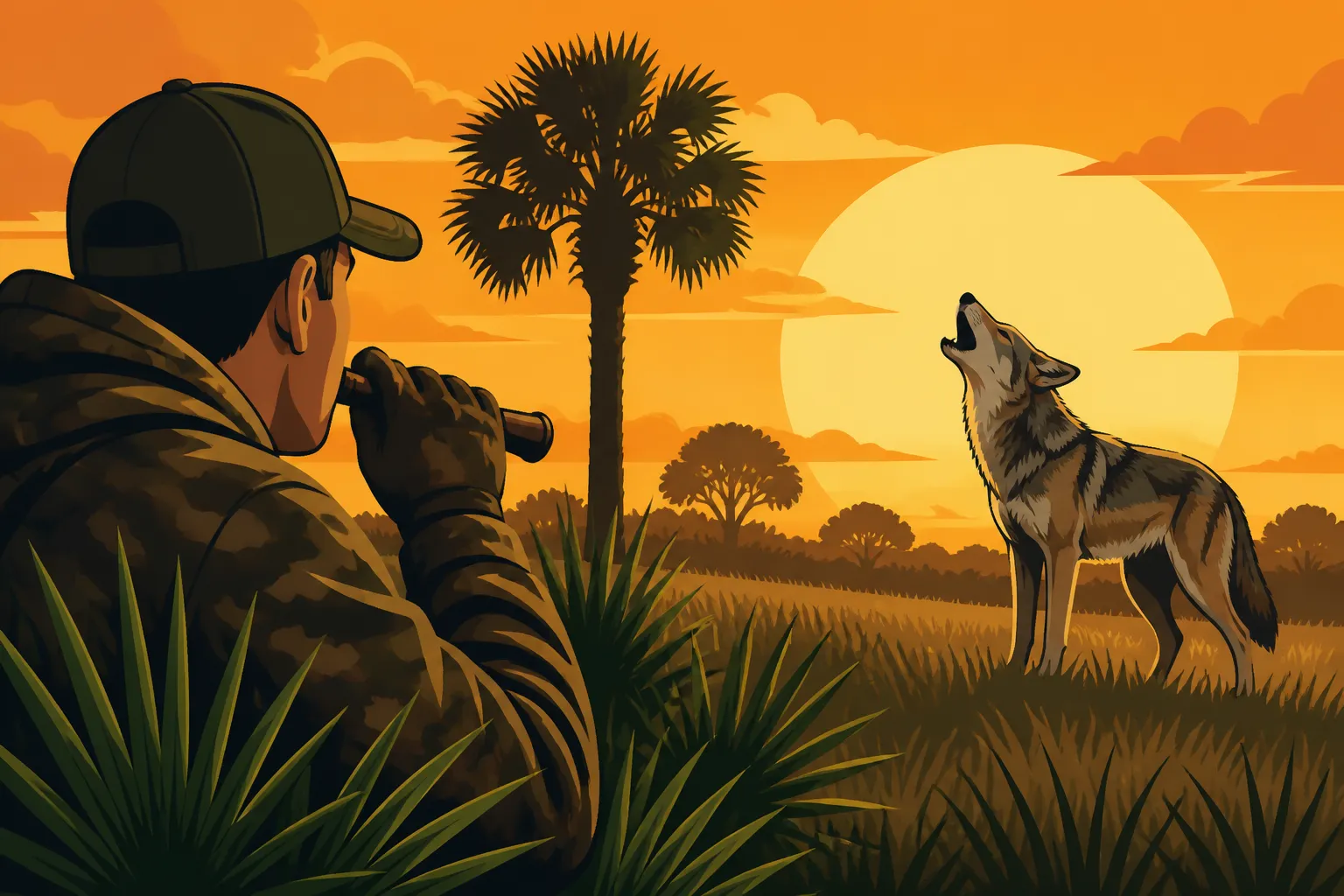
Constantly observe, learn, and adapt your tactics. Just because a specific call or setup worked last week doesn't mean it will work today. The most effective coyote callers are the ones who are always adjusting, always learning, and always pushing themselves to understand their quarry better. From Coyote Calling Florida Ranch Country at Dawn to hunting into the dark, every scenario offers a learning opportunity.
Table: Electronic vs. Mouth Calls for Florida Coyotes
| Feature | Electronic Calls | Mouth Calls (Hand Calls) |
|---|---|---|
| Sound Variety | Vast library of realistic sounds, easy to switch | Limited by skill, but offers realistic nuances |
| Realism | High-quality digital sound | Highly realistic, can add custom inflections |
| Placement | Can place away from hunter, drawing attention away | Must be held by hunter, drawing attention to hunter |
| Volume | Easily adjustable, can be very loud for distance | Depends on lung power, better for close/mid-range |
| Ease of Use | Beginner-friendly, easy to learn | Requires practice and skill to master |
| Reliability | Requires batteries, susceptible to electronics issues | No batteries, highly reliable |
| Cost | Generally higher (hundreds of dollars) | Lower (tens of dollars per call) |
| Hands-Free | Remote operation allows hands-free shooting | Requires hands to operate, can hinder shooting position |
| Pressure | Can be predictable on pressured coyotes | More subtle, can be effective on call-shy coyotes |
Disclaimer
The information provided in this guide is for informational purposes only and is not intended to be legal advice. Hunting regulations, licensing requirements, and specific rules regarding predator control, night hunting, and firearms can change. Always consult the latest Florida Fish and Wildlife Conservation Commission (FWC) regulations and local ordinances before engaging in any hunting activity. Ensure you have all necessary licenses, permits, and landowner permissions. The user assumes all responsibility for adhering to legal and safe hunting practices.